
AI-Powered Supplier Matching: How Reshore Finds the Right Factory
April 23, 2026
AI-Powered Supplier Matching: How Reshore Finds the Right Factory
Finding the right contract manufacturer used to take months. Procurement teams would fly to trade shows, work through referral chains, sift through spreadsheets of potential vendors, and then spend weeks qualifying each one. For companies looking to move plastic production out of China, that timeline is no longer viable. Tariff exposure, freight volatility, and customer pressure for shorter lead times have turned supplier discovery into a race against the clock.
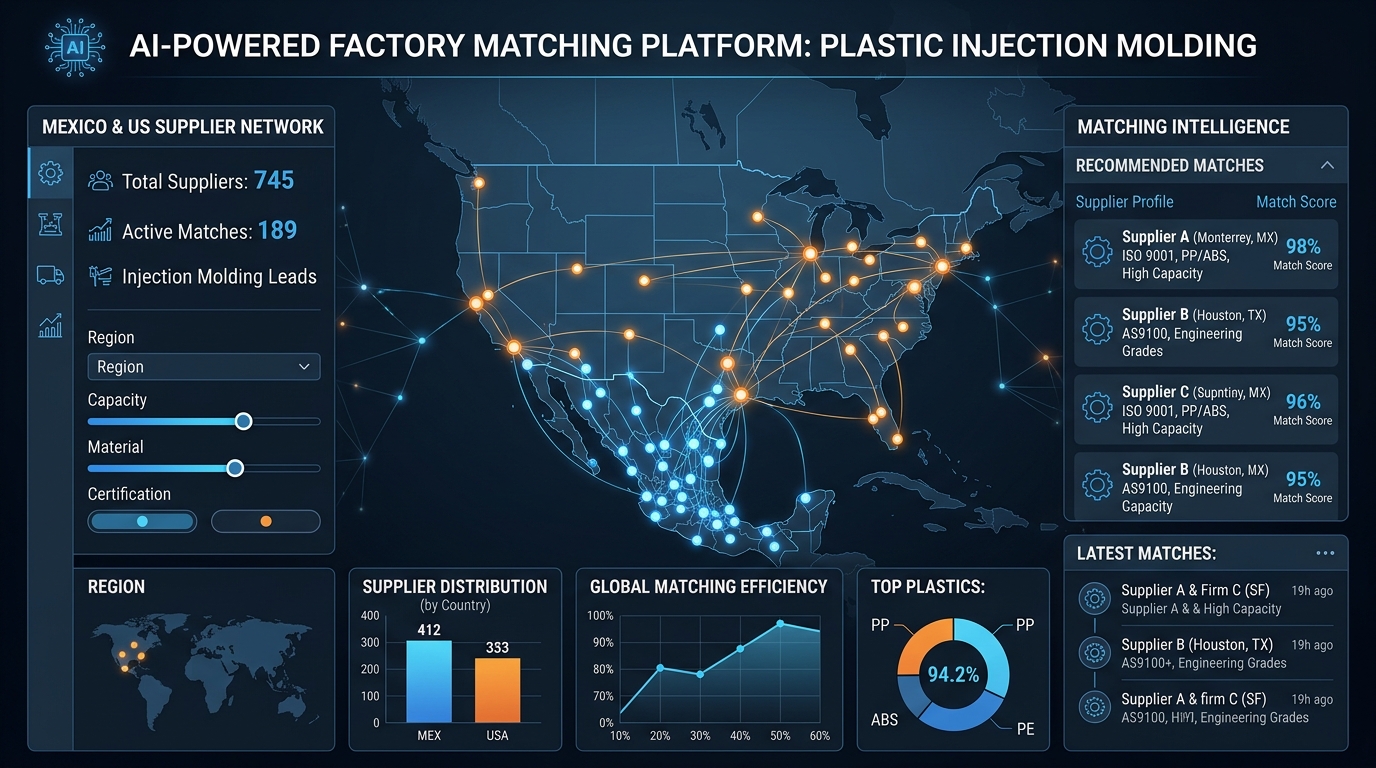
At Reshore, we built our AI sourcing engine to solve exactly this problem. Instead of chasing suppliers one by one, our platform matches buyers to verified manufacturers across Mexico and the United States in hours — not quarters. Below, we walk through how the matching process works, what data powers it, and why AI supplier sourcing is changing how American brands reshore production.
Why Traditional Supplier Discovery Breaks Down
When a US brand decides to move an injection molding program out of Shenzhen or Dongguan, the instinct is to search directories, ask industry peers, and request quotes from a handful of contacts. That approach has three structural problems:
- Incomplete visibility. The Americas have thousands of plastics shops, but only a fraction advertise online. According to the US Bureau of Labor Statistics, the plastics and rubber products subsector employs hundreds of thousands of workers across small and mid-sized facilities — many of which never show up in English-language search results.
- Stale data. A shop's capability list from two years ago rarely reflects today's machine roster, certifications, or open capacity.
- Poor capability matching. A 500-ton press shop and a 2,000-ton press shop both appear as "injection molders," but sending the wrong RFQ to either wastes weeks.
Manual sourcing also tends to optimize for the suppliers a buyer already knows about, not the best fit. That is where automated supplier discovery changes the equation.
How Reshore's AI Matching Engine Works
Our platform treats supplier matching as a multi-variable optimization problem. Every buyer program has a fingerprint — resin type, shot size, tolerances, annual volume, secondary operations, regulatory requirements, target landed cost, and lead time windows. Every manufacturer on our network has a parallel fingerprint built from verified data.
The Reshore AI then scores compatibility across several dimensions simultaneously.
1. Capability Fingerprinting
We ingest structured data on each manufacturer: press tonnage range, cavitation capabilities, resin experience (PP, ABS, PC, POM, TPE, medical-grade, etc.), tooling support, cleanroom class if applicable, and quality certifications such as ISO 9001, ISO 13485, or IATF 16949. Each facility is tagged across hundreds of attributes rather than a handful of broad categories.
2. Capacity and Lead-Time Signals
Static directories tell you what a factory can do. AI matching tells you what they can do this month. We continuously update open press hours, lead time trends, and project intake velocity so matches reflect real availability.
3. Geographic and Trade Optimization
For plastic parts bound for US customers, location matters. The engine weighs proximity to the buyer's distribution hubs, border crossings, and USMCA eligibility. Programs that need to stay duty-free under USMCA rules of origin get routed toward facilities that can document qualifying resin and processing.
4. Risk and Compliance Screening
Matches are filtered against sanction lists, ownership records, financial health signals, and historical quality performance. Buyers never see a recommendation that would fail a basic due diligence review.
A Side-by-Side Look: Manual vs. AI Supplier Sourcing
| Dimension | Traditional Sourcing | Reshore AI Matching |
|---|---|---|
| Time to shortlist | 6–12 weeks | 24–72 hours |
| Suppliers evaluated | 10–30 | 500+ screened, top 5–8 surfaced |
| Data freshness | Quarterly or annual | Continuously updated |
| Capability accuracy | Self-reported, unverified | Verified via audits and platform data |
| USMCA eligibility check | Manual review | Automated |
| Cost benchmarking | Quote-dependent | Modeled before RFQ |
What Buyers See When They Submit a Program
A buyer uploads part drawings, a bill of materials, annual volumes, and target cost. Within hours, the platform returns a shortlist of matched manufacturers, each with:
- A compatibility score and the reasons behind it
- Verified certifications and audit status
- Modeled landed cost estimates for Mexico and US options
- Suggested next steps — whether that is an RFI, an RFQ, or a site visit
This is where AI-powered matching connects to the rest of the reshoring workflow. The same platform that identifies candidates also coordinates tooling transfer, logistics, and production ramp. Buyers who want to understand where each document type fits can reference our guide on RFQ vs. RFP vs. RFI in Manufacturing.
Why This Matters for Plastics Reshoring
Plastic injection molding is a particularly strong fit for AI matching because programs are highly technical and small mismatches are costly. Choosing a shop with the wrong press size or resin experience leads to scrap, cycle time problems, and missed launches. For medical devices, consumer goods, and electronics enclosures — the three verticals we see most often — the cost of a bad match is measured in hundreds of thousands of dollars per program.
Mexico has emerged as the dominant nearshore destination for these programs. Facilities in Monterrey, Querétaro, Guadalajara, and Tijuana offer modern press technology, engineering talent, and duty-free access to the US market under USMCA. The challenge has always been visibility: most US buyers cannot name ten qualified plastic injection molders in Mexico, let alone evaluate them. AI sourcing closes that gap.
The Human Layer Behind the AI
Algorithms shortlist; people close. Every match our platform surfaces is reviewed by a sourcing specialist who has visited facilities, understands regional labor dynamics, and can flag nuances the model cannot see — a new plant manager, an upcoming expansion, a quality issue that recently surfaced. Reshore pairs AI supplier sourcing with human verification so buyers get both speed and judgment.
For teams weighing a move, our reshoring assessment walks through tooling, part complexity, and supplier requirements before any RFQ goes out. It is the fastest way to see what your shortlist would look like.
Where AI Matching Goes Next
The next generation of automated supplier discovery is moving beyond matchmaking into continuous optimization. That means monitoring programs after launch, flagging when a secondary supplier should be qualified, and re-running the match when volumes, tariffs, or lead times shift. For companies pursuing a China+1 strategy or full reshoring, that continuous loop is where the real cost savings compound.
Reshoring is no longer a one-time project. It is an ongoing portfolio decision, and AI is what makes managing that portfolio practical.
Frequently Asked Questions
Q: What is AI supplier sourcing?
AI supplier sourcing is the use of machine learning and structured supplier data to automatically match a buyer's manufacturing requirements to the most compatible factories. Instead of manually reviewing directories and sending blind RFQs, buyers describe their program and the AI returns a ranked shortlist based on capability, capacity, location, and risk factors.
Q: How accurate is AI manufacturing matching compared to using a sourcing agent?
AI matching typically evaluates hundreds of suppliers against dozens of criteria in hours, while a sourcing agent might consider a few dozen from their personal network. Accuracy depends on data quality — platforms that verify supplier capabilities through audits and continuous updates, like Reshore, tend to outperform agents on breadth while matching them on depth when combined with human review.
Q: Can automated supplier discovery handle highly regulated industries like medical devices?
Yes, provided the platform filters for the right certifications and processes. For medical device plastics, matching engines should screen for ISO 13485, cleanroom class, validation experience, and FDA registration where relevant. Reshore applies these filters automatically and flags only suppliers with documented compliance before they reach a buyer's shortlist.
Q: How does Reshore AI verify that a manufacturer is actually qualified?
We combine platform data with on-the-ground verification. Every manufacturer undergoes capability documentation, certification review, and in most cases a facility audit before being listed. Ongoing signals — quote response time, delivered quality, and buyer feedback — continuously update each supplier's standing on the platform.
Q: Is AI supplier matching only useful for large enterprises?
No. Smaller and mid-market brands often benefit more because they lack the internal sourcing teams that enterprises maintain. AI matching lets a 20-person product company access the same breadth of qualified suppliers that a Fortune 500 procurement team would — without hiring consultants or flying to trade shows.
Q: Does Reshore charge buyers to use the AI matching platform?
Buyers can join the waitlist and run an initial assessment at no cost. Fees apply when a program moves into active sourcing, tooling transfer, or full reshoring execution. Pricing depends on program scope, and we outline it transparently during the reshoring assessment.
Q: How long does it take to go from initial match to production parts?
For plastic injection molding programs with existing tooling, buyers on our platform typically move from shortlist to first-article samples in 6–10 weeks, depending on tooling transfer complexity. New tooling programs run 12–20 weeks. AI matching compresses the front end of that timeline — the part that used to take months — down to days.
Q: What industries benefit most from AI-powered reshoring platforms?
Consumer goods, medical devices, electronics enclosures, automotive components, and industrial products see the strongest fit. These categories involve technical plastic parts where capability matching matters and where USMCA benefits make Mexico and US production economically competitive with China.