
Case Study: $4.2M Saved Over 5 Years by Reshoring Metal Parts
April 23, 2026
Case Study: $4.2M Saved Over 5 Years by Reshoring Metal Parts
When a mid-sized industrial equipment manufacturer based in the Midwest approached us in early 2025, they were facing a familiar set of pressures: rising tariffs on Chinese imports, unpredictable ocean freight costs, quality drift from their long-time Shenzhen supplier, and a growing list of customers asking pointed questions about supply chain resilience. Five years earlier, reshoring their machined and stamped metal components would have looked financially unviable on a unit-cost basis. By the time we modeled their Total Cost of Ownership, the math told a very different story.
This case study breaks down how that company saved $4.2 million over a five-year horizon by moving a portfolio of metal parts from China to a mix of US and Mexican suppliers — and what finance and operations leaders can learn from the numbers.
Client Snapshot
To protect client confidentiality, we'll refer to the company as "Midwest Industrial." Key characteristics:
- Industry: Industrial equipment and power transmission components
- Annual revenue: ~$180M
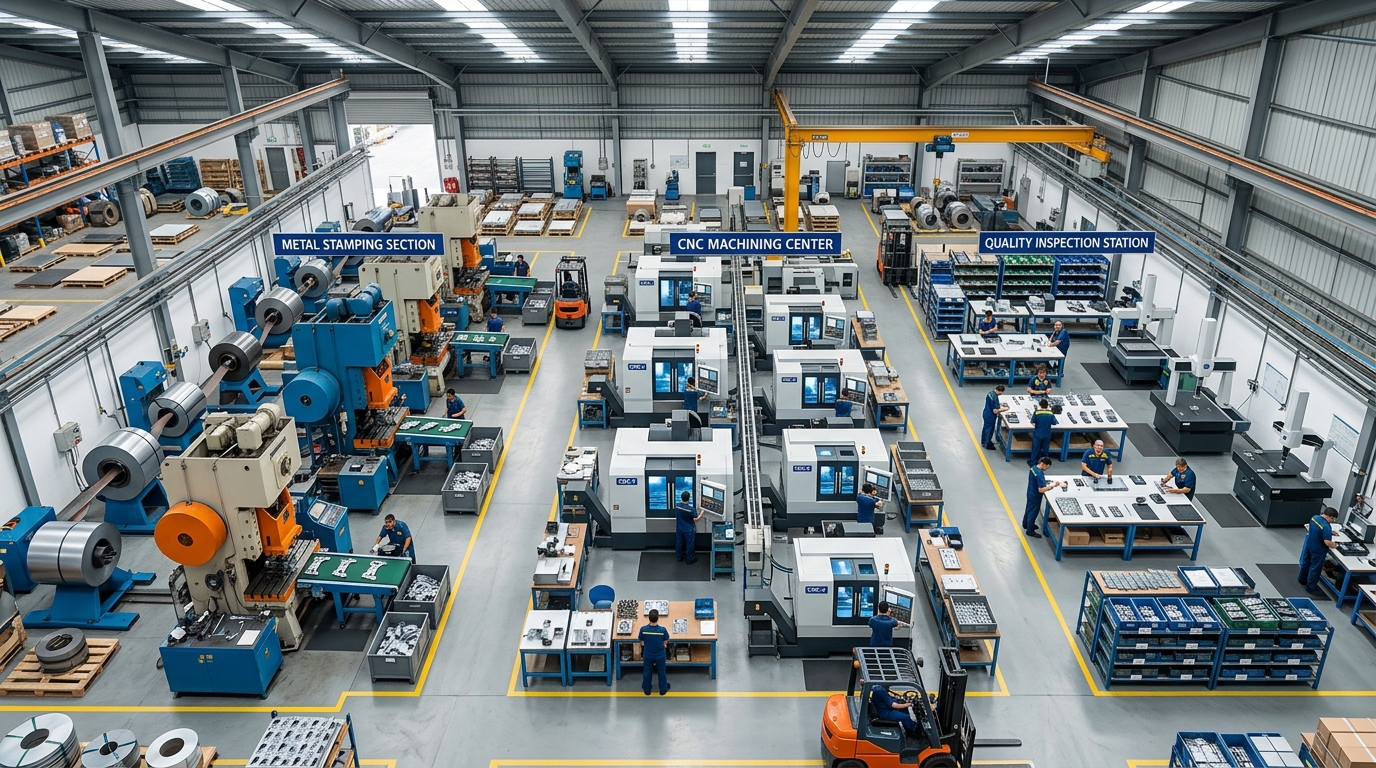
- Reshored portfolio: 47 SKUs of precision-machined and stamped steel, aluminum, and stainless parts
- Annual spend on reshored parts (pre-move): $6.8M landed
- Original manufacturing location: Shenzhen and Dongguan, China
- New footprint: Tier-1 machining partner in Ohio (60% of volume) and a stamping/finishing partner in Monterrey, Mexico (40%)
Midwest Industrial had been offshore since 2011. Their Chinese supplier was technically competent but increasingly difficult to manage across language, time zone, IP, and quality-control dimensions.
The Starting Point: Why the Old Math No Longer Worked
Finance teams that evaluated reshoring in 2018 almost always concluded it was too expensive. The quoted unit-price gap between a Chinese machine shop and a US one was often 30–45%. But quoted unit price is not the same as landed cost, and landed cost is not the same as Total Cost of Ownership.
When we walked Midwest Industrial's CFO through a proper TCO model, here's what showed up that hadn't been on the original 2011 spreadsheet:
| Cost Category | Captured in Original Offshore Quote? | Real 2025 Impact |
|---|---|---|
| Unit price (ex-works) | Yes | Baseline |
| Ocean freight + fuel surcharges | Partially | +18% vs. 2019 |
| Section 301 tariffs on metal parts | No | 25% |
| Proposed tariff increases (2025–2026) | No | +10–15% contingency |
| Inventory carrying cost (90-day pipeline) | No | ~6% of COGS |
| Quality escapes & rework | No | 2.3% of spend |
| Expediting / air freight fallbacks | No | $340K/year |
| Engineering change order lag (8–12 weeks) | No | Lost revenue on new products |
| IP leakage risk | No | Strategic exposure |
For a deeper framework on this methodology, our Total Cost of Ownership (TCO) Guide for Reshoring Decisions walks through each line item. The core insight: the longer a company has been offshore, the more of these hidden costs have quietly calcified into "just how things are."
The Reshoring Plan
We at Reshore structured the project in three phases over roughly 11 months.
Phase 1: TCO Baseline and Portfolio Triage (Months 1–2)
Not every SKU should be reshored. We ran all 47 parts through a scoring model evaluating:
- Annual volume and revenue contribution
- Tooling complexity and transferability
- Material availability in North America
- Tariff exposure (HTS code analysis)
- Quality history and customer criticality
Twelve parts were flagged as "high-priority reshore" — high tariff exposure, recurring quality issues, or strategic customer exposure. Another 28 were "candidates." Seven lower-volume SKUs we recommended leaving in China or sourcing through a China+1 strategy in Vietnam. Choosing what not to reshore is often as valuable as choosing what to move.
Phase 2: Supplier Matching and Qualification (Months 3–6)
Using our AI-powered supplier matching engine, we identified 14 qualified candidates across the US and Mexico — Ohio, Michigan, Tennessee, Monterrey, and Querétaro. After on-site audits, we narrowed to two primary partners:
- An Ohio CNC shop with ISO 9001 and AS9100 certifications, 40,000 sq ft, and existing capacity on 5-axis machining centers
- A Monterrey stamping and finishing operation with strong USMCA documentation and English-speaking quality leadership
Finance teams often ask how we evaluate suppliers consistently. The short version: verified certifications, audited financials, equipment lists mapped to part requirements, references from similar US buyers, and a structured first-article inspection protocol. We've documented the full approach in How to Find and Vet a US Contract Manufacturer in 2026.
Phase 3: Tooling Transfer, PPAP, and Production Ramp (Months 7–11)
The hardest part of any reshoring project is rarely sourcing — it's the transition itself. Tooling transfer from China carries real risk: tools can be "held hostage," documentation is often incomplete, and first-article qualification on new equipment exposes design assumptions that were never written down. We managed:
- Tooling audit and export logistics from Shenzhen
- Reverse-engineering and drawing cleanup for 9 parts with incomplete documentation
- PPAP (Production Part Approval Process) with both new suppliers
- Phased volume ramp with parallel production for two months to de-risk customer shipments
The 5-Year Financial Results
Here's the TCO comparison that drove the $4.2M in savings. All figures in USD, modeled over a 5-year horizon with 3% annual volume growth.
| Cost Category | China (5-Yr) | US + Mexico (5-Yr) | Delta |
|---|---|---|---|
| Piece-part cost | $24.8M | $28.9M | +$4.1M |
| Ocean & inland freight | $3.6M | $1.1M | –$2.5M |
| Section 301 tariffs (25%) | $6.2M | $0 | –$6.2M |
| Inventory carrying cost | $2.1M | $0.7M | –$1.4M |
| Quality, rework, expediting | $1.9M | $0.4M | –$1.5M |
| Engineering agility (revenue impact) | –$0.9M | +$0 | +$0.9M (avoided loss) |
| 5-Year Total Cost | $39.5M | $35.3M | –$4.2M |
Net savings: $4.2M, or roughly 10.6% of 5-year total spend. Payback on the one-time transition cost (tooling transfer, qualification, engineering) was 14 months.
A few details worth calling out:
- Unit cost did go up. Piece-part cost increased by $4.1M over five years. Reshoring is not about beating China on unit price; it's about winning on total cost and risk.
- Tariffs were the single biggest line-item swing. Companies still modeling reshoring without scenario-testing tariff increases through 2027 are underestimating the offshore cost curve.
- Inventory reduction freed $1.6M in working capital that wasn't in the $4.2M savings number at all — that's a balance-sheet benefit layered on top.
You can run a similar projection for your own portfolio using the Reshoring ROI Calculator: Payback Period & 5-Year Savings.
What Made This Project Work
Every reshoring project we run teaches us something. Four factors separated Midwest Industrial's outcome from less successful attempts we've seen in the market:
1. Honest TCO Modeling, Not Unit-Price Comparisons
The CFO insisted on a line-by-line model, including tariff scenarios and quality data pulled from five years of supplier scorecards. Once the full picture was visible, the business case defended itself.
2. Portfolio Segmentation
Reshoring 100% of a portfolio rarely makes sense. Seven SKUs stayed offshore because the economics didn't support moving them. Treating reshoring as a binary decision is one of the mistakes we cover in 10 Common Reshoring Mistakes (and How to Avoid Them).
3. A Hybrid US + Mexico Footprint
Pure-US reshoring would have added roughly $900K to the five-year cost. Pure-Mexico would have introduced more logistics and quality management overhead than the team wanted. Splitting high-complexity machining to Ohio and higher-volume stamping to Monterrey captured the best of both. Mexico's USMCA advantages — tariff-free qualifying goods, proximity, and a mature manufacturing base — make it a natural partner for most reshoring programs.
4. Managed Tooling Transfer
Two of the 12 priority tools had incomplete drawings. One had been modified in-shop in China without notifying Midwest Industrial. Catching these during a structured transfer — rather than during first production runs in Ohio — saved an estimated 6–8 weeks of delay.
What Finance Teams Should Take Away
If you're at the awareness stage of evaluating reshoring, three points are worth internalizing:
- The unit-price gap is real but misleading. Once tariffs, freight, inventory, and quality are modeled honestly, US + Mexico footprints are competitive on TCO for a large share of metal and plastic parts.
- Payback periods are shorter than most people assume. Midwest Industrial hit payback in 14 months. We've seen plastics programs with payback under 12 months when tariff exposure is high.
- The risk of not moving is rising. Tariff policy, geopolitical volatility, and customer supply-chain scrutiny all push in the same direction.
Our TCO FAQ: 25 Questions Finance Teams Ask About Reshoring addresses the specific objections that tend to come up in CFO-led reviews.
Is Your Portfolio a Candidate?
The honest answer is: it depends on your part mix, tariff exposure, volumes, and quality history. The only way to know is to model it. We at Reshore offer a structured reshoring assessment that applies the same TCO methodology used in this case study to your actual SKUs. If the numbers don't justify a move, we'll tell you. If they do, we coordinate the full process — tooling transfer, supplier matching, factory sourcing, and production ramp — so your team isn't rebuilding a supply chain from scratch.
Midwest Industrial's $4.2M wasn't found in a spreadsheet. It was realized by executing carefully over 11 months with the right partners. That's the part that doesn't show up in the quote.
Frequently Asked Questions
Q: How long does a typical metal parts reshoring project take from kickoff to full production?
Most projects run 9–14 months depending on tooling complexity and the number of SKUs. TCO modeling and supplier qualification typically take 3–4 months, tooling transfer and PPAP another 4–6 months, and production ramp 2–3 months. Simpler programs with fewer parts and transferable tooling can close faster.
Q: Is this level of savings typical for metal parts reshoring programs?
The $4.2M figure over five years reflects a program with compounding advantages: high Section 301 and Section 232 tariff stacking on steel components, owned tooling in good condition, and a well-matched Midwest supplier. Programs with similar profiles — 40–60 SKUs, $5–15M annual offshore spend, standardized tolerances — typically see 15–35% total landed cost reductions over a five-year horizon. Programs with lower tariff exposure or highly automated offshore production will see narrower spreads. A TCO model calibrated to your specific portfolio is the most reliable way to project savings before committing.
Ready to get started? Request a reshoring assessment or run a cost comparison — we’ll respond within one business day.