
China Exit Cost Calculator: Tariff, Freight & Tooling Transfer
April 23, 2026
China Exit Cost Calculator: Tariff, Freight & Tooling Transfer
Exiting a Chinese supplier relationship isn't a single line item on a spreadsheet — it's a cascade of one-time transition costs, ongoing operational shifts, and risk-adjusted savings that compound over years. Many US companies underestimate the true cost of staying in China because recurring tariffs, freight volatility, and IP exposure don't show up on a standard PO. Others overestimate the cost of leaving because they lump every expense into a single scary number without understanding which costs are recoverable within 12 months.
At Reshore, we built the China Exit Cost Calculator to solve exactly this problem: give decision-makers a clear, honest picture of what it costs to leave China — and what it costs not to.
Why a China Exit Cost Calculator Matters in 2026
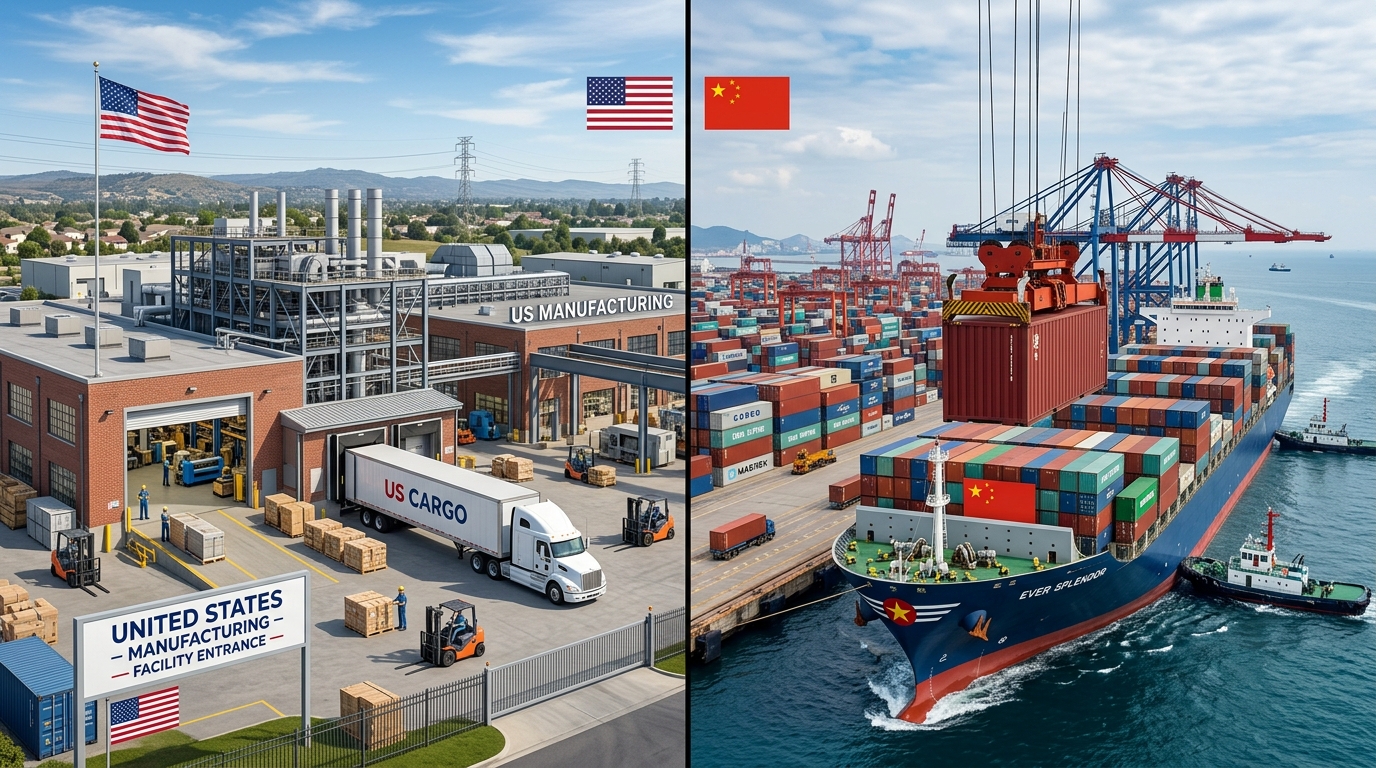
Section 301 tariffs, reciprocal tariff adjustments, and ocean freight volatility have rewritten the math on offshore production. According to the Office of the US Trade Representative, tariff stacking on many HTS codes covering plastics, electronics enclosures, and consumer goods now ranges from 25% to well over 50% depending on category. Layer in longer lead times, quality rework, and the rising cost of compliance audits, and the "cheap China" assumption collapses for a growing share of SKUs.
A proper reshore calculator doesn't just compare unit prices. It models:
- One-time transition costs (tooling transfer, PPAP requalification, validation runs)
- Recurring cost deltas (piece-part price, duty, freight, inventory carrying cost)
- Risk-adjusted savings (IP protection, supply chain resilience, reduced lead times)
- Payback period against alternatives in Mexico or the US
The Four Cost Buckets in a China Exit
To calculate your true china exit cost, you need to separate expenses into four categories. Mixing them together is the most common mistake we see in internal finance models.
1. Tariff & Duty Exposure
This is usually the largest recurring savings line. Use a tariff calculator approach: identify the HTS code for each SKU, apply the current Section 301 rate plus any MFN duty, and multiply by annual landed value.
| Product Category | Typical HTS Section 301 Rate | Annual Impact on $1M Import Value |
|---|---|---|
| Injection-molded plastic parts | 25% | $250,000 |
| Electronic enclosures | 25–50% | $250,000–$500,000 |
| Consumer plastic goods | 7.5–25% | $75,000–$250,000 |
| Industrial components | 25% | $250,000 |
For a deeper breakdown by HTS code, our Tariff Impact Calculator quantifies annual exposure against volume.
2. Freight & Logistics Delta
Ocean freight from China to US West Coast averages 30–45 days door-to-door, compared to 3–7 days trucking from central Mexico. Beyond transit time, you'll want to model:
- Container rate volatility (spot rates on trans-Pacific lanes have swung 3x in 18 months)
- Inventory carrying cost for in-transit and safety stock
- Demurrage, detention, and port congestion surcharges
- Last-mile distribution differences
3. Tooling Transfer Costs
For plastic injection molding, this is the transition cost that causes the most hesitation. A complete tooling migration includes:
- Mold extraction & release from the incumbent Chinese supplier (often negotiated, sometimes contentious)
- Crating, ocean freight, customs clearance — typically $2,000–$8,000 per mold
- Mold inspection & refurbishment at the receiving facility
- Sampling, FAI, and PPAP requalification
- Engineering time for DFM review and process validation
Our Tooling Migration Cost Estimator generates per-mold costs and timelines based on mold size, complexity, and destination country. For most small-to-medium tools, total migration runs $5,000–$15,000 per mold including requalification.
4. Supplier Transition Cost (Soft Costs)
This is where internal finance models almost always under-budget. Supplier transition cost includes:
- RFQ and sourcing cycles for new suppliers
- Qualification audits and site visits
- Dual-running inventory during the transition window
- Engineering bandwidth for drawings, specs, and tolerance reviews
- Legal review of IP assignment and mold ownership documentation
- Project management overhead
A reasonable rule of thumb: budget 3–6% of annual spend as a one-time soft cost for a structured transition, and 8–12% if you're navigating it without experienced partners.
How to Use the China Exit Cost Calculator
Our calculator follows a five-step flow:
- Enter your current Chinese supplier profile — annual spend, SKU count, HTS codes, and current landed cost per unit.
- Input your tooling inventory — number of molds, approximate size class, and current condition.
- Select destination — Mexico (nearshore) or US (full reshore). Each generates different freight, labor, and tariff assumptions.
- Define transition timeline — aggressive (6 months), standard (12 months), or conservative (18+ months). Timeline affects dual-running inventory costs.
- Review outputs — one-time cost, annual savings, payback period, and 5-year NPV.
The result is a side-by-side comparison: stay in China vs. move. For most mid-volume plastic products we've modeled, payback lands between 8 and 18 months when tariffs exceed 15%.
Interpreting Your Results: Three Common Scenarios
Scenario A: High-Tariff, Medium-Volume Plastic Parts
A company importing $2M/year of injection-molded parts under a 25% tariff category typically sees:
- Annual tariff savings: ~$500K
- One-time transition cost: ~$180K (8 molds + qualification)
- Payback: ~4–5 months
Scenario B: Low-Tariff, High-Complexity Components
When tariffs are under 10% but components require significant engineering, savings come more from lead time reduction and IP protection than from duty. Payback stretches to 18–30 months but non-financial risk reduction often drives the decision.
Scenario C: China+1 Hybrid
Not every SKU needs to move. Our China+1 vs. Full Reshoring guide walks through how to split a portfolio — keeping low-risk, low-tariff SKUs in China while migrating high-exposure items to Mexico. The calculator supports this partial-move modeling.
What the Calculator Doesn't Capture (And Why That's OK)
No calculator replaces due diligence. Our model doesn't quantify:
- IP risk monetization — what it's worth to own your tooling on US or Mexican soil
- Geopolitical tail risk — tariff escalation, export controls, or sudden supply disruption
- Customer perception — "Made in Mexico" or "Made in USA" labeling value
- Organizational learning — internal capability gains from managing nearshore production
We treat these as qualitative factors that strengthen the business case when the quantitative payback is already favorable.
Next Steps After Running the Numbers
If your payback looks compelling, the logical next steps are:
- Validate assumptions with a structured reshoring assessment — we do this at Reshore as a starting engagement to pressure-test tooling condition, supplier fit, and realistic timelines.
- Run the Reshoring Readiness Quiz to score your internal readiness across engineering, finance, and operations.
- Compare destinations using our China vs Mexico Plastic Manufacturing Cost Calculator if you're deciding between nearshore and full reshore.
- Map the transition with the How to Move Production from China to the US 2026 Transition Guide.
Companies ready to move past the modeling phase can book a reshoring assessment to get a project-specific cost and timeline.
Frequently Asked Questions
Q: What is a China exit cost calculator and what does it include?
A China exit cost calculator is a modeling tool that estimates the total financial impact of moving production away from a Chinese supplier. It typically includes tariff exposure, freight differentials, tooling transfer costs, requalification expenses, and supplier transition soft costs — then compares them against projected annual savings to produce a payback period.
Q: How much does it cost to transfer injection molds out of China?
For most small-to-medium injection molds, expect $5,000–$15,000 per tool including extraction, ocean freight, customs, inspection, and requalification at the receiving facility. Larger or multi-cavity precision molds can run $20,000+. The dominant variables are mold size, condition, and whether the receiving supplier requires refurbishment before first article inspection.
Q: How are tariffs calculated on imports from China?
Tariffs are calculated by applying the duty rate for a product's HTS (Harmonized Tariff Schedule) code to the declared customs value. For China-origin goods, this often includes both the standard MFN duty and additional Section 301 tariffs, which commonly add 7.5%–25% or more depending on the product list. You can verify rates through the US International Trade Commission.
Q: What's the typical payback period when reshoring from China to Mexico?
For plastic manufacturing SKUs facing 25% Section 301 tariffs, payback periods typically range from 4 to 18 months depending on volume, tooling complexity, and transition pace. Lower-tariff categories or highly engineered parts may extend payback to 24–36 months, though non-financial benefits like lead time reduction and IP control often justify the move earlier.
Q: Does Reshore offer a full China exit cost calculator along with execution support?
Yes. Reshore provides both the calculator for upfront modeling and end-to-end execution support — tooling transfer coordination, verified supplier matching in Mexico and the US, factory sourcing, and production setup. The calculator is designed as the starting point; from there, a reshoring assessment converts estimates into a project-specific migration plan.
Q: What's the difference between China+1 and full reshoring from a cost perspective?
China+1 keeps a portion of production in China while adding a second source (typically Mexico or Southeast Asia), reducing concentration risk with lower one-time transition costs. Full reshoring moves all production out of China, maximizing tariff savings and IP protection but requiring higher upfront investment. The right choice depends on SKU-level tariff exposure, volume, and strategic risk tolerance.
Q: How long does a typical China-to-Mexico manufacturing transition take?
A structured transition for plastic injection molding typically runs 6–12 months from supplier selection to full production at the new facility. Aggressive timelines of 4–6 months are possible with existing qualified suppliers and straightforward tooling. Complex programs with multiple molds, regulatory requalification, or new supplier development can extend to 18 months.
Q: Can I move only some SKUs out of China instead of my entire product line?
Yes, and this is often the smartest starting strategy. Partial migration — moving high-tariff or high-risk SKUs first while keeping others in China — lets you validate the new supply chain economics before committing to a full migration. Starting with a subset of SKUs also spreads tooling transfer costs, reduces organizational change management burden, and generates real production data to benchmark against China costs. Our TCO calculator can model partial-migration scenarios alongside a full exit — run both to identify where the crossover point falls for your specific program.
Ready to get started? Request a reshoring assessment or run a cost comparison — we’ll respond within one business day.