
Directory of Americas-Based Contract Manufacturers by Process
April 23, 2026
Directory of Americas-Based Contract Manufacturers by Process
As US brands accelerate their exit from Chinese supply chains, the single biggest question we hear at Reshore is deceptively simple: "Who, exactly, can make my part in North America?" The answer depends less on geography and more on process capability. A precision injection molder in Querétaro solves a different problem than a blow molder in Ohio or a thermoformer in Ontario.
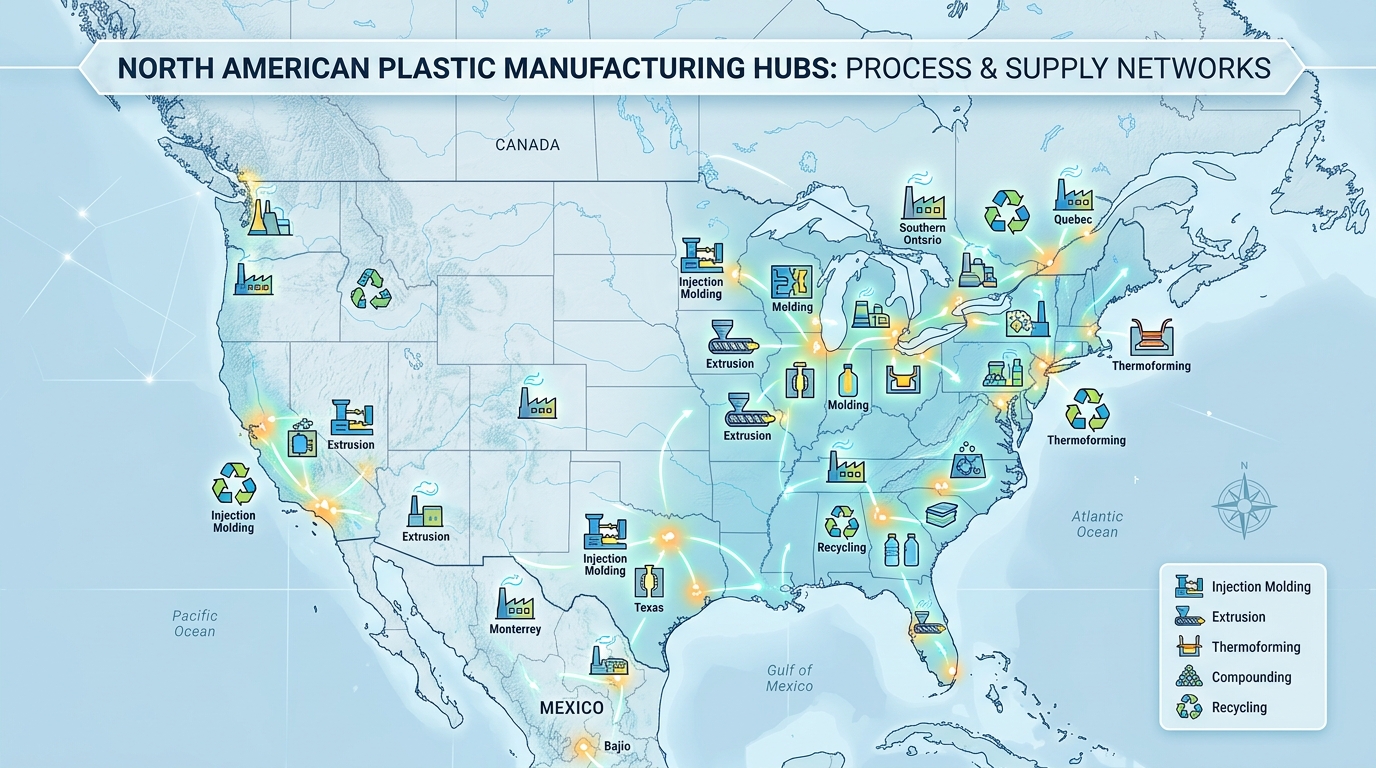
This directory organizes verified contract manufacturers across the Americas — the United States, Mexico, and Canada — by manufacturing process. Use it as a starting point to map capabilities to your product, then pair it with a proper qualification workflow before you award tooling.
How to Use This Directory
Before you scroll through process categories, do three things:
- Define your process first, not your region. A part designed for injection molding rarely translates cleanly to rotational molding. Match process to part geometry, tolerance, and volume.
- Confirm certifications required by your industry. Medical (ISO 13485), automotive (IATF 16949), and aerospace (AS9100) require shops with active, audited systems.
- Run a structured vetting cycle. Our Supplier Qualification Checklist: 40 Questions Before You Sign walks through financial health, tooling ownership, capacity, and IP protections — the areas where reshoring deals most often fall apart.
The directory below is organized by the plastics processes most commonly reshored from China, with notes on where each process has the deepest Americas-based capacity.
Injection Molding
Injection molding is by far the most-reshored plastics process, covering everything from consumer electronics housings to automotive interior trim and medical disposables.
United States
| Region | Notable Clusters | Typical Strengths |
|---|---|---|
| Midwest (OH, MI, IN, IL) | Automotive Tier 1/2, appliance | Large-tonnage presses, engineering resins |
| Southeast (NC, SC, GA, TN) | Medical devices, packaging | ISO 13485 cleanrooms, high-cavity tooling |
| Northeast (MA, CT, PA) | Precision optics, defense | Micro-molding, tight-tolerance work |
| Mountain West (UT, CO, AZ) | Consumer products, electronics | Shorter lead times to West Coast brands |
US injection molders typically run presses from 20 to 3,000+ tons. For a practical roadmap to qualifying these shops, see How to Find and Vet a US Contract Manufacturer.
Mexico
Mexico's injection molding base has grown dramatically alongside nearshoring demand. Key hubs:
- Bajío (Querétaro, Guanajuato, San Luis Potosí) — Automotive and appliance Tier 1/2 molders, many running European-spec tooling.
- Nuevo León (Monterrey) — Electronics, HVAC, industrial equipment. Strong bilingual engineering teams.
- Baja California (Tijuana, Mexicali) — Medical devices, consumer electronics. Same-day truck access to San Diego and Los Angeles.
- Jalisco (Guadalajara) — Electronics, consumer goods, IoT hardware.
For a deeper regional breakdown, the Mexico Plastic Manufacturing Hub Directory maps facilities by state, press tonnage, and certifications. Buyers sourcing automotive components specifically should consult the Automotive Plastic Parts: Nearshore Manufacturing Directory.
Canada
Ontario (Windsor, Toronto, Kitchener-Waterloo) dominates Canadian injection molding, with strong automotive Tier 1 and packaging presences. Quebec adds aerospace and medical capacity.
Blow Molding
Used for hollow containers, fuel tanks, ducts, and industrial drums. Three sub-processes matter:
- Extrusion Blow Molding (EBM) — bottles, automotive ducts
- Injection Blow Molding (IBM) — small pharmaceutical bottles
- Injection Stretch Blow Molding (ISBM) — PET beverage containers
Where to Source
| Country | Strongest Clusters |
|---|---|
| USA | Midwest industrial drum makers; Southeast PET beverage; Texas for chemical containers |
| Mexico | Monterrey (industrial), Mexico City metro (CPG beverage), Toluca (automotive ducts) |
| Canada | Southern Ontario (automotive fuel systems, industrial) |
Extrusion (Profile, Sheet, and Film)
Extrusion covers continuous plastic shapes — window profiles, tubing, sheet stock, and packaging film.
- Profile extrusion: Strong US base in the Midwest and Southeast; growing Mexican capacity in Monterrey and Puebla.
- Sheet extrusion: Ohio, Pennsylvania, and Indiana lead in the US. Mexican sheet producers cluster around Mexico City and Guadalajara.
- Film extrusion: Significant capacity in Wisconsin, Georgia, and Texas; Mexican film producers serve CPG and agriculture markets.
Thermoforming
Thermoforming splits into thin-gauge (packaging, clamshells) and heavy-gauge (equipment housings, vehicle interiors, medical carts).
- Thin-gauge: Dense US capacity in Ohio, California, and the Southeast. Mexican thin-gauge clusters in Estado de México and Nuevo León.
- Heavy-gauge: Michigan, Minnesota, and North Carolina lead US capacity. Mexico's heavy-gauge base is concentrated in the Bajío serving automotive and industrial OEMs.
Rotational Molding
Rotomolding produces large hollow parts — tanks, kayaks, playground equipment, agricultural components. The Americas base is fragmented but deep:
- USA: Oklahoma, Texas, Iowa, and Ohio have legacy rotomolding clusters.
- Mexico: Monterrey and Guadalajara serve agricultural and water storage markets.
- Canada: Alberta and Ontario host rotomolders for energy and recreational markets.
Compression Molding and Thermoset Processing
For phenolics, epoxies, BMC, and SMC — common in electrical, automotive under-hood, and appliance applications.
- USA: Indiana, Ohio, and Michigan host most established compression molders.
- Mexico: Growing capacity in Querétaro and San Luis Potosí serving Tier 1 automotive.
Secondary and Value-Added Services
Most reshoring projects require more than a molder. Look for contract manufacturers offering:
- In-house tooling and tool maintenance — critical when transferring molds from China
- Pad printing, hot stamping, laser marking
- Ultrasonic welding and assembly
- Cleanroom packaging (ISO Class 7/8)
- Kitting and direct-to-consumer fulfillment
When a shop controls more of the value chain, your landed cost and lead time both improve. Reshore's platform flags suppliers with integrated secondary capabilities during matching.
Regional Comparison at a Glance
| Factor | USA | Mexico | Canada |
|---|---|---|---|
| Labor cost (fully loaded) | Highest | Lowest | Mid-to-high |
| USMCA advantages | ✓ | ✓ | ✓ |
| Typical lead time to US East Coast | 1–5 days | 2–7 days | 1–4 days |
| Engineering resin depth | Deepest | Growing fast | Moderate |
| Tooling build capacity | Strong | Expanding | Limited |
| IP enforcement | Strongest | Strong (USMCA) | Strongest |
| Reshoring incentives available | Federal + state | Federal + state | Provincial |
For a state-by-state breakdown of available incentives, see our Directory of US Reshoring Incentives by State.
Vetting Any Manufacturer on This Directory
Inclusion in a directory is a starting point, not a qualification. Before committing tooling or a PO:
- Issue the right sourcing document. If you're still defining requirements, start with an RFI. If pricing is your main unknown, issue an RFQ. Our guide on RFQ vs. RFP vs. RFI in Manufacturing clarifies when each applies.
- Conduct an on-site or virtual audit using a structured Quality Control Checklist for Nearshore Manufacturing.
- Resolve tooling ownership and transfer terms up front. The FAQ on Tooling Transfer, IP, and Supplier Transition from China addresses the most common legal pitfalls.
- Match capacity to your forecast — not just your first PO. Reshoring programs stall when a supplier runs out of press hours in year two.
How Reshore Accelerates This
Scrolling through directories is useful for orientation, but it doesn't tell you which of 300 injection molders in the Bajío can actually run your resin, at your tolerances, on your timeline. That's the problem we built Reshore to solve.
Our AI-powered supplier matching engine ingests your part drawings, resin specs, volumes, and certification requirements, then matches against verified US and Mexican manufacturers with confirmed capacity. For companies actively exiting Chinese suppliers, our end-to-end reshoring service coordinates tooling transfer, factory qualification, and first-article approval in a single managed workflow.
If you're earlier in the process and still mapping what a reshoring project would look like, you can join the waitlist or book a reshoring assessment to scope your tooling, volumes, and target geography.
Frequently Asked Questions
Q: What is the fastest-growing plastics manufacturing process in Mexico?
Injection molding has grown fastest, driven by automotive and appliance nearshoring from China. The Bajío corridor alone has added significant press capacity since 2022, with several Tier 1 suppliers building dedicated cells for US-bound programs. Blow molding and thermoforming are also expanding, though from smaller bases.
Q: How do I know if a US contract manufacturer has real capacity or is quoting optimistically?
Ask for a press utilization report covering the last 90 days, look at scheduled PM windows, and request a site visit to see unassigned tooling slots. Shops overbooked on paper will often show it in floor congestion, overtime patterns, and PM deferrals. A structured on-site audit flags this quickly.
Q: Are Mexican contract manufacturers USMCA-compliant by default?
No — USMCA compliance depends on the product's regional value content and specific rule of origin, not the factory's location. A part molded in Mexico from Chinese resin may not qualify. Work with your manufacturer and a trade compliance advisor to confirm eligibility before assuming duty-free treatment.
Q: What's the minimum order volume most North American injection molders will accept?
It varies widely. Dedicated high-volume shops often require 50,000+ annual units to eng