
How to Find and Vet a US Contract Manufacturer in 2026
April 23, 2026
How to Find and Vet a US Contract Manufacturer in 2026
Reshoring momentum hasn't slowed. With tariff volatility, tightening IP enforcement concerns, and the push for supply chain resilience, more US brands are actively searching for domestic and nearshore production partners than at any point in the last two decades. But finding a contract manufacturer is the easy part — vetting one that can actually deliver on quality, capacity, and commercial terms is where most sourcing initiatives stall.
This guide walks through the practical steps to identify, qualify, and contract with a US contract manufacturer in 2026, with a particular focus on plastics and injection molding — the categories we work in most often at Reshore.
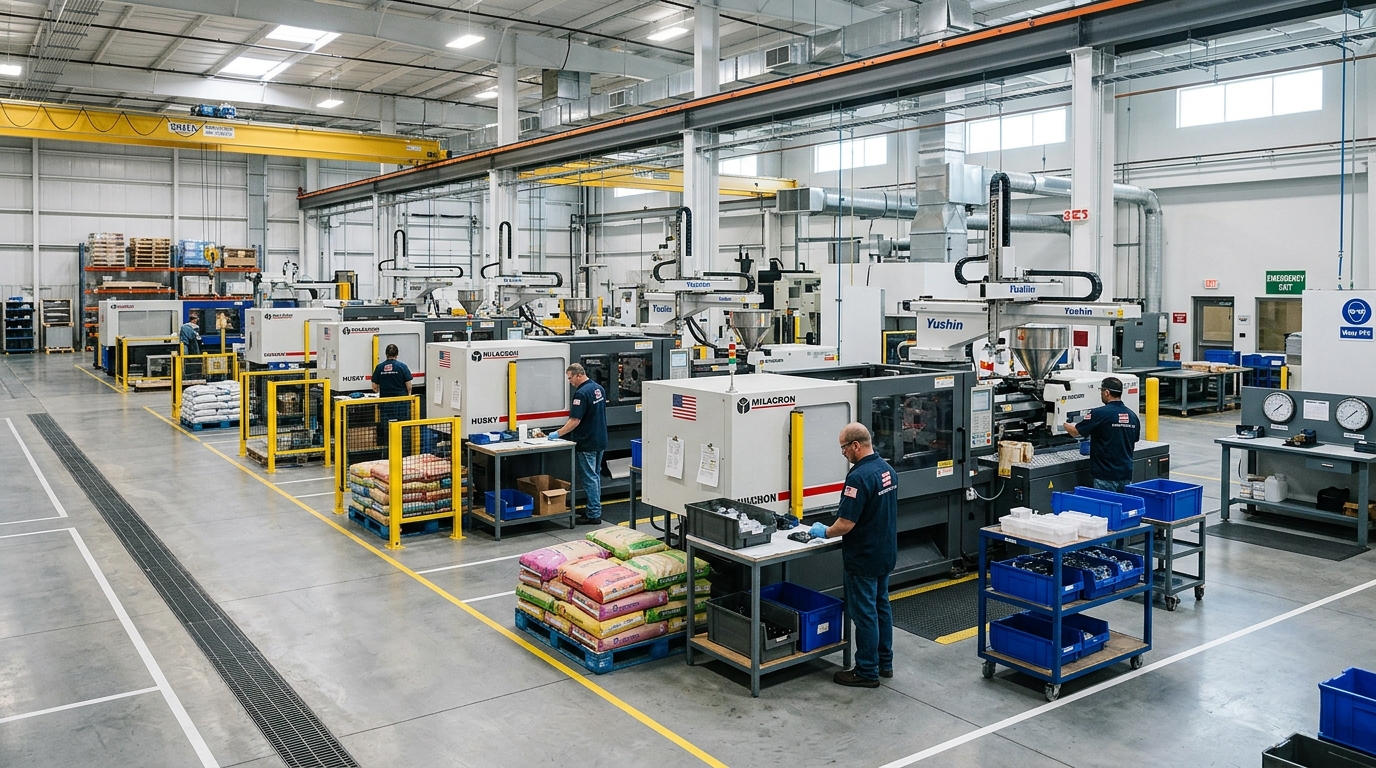
Why the Search Looks Different in 2026
The sourcing landscape has shifted meaningfully over the past 24 months. Three dynamics are reshaping how buyers find American manufacturing partners:
- Capacity is tighter than you think. Reshoring inflows have filled slots at many mid-size molders. According to the Reshoring Initiative's 2024 Annual Report, reshoring and FDI job announcements have continued at historically elevated levels, and that has downstream effects on lead times for new program onboarding.
- AI sourcing has matured. Buyers no longer rely solely on trade shows, Thomasnet searches, or warm introductions. Platforms can now match programs to factory capabilities based on tonnage, resin experience, certifications, and geographic preference within minutes.
- The "US or Mexico?" question is now standard. Most sourcing teams evaluate both in parallel. Labor arbitrage still favors Mexico for labor-intensive assembly, while the US wins on logistics speed, IP protection, and automation-heavy programs.
If you're still deciding between domestic and nearshore, our guides on China+1 vs. Full Reshoring and Mexico vs. China manufacturing comparisons are good companion reads before committing to a search geography.
Step 1: Define Your Manufacturing Profile Before You Search
Most bad supplier matches trace back to a vague brief. Before you contact a single factory, document:
| Category | What to Specify |
|---|---|
| Process | Injection molding, blow molding, thermoforming, extrusion, overmolding, insert molding |
| Volume | Annual units + expected variability (seasonal, ramp, EOL) |
| Tonnage range | Press size needed (e.g., 50–500 ton) |
| Materials | Resin family, grade, colorant, regrind tolerance |
| Tolerances | Critical-to-quality dimensions, cosmetic requirements |
| Certifications | ISO 9001, ISO 13485, IATF 16949, FDA, UL |
| Secondary ops | Pad printing, ultrasonic welding, assembly, packout |
| Target landed cost | Piece price + tooling amortization + freight |
This profile becomes the backbone of your RFI, RFQ, or RFP. If you're unsure which document to send first, the short version: RFI for discovery, RFQ for priced quotes on a specified design, RFP when you need suppliers to propose a solution.
Step 2: Build a Long List of Candidate Manufacturers
There are four proven channels for building an initial list of US contract manufacturers:
Industry Directories
Thomasnet, MFG.com, and the Plastics Industry Association directory remain reliable starting points. State-level manufacturing extension partnership (MEP) centers, funded through NIST MEP, also maintain regional rosters of vetted shops.
Trade Associations
The Society of Plastics Engineers (SPE), MAPP (Manufacturers Association for Plastics Processors), and AMBA (American Mold Builders Association) publish member lists that skew toward quality-focused shops.
Peer Referrals
Ask product development consultants, tool makers, and resin distributors. Tool makers in particular know which molders run their tools well — a signal you can't easily get elsewhere.
AI-Powered Supplier Matching
Traditional search returns hundreds of shops without telling you which ones can actually run your program. We built Reshore's AI sourcing engine specifically to collapse this step — matching programs to verified factories by press tonnage, resin experience, certifications, and available capacity rather than surface-level keyword hits. It's designed to produce a short list of 5–8 viable partners in days rather than weeks of cold outreach.
Aim for an initial long list of 15–25 names. You'll cut this to a short list of 5–8 after the RFI round.
Step 3: Send a Structured RFI
The RFI is where you screen for fit, not price. Keep it under 15 questions and cover:
- Ownership structure, years in business, and employee count
- Press count, tonnage range, and current capacity utilization
- Resins and industries with the most experience
- Certifications held (with expiration dates)
- Quality system — SPC, PPAP capability, CAPA process
- Customer concentration (no single customer should exceed ~30%)
- Tooling capabilities — in-house tool room, tool transfer experience
- Typical program size and minimum annual volume
- Location(s) and any Mexico or Canada operations
- References from customers with comparable programs
Suppliers who respond with boilerplate marketing decks instead of answering the questions directly are already telling you something.
Step 4: Vet Suppliers Through Structured Due Diligence
This is the stage where most sourcing processes fail. A clean RFI response does not mean a factory can actually run your part. Build a vetting protocol that covers four dimensions:
Financial Health
Request D&B reports or recent financial statements for programs above $500K annually. You're looking for positive working capital, reasonable debt levels, and no outstanding liens against production equipment. A molder that can't finance resin purchases will put your program at risk the first time commodity prices spike.
Quality System Audit
Don't accept a framed ISO certificate as proof of anything. Ask for:
- Last three years of internal and external audit findings
- Current PPM rates by customer (or aggregate if NDAs apply)
- Scrap rate trends
- Cpk data for a representative program
Operational Capacity
Tour the facility — either in person or via structured virtual walkthrough. Look at:
- Press utilization and whether machines are well maintained
- Material handling and resin storage practices
- Tool storage conditions (climate-controlled, organized, labeled)
- Finished goods area — is inventory managed or chaotic?
- Maintenance records posted at the presses
Cultural and Commercial Fit
This one is underrated. Factor in response time to questions, willingness to engage on DFM, transparency about capacity constraints, and whether leadership shows up in sourcing conversations. A technically capable supplier who treats you as a small account will frustrate you for years.
For a complete due diligence framework, we maintain a Supplier Qualification Checklist with 40 questions we use on every Reshore engagement — covering the items above plus contractual, IP, and logistics considerations.
Step 5: Structure a Narrow, Focused RFQ
Once you've qualified 3–5 finalists, issue an RFQ with:
- Full 2D and 3D part data
- Annual volume and order frequency assumptions
- Packaging and ship-to requirements
- Target EAU for tooling amortization
- Required PPAP level (typically Level 3 for new programs)
- Payment terms expectations
- Tooling ownership and transfer rights
Apples-to-apples quotes require apples-to-apples inputs. The most common quoting mistake we see is suppliers pricing against different assumptions — cycle time, cavitation, resin grade — which makes comparison meaningless. Specify these upfront.
Step 6: Validate Before You Award
Before final award, run two validations:
Reference calls. Talk to at least three current customers. Ask specifically about on-time delivery, quality performance over time, response to a major issue, and pricing behavior at contract renewal.
A sample or short pilot run. For programs above $250K annually, the cost of running a short validation order is trivial compared to the cost of discovering problems after full tool transfer.
Step 7: Contract with Protections That Matter
The final contract should address tooling ownership explicitly (you own it, it can be pulled at any time), quality remedies, capacity commitments, raw material pass-throughs, and termination rights. For programs involving tool transfer from China, we also strongly recommend clear language on tool condition acceptance, first-article approval, and dual-sourcing rights during ramp.
How Reshore Approaches the Problem
We built Reshore because this process — done manually — takes 6 to 9 months for most brands, and even then many sourcing teams end up with suppliers who look good on paper but underperform in production. Our platform compresses the long-list-to-short-list stage dramatically using AI matching against a verified network of US and Mexico manufacturers, and we handle the vetting, tool transfer coordination, and ramp-up logistics as an integrated service rather than a series of handoffs.
If you're early in the process and want a structured evaluation of your current production footprint, a reshoring assessment is the fastest way to get a defensible plan on paper. If you're further along and want to see matched suppliers for a specific program, our buyer platform is where that happens.
Frequently Asked Questions
Q: How long does it typically take to find and qualify a US contract manufacturer?
Done manually, the process from initial search through signed contract typically runs 4–9 months for plastics programs, depending on complexity and certification requirements. AI-powered sourcing platforms can compress the discovery and qualification stages to 4–8 weeks, though tool transfer and PPAP still follow their normal timelines.
Q: What's the difference between a contract manufacturer and a job shop?
A contract manufacturer takes ownership of a program under a multi-year agreement, typically handling production, quality, and often secondary operations and packout. A job shop runs discrete purchase orders, usually on a transactional basis, without long-term capacity commitments. For reshored programs with stable volume, a contract manufacturer relationship almost always makes more sense.
Q: How much does it cost to tool up with a new US manufacturer?
Injection molding tooling in the US typically runs 1.5x to 2.5x the equivalent Chinese tool cost, though the gap has narrowed as Chinese tool prices have risen. For programs moving from China, tool transfer is often the better economic path — keeping the original tool and shipping it to a US or Mexico molder, with modifications as needed.
Q: Should I source in the US or Mexico?
It depends on labor intensity, automation level, logistics sensitivity, and IP considerations. Highly automated programs with short lead time requirements often favor the US. Labor-intensive assembly and programs with significant cost pressure frequently favor Mexico. Most sourcing teams in 2026 evaluate both in parallel rather than committing to one geography upfront.
Q: What certifications should a plastics contract manufacturer have?
ISO 9001 is baseline for virtually any program. ISO 13485 is required for medical devices, IATF 16949 for automotive, and FDA registration plus food-contact resin certifications for food and consumer goods. UL certifications matter for electrical and electronic housings.
Q: Does Reshore work with manufacturers outside of plastics?
Our core expertise and network are concentrated in plastics — injection molding, blow molding, thermoforming, and related processes including tooling, secondary operations,