
Injection Molding vs. Blow Molding vs. Thermoforming: A Buyer's Guide
April 23, 2026
Injection Molding vs. Blow Molding vs. Thermoforming: A Buyer's Guide
Choosing the right plastic molding process is one of the most consequential decisions a product team will make. It determines your tooling investment, per-part economics, design flexibility, production speed, and — increasingly — where in the world you can realistically manufacture. As US companies continue shifting plastic production out of China and into Mexico and the United States, understanding the trade-offs between injection molding, blow molding, and thermoforming has never mattered more.
At Reshore, we work with buyers every week who are re-evaluating their molding strategy as part of a broader reshoring initiative. This guide breaks down the three dominant plastics manufacturing processes, when to use each, and what to consider when sourcing from Americas-based manufacturers.
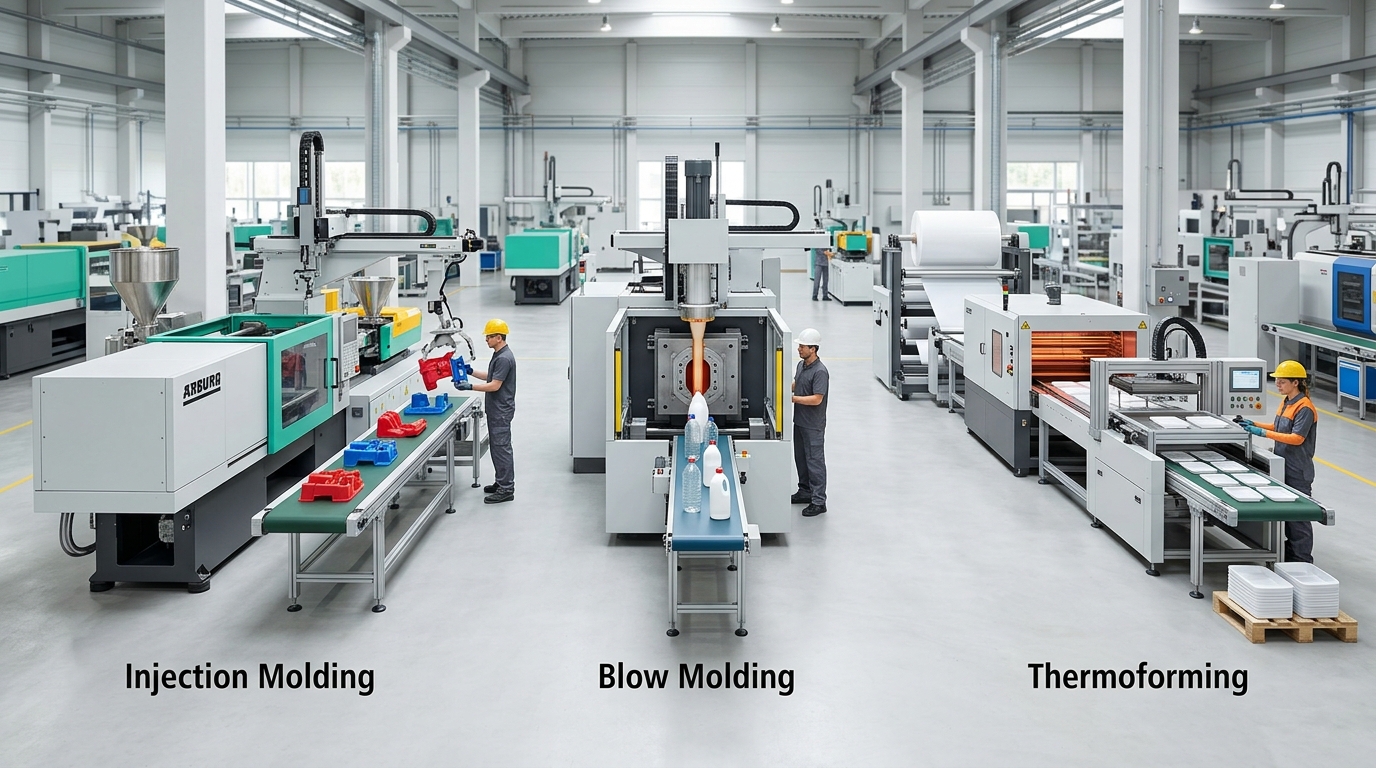
The Three Dominant Plastic Molding Processes
Plastic molding is not a monolithic category. Each process is optimized for a specific geometry, wall thickness range, and production volume. Picking the wrong one can inflate tooling costs by 10x or make your part economically impossible to produce.
Here is a high-level comparison before we dig into each process:
| Attribute | Injection Molding | Blow Molding | Thermoforming |
|---|---|---|---|
| Best for | Solid, complex parts | Hollow containers | Large, thin-walled shapes |
| Tooling cost | High ($20K–$200K+) | Medium ($10K–$80K) | Low ($2K–$25K) |
| Cycle time | 10–60 seconds | 8–25 seconds | 20–90 seconds |
| Typical volumes | 10K–10M+ units | 5K–5M+ units | 500–500K units |
| Wall thickness | 0.5–4 mm | 0.3–2 mm | 1–6 mm |
| Material waste | Low | Low–Medium | High (trim scrap) |
| Design complexity | Very high | Medium | Low–Medium |
Injection Molding: The Workhorse of Plastics Manufacturing
Injection molding forces molten resin into a precision-machined steel or aluminum mold under high pressure. Once cooled, the solid part ejects and the cycle repeats. It is the dominant process for consumer electronics housings, automotive components, medical devices, closures, and nearly anything that needs tight tolerances or intricate features.
Strengths
- Geometric complexity: Undercuts, living hinges, threaded inserts, and multi-material overmolds are all achievable.
- Repeatability: Tolerances of ±0.05 mm are routine. This is why the process dominates medical and automotive supply chains.
- Scale economics: Once the tool is paid for, per-part costs can drop below $0.10 for simple components.
- Material range: Virtually any thermoplastic — from commodity PP and ABS to engineering resins like PEEK and PC/ABS.
Weaknesses
- Tooling cost and lead time: A production-grade multi-cavity tool can run $50K–$200K and take 8–16 weeks to cut. This is precisely why tooling transfer is often the most valuable service in a reshoring project — re-cutting tools from scratch is rarely necessary.
- Not ideal for hollow parts: You can mold two halves and weld them, but it's usually more expensive than blow molding.
- Design lock-in: Once steel is cut, changes are expensive.
When to Choose Injection Molding
Choose injection molding when you need high volumes (typically 10,000+ parts annually), tight tolerances, complex geometry, or a premium surface finish. For a deeper economic breakdown, our Injection Molding Cost Calculator can estimate piece-part and tooling costs based on resin, cavitation, and annual volume.
Blow Molding: The Process Behind Every Bottle You Own
Blow molding creates hollow parts by inflating a heated plastic tube (called a parison) against the walls of a mold. Think water bottles, detergent jugs, fuel tanks, and industrial drums. There are three main variants:
- Extrusion blow molding (EBM) — most common, used for HDPE containers
- Injection blow molding (IBM) — higher precision, used for smaller pharmaceutical bottles
- Injection stretch blow molding (ISBM) — used for PET beverage bottles, produces superior clarity and strength
Strengths
- Efficient hollow geometries: Making a one-gallon jug by injection molding and welding would be absurdly expensive. Blow molding does it in one shot.
- Fast cycle times: Container production can exceed 2,000 units per hour on a well-tuned line.
- Lightweighting: Modern ISBM can produce a 500ml PET bottle using less than 10 grams of resin.
Weaknesses
- Limited to hollow parts: If your product has a solid cross-section, blow molding isn't an option.
- Wall thickness variation: Harder to control than injection molding. Corners and bottoms often have thinner walls.
- Fewer feature options: Threads and necks are achievable, but intricate details are not.
When to Choose Blow Molding
Bottles, tanks, containers, hollow toys, automotive ductwork, and any enclosed-volume part where weight and material cost matter more than intricate detail.
Thermoforming: The Low-Tooling-Cost Champion
Thermoforming heats a plastic sheet until pliable, then forms it over or into a single-sided mold using vacuum, pressure, or matched tooling. The result is trimmed to final shape. Common outputs include clamshell packaging, medical trays, refrigerator liners, spa shells, and vehicle door panels.
Strengths
- Dramatically lower tooling costs: Aluminum or even epoxy tools can run $2,000–$15,000, compared to $50K+ for injection molds.
- Fast time-to-market: Tools can be cut in 2–4 weeks.
- Great for large parts: A 6-foot spa shell would require an impossibly large injection press; thermoforming handles it easily.
- Low-to-medium volume friendly: Economical from hundreds to tens of thousands of units.
Weaknesses
- Material waste: Trim scrap can reach 20–40% of sheet material (though it's often reground and reused).
- Limited detail: No undercuts, no threads, looser tolerances (±0.25 mm typical).
- Wall thickness thinning: Deep draws result in uneven wall thickness.
When to Choose Thermoforming
Large parts, low-to-medium volumes, packaging applications, or when you need to validate a market before committing to injection molding tooling. Many consumer goods companies launch with thermoformed prototypes and transition to injection molding as volumes scale.
Decision Framework: Which Process Fits Your Product?
Here's a simplified decision matrix we use with buyers on the Reshore platform:
| If your part is... | And your volume is... | Then consider... |
|---|---|---|
| Solid, complex, tight tolerance | 10K+ per year | Injection molding |
| Hollow container or tank | 5K+ per year | Blow molding |
| Large, thin-walled, or packaging | 500–50K per year | Thermoforming |
| Small solid part, very low volume | <5K per year | Thermoforming or 3D printing bridge production |
| Multi-material or overmolded | Any volume | Injection molding (multi-shot) |
Resin choice also narrows your options. Polypropylene and HDPE work across all three processes. PET dominates blow molding. Engineering resins like PC, nylon, and POM are almost exclusively injection molded. We cover this in detail in our guide to plastic resin selection for nearshore manufacturing.
What This Means for Reshoring Buyers
If you're currently producing in China, your process choice affects your reshoring strategy in meaningful ways:
Injection molding has the deepest reshoring infrastructure. Mexico — particularly the Bajío region, Nuevo León, and the border states — has a mature injection molding ecosystem supporting automotive, medical, and consumer electronics. Tooling transfer from Chinese tool shops to Mexican or US facilities is well-understood, and most steel tools survive the move without modification.
Blow molding capacity in Mexico and the US is strong for packaging (food, beverage, household chemicals) but thinner for technical applications like fuel tanks or industrial drums. Lead times for blow mold transfers are generally shorter since the tools are less complex.
Thermoforming is the easiest process to reshore because tooling is cheap enough that cutting new tools domestically often makes more sense than shipping them from China. US thermoforming capacity is particularly robust in the Midwest and Southeast.
Under USMCA, plastic parts manufactured in Mexico generally enter the US duty-free when regional value content requirements are met. This is a meaningful cost advantage that compounds across high-volume injection molding programs. For buyers evaluating the full picture, our reshoring assessment benchmarks current China landed costs against projected Mexico or US landed costs, including tooling transfer logistics.
Total Cost of Ownership: Beyond the Piece Part
Too many buyers evaluate molding processes on piece-part price alone. We recommend a broader TCO view:
- Tooling amortization — Spread across realistic annual volume
- Freight and duties — Ocean freight from China plus Section 301 tariffs versus truck freight from Mexico
- Inventory carrying costs — 6–8 weeks of Pacific crossing inventory versus 3–5 days from Monterrey
- Quality risk — Scrap, rework, and field failures
- IP risk — Tooling duplication exposure
- Responsiveness — Cost of delayed engineering changes
When you run these numbers, the gap between "cheap Chinese piece part" and "slightly higher Mexican or US piece part" often closes or reverses entirely — especially for injection-molded parts where tooling is already amortized and simply needs to be relocated.
Putting It All Together
There is no universally "best" plastic molding process. Injection molding wins on complexity and volume. Blow molding wins on hollow geometries. Thermoforming wins on tooling cost and large-format parts. The right answer depends on your product geometry, annual volume, tolerance requirements, and material choice.
What has changed in the reshoring era is that your process selection now directly influences where you can produce cost-effectively. All three processes have robust Mexican and US capacity, but the depth, pricing, and lead times vary by region and technology. If you're evaluating a move from China, understanding your process is step one; matching it to the right Americas-based manufacturer is step two.
If you'd like help mapping your current tooling and finding verified manufacturers capable of running your program, the Reshore platform matches buyers to pre-qualified facilities across Mexico 🇲🇽 and the US based on process, resin, tolerance class, and certification requirements.
Frequently Asked Questions
Q: What is the main difference between injection molding and blow molding?
Injection molding produces solid parts by forcing molten plastic into a closed mold under high pressure, while blow molding creates hollow parts by inflating a heated plastic tube against the walls of a mold. Injection molding excels at complex, detailed parts; blow molding excels at containers, bottles, and tanks where a hollow interior is required; thermoforming excels at large, thin-walled parts — trays, panels, and covers — where tooling cost must be minimized. The right process depends on part geometry, wall thickness, annual volume, and material. Request a quote and our sourcing team will recommend the optimal manufacturing approach during the RFQ intake.
Ready to get started? Request a reshoring assessment or run a cost comparison — we’ll respond within one business day.