
Mexico vs. China Manufacturing: Cost, Lead Time & Quality Compared
April 23, 2026
Mexico vs. China Manufacturing: Cost, Lead Time & Quality Compared
For two decades, "Made in China" was the default answer for US brands looking to scale production affordably. That calculus has shifted dramatically. Between Section 301 tariffs, ocean freight volatility, IP concerns, and a growing push for supply chain resilience, a growing number of American companies are evaluating Mexico as a serious manufacturing alternative — especially for plastics and injection-molded components.
But how does Mexico actually stack up against China on the metrics that matter most: cost, lead time, and quality? Below is a side-by-side breakdown based on current market data, trade policy, and the real migration patterns we at Reshore see every week as we help US companies relocate production.
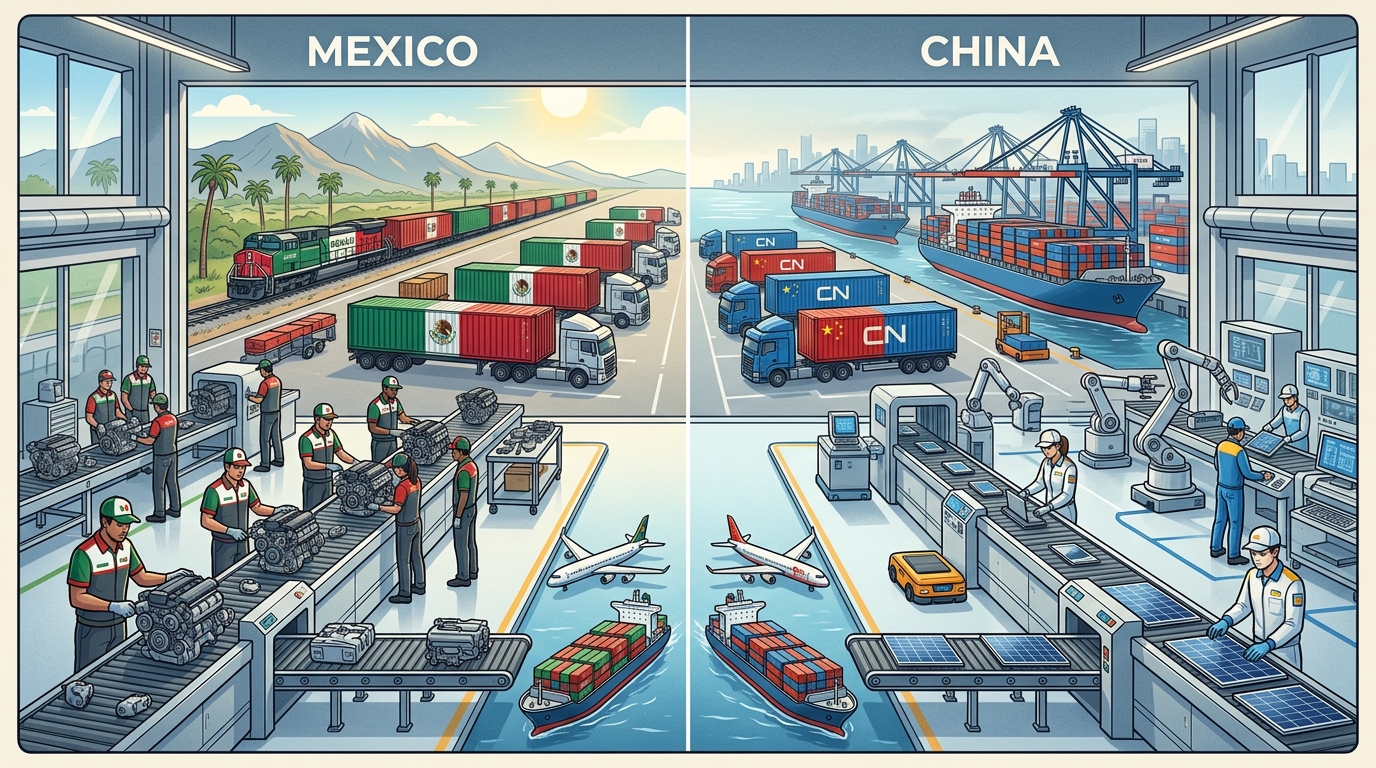
The Big Picture: Why This Comparison Matters in 2026
The manufacturing landscape looks nothing like it did five years ago. According to Kearney's Reshoring Index, US imports from low-cost Asian countries have been steadily declining as a share of manufacturing imports, while Mexico overtook China in 2023 as the largest source of US imports — a position it has since strengthened.
Three forces are driving the shift:
- Tariffs — Section 301 duties on Chinese goods range from 7.5% to over 100% depending on HTS code, with additional rounds layered on since 2024.
- USMCA — The US-Mexico-Canada Agreement provides duty-free treatment for qualifying goods, provided regional content requirements are met.
- Nearshoring economics — Shorter supply chains reduce inventory carrying costs, freight exposure, and time-to-market.
For plastics manufacturers in particular — injection molding, blow molding, extrusion — Mexico has quietly built the infrastructure, tooling expertise, and resin supply chain to compete head-on with Guangdong and Zhejiang.
Cost Comparison: Unit Price vs. Landed Cost
The biggest misconception we encounter is that China is still "cheaper." On a quoted unit-price basis, Chinese suppliers often are — sometimes by 10–20%. But unit price is only one line in a far longer ledger.
Direct Manufacturing Costs
| Cost Factor | China | Mexico |
|---|---|---|
| Average manufacturing wage (2026) | ~$6.50–$8.00/hr (coastal) | ~$4.50–$6.00/hr |
| Electricity (industrial) | $0.09–$0.11/kWh | $0.08–$0.12/kWh |
| Resin (commodity grades) | Comparable, slight China advantage | Comparable, USMCA sourcing options |
| Tooling (steel mold) | 20–40% cheaper upfront | Higher initial, longer lifespan |
Chinese coastal wages have risen more than 300% over the past 15 years, according to data from the US Bureau of Labor Statistics and China's National Bureau of Statistics. Meanwhile, Mexican wages — particularly in manufacturing hubs like Monterrey, Querétaro, and Tijuana — have remained competitive.
Landed Cost: Where Mexico Usually Wins
When you add freight, duties, tariffs, inventory carrying costs, and quality-related scrap, the picture inverts for most plastic parts.
| Landed Cost Factor | China → US | Mexico → US |
|---|---|---|
| Ocean freight (40' container) | $2,800–$4,500 | N/A (truck) |
| Ground freight (truck) | N/A | $1,800–$3,200 |
| Transit time | 30–45 days | 2–5 days |
| Section 301 tariff | 7.5%–100%+ | 0% (USMCA-qualifying) |
| Safety stock requirement | 60–90 days | 15–30 days |
| IP risk premium | Variable, high | Low |
For a deeper breakdown of the full cost picture, our analysis on the Hidden Costs of China Plastic Manufacturing: Beyond the Unit Price walks through factors most RFQs ignore — including demurrage, customs brokerage, and the cost of capital tied up in in-transit inventory.
Clients using our Nearshoring Savings Calculator typically see total landed cost reductions of 15–35% after migration, even when unit prices remain slightly higher in Mexico.
Lead Time: Days, Not Weeks
Lead time is where nearshoring vs. offshoring produces its most dramatic delta.
- China production + transit: 45–90 days door-to-door (production + ocean freight + customs + drayage)
- Mexico production + transit: 10–25 days door-to-door
During the 2021–2022 supply chain disruption, ocean freight from China hit record delays, with some containers stuck at anchor for weeks. While rates have normalized, the Federal Maritime Commission continues to flag schedule reliability as a structural concern for trans-Pacific shipping.
With Mexico, overnight trucking from Monterrey to Texas is standard. This compresses the cash conversion cycle, reduces the need for safety stock, and — critically — allows brands to respond to demand signals in near-real-time. For consumer goods, medical devices, and electronics with short product cycles, this speed advantage often matters more than unit price.
Quality: The Narrative Has Caught Up to Reality
The old assumption that "China has better quality" is, at best, decades out of date. Both countries have world-class facilities and both have mediocre ones — the difference lies in vendor selection.
Certifications and Standards
Mexican plastics manufacturers routinely hold:
- ISO 9001 (quality management)
- ISO 13485 (medical devices)
- IATF 16949 (automotive — Mexico leads the Americas here)
- FDA registration for food-contact and medical components
- ISO 14001 (environmental)
Automotive OEMs including GM, Ford, Stellantis, BMW, Nissan, and Toyota have long relied on Mexican tier-1 and tier-2 suppliers for critical plastic and composite parts. That automotive pedigree has spilled over into medical, consumer, and electronics plastics.
Injection Molding Specifics
In a direct comparison of injection molding quality standards, the gap between top-tier Mexican and Chinese molders is minimal. Both can deliver:
- Scientific molding / DOE-based process development
- Sub-micron cavity tolerances on appropriate tooling
- CMM inspection, vision systems, and SPC
- Cleanroom molding (ISO 7/8) for medical applications
Where Mexico pulls ahead: communication, time zone alignment, on-site audits, and IP protection under US treaty frameworks. Where China can still edge out: volume of specialty tooling shops and breadth of exotic resin inventory — though Mexico's ecosystem has closed most of this gap.
USMCA: The Structural Advantage
USMCA is the single biggest reason Mexico's cost position is defensible long-term. Qualifying goods move across the US-Mexico border duty-free, while goods from China face layered tariffs that show no sign of retreating regardless of administration.
Key USMCA benefits for plastic manufacturing include:
- Duty-free treatment for goods meeting regional value content thresholds
- Streamlined customs via the CBP's trusted trader programs
- Certificate of origin self-certification (no consular legalization)
- IP enforcement aligned with US standards, including trade secret protections
For a full treatment of how USMCA stacks against current tariff exposure, see our analysis of USMCA vs. Tariffs: Why Mexico Manufacturing Wins in 2026.
Where Mexico Still Has Gaps
We believe in honest comparisons. Mexico isn't a universal answer:
- Deep-tier electronics components (PCBs, semiconductors, rare-earth magnets) still concentrate in Asia.
- Very high-volume commodity plastics (think $0.02 parts at 50M annual units) sometimes still pencil out cheaper in China despite tariffs.
- Specialty resins and masterbatches occasionally require import from Asia or Europe.
- Skilled labor tightness in hot markets like Monterrey can push wages higher for specialized roles.
The right answer is rarely "all in" on one country. It's a portfolio decision based on part complexity, volume, IP sensitivity, and demand volatility.
How to Evaluate Your Own Migration
If you're weighing a shift, a structured comparison typically looks like this:
- Audit your current China spend — unit cost, tooling amortization, freight, duties, inventory holding.
- Classify parts by migration priority — high-tariff, high-IP, or high-velocity parts migrate first.
- Identify vetted Mexican suppliers — capability, certifications, capacity, proximity to your US distribution point.
- Model total landed cost — not just quoted unit price.
- Plan tooling transfer — the operational heart of any reshoring project.
This is the work we at Reshore built our platform to accelerate. Instead of spending 6–12 months sourcing factories, auditing suppliers, and coordinating mold transfer logistics, our AI-powered matching and our network of vetted Mexican manufacturers compress the timeline to weeks. For teams ready to put numbers against their own parts, a reshoring assessment is typically the fastest way to quantify the opportunity.
The Bottom Line
On unit price alone, China can still appear cheaper. On total landed cost, lead time, quality, and risk, Mexico wins for the majority of US plastic manufacturing programs in 2026. The countries that drew a manufacturing talent pool away from North America over 25 years cannot be unwound overnight, but the migration is firmly underway — and for companies that move strategically rather than reactively, the economics are compelling.
Frequently Asked Questions
Q: Is manufacturing in Mexico really cheaper than China in 2026?
On total landed cost, yes — for most categories. Unit prices in China can still be 10–20% lower on paper, but once you factor in Section 301 tariffs, ocean freight, extended lead times, safety stock, and IP risk, Mexico typically delivers 15–35% lower total cost for US-bound production. The gap widens further for tariffed HTS codes.
Q: What is nearshoring vs. offshoring?
Offshoring means moving production to a distant country, typically across an ocean, primarily to chase labor cost arbitrage — China being the classic example for US brands. Nearshoring means moving production to a geographically and culturally closer country, like Mexico for US buyers, prioritizing shorter lead times, easier oversight, and supply chain resilience over pure labor cost.
Q: What are the best China alternatives for plastic manufacturing?
Mexico leads for US-bound production due to USMCA, proximity, and a mature automotive-grade plastics ecosystem. Secondary alternatives include Vietnam, India, and Malaysia, but none match Mexico's tariff advantage, two-day trucking to US markets, or IP protection under treaty frameworks. For plastic injection molding specifically, Mexico is usually the strongest single choice.
Q: How long does it take to move production from China to Mexico?
A well-run migration typically takes 4–9 months end-to-end