
Reshoring Project Timeline: What to Expect Month-by-Month
April 23, 2026
Reshoring Project Timeline: What to Expect Month-by-Month
Reshoring a plastics program from China to North America isn't a flip-the-switch decision—it's a coordinated, multi-phase project that touches engineering, procurement, logistics, and finance. For most small and mid-sized manufacturers we work with, the full reshoring timeline runs between six and twelve months from kickoff to steady-state production, depending on tooling complexity, regulatory requirements, and supplier readiness.
At Reshore, we've guided dozens of companies through this transition, and one pattern holds true: teams that plan around realistic milestones succeed; teams that underestimate the timeline stall out in month three. This article walks you through what a typical reshoring project looks like, month by month, so you can set expectations internally and execute with confidence.
Why the Reshoring Timeline Matters
A reshoring project isn't just a supplier switch—it's a supply chain redesign. Pulling tooling out of a Chinese factory, qualifying a new manufacturer in Mexico or the US, revalidating parts, and ramping production involves dependencies that can't be compressed past a certain point. Miss a step, and you risk line-down events, quality failures, or costs that exceed what you were paying offshore.
The good news: when each reshoring phase is sequenced correctly, the process is predictable. Below is the timeline we typically use when scoping client engagements.
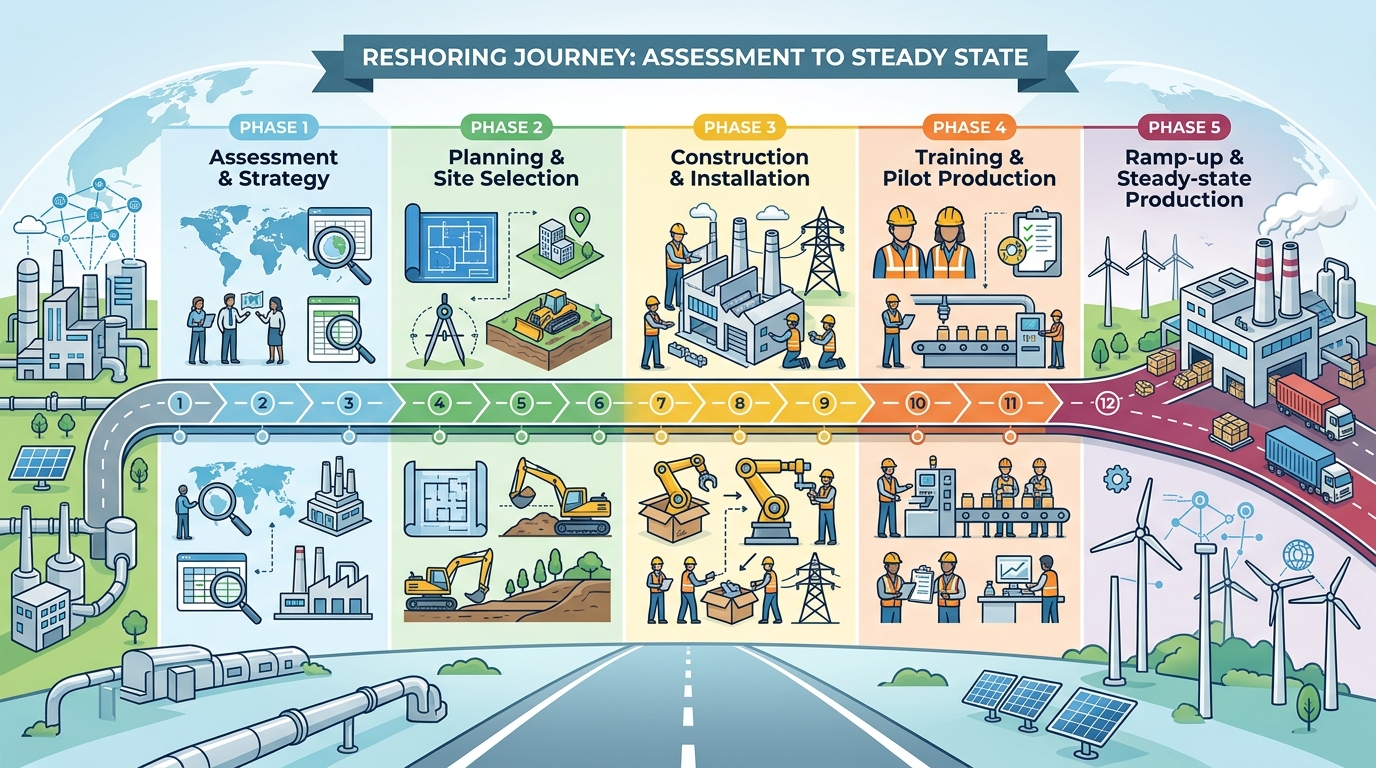
The Reshoring Timeline at a Glance
| Phase | Timeframe | Primary Activities |
|---|---|---|
| 1. Assessment & Strategy | Month 1 | TCO modeling, scope definition, readiness evaluation |
| 2. Supplier Sourcing & Matching | Months 2–3 | RFQ/RFP, factory shortlisting, quotes |
| 3. Supplier Qualification & Contracting | Month 3–4 | Audits, NDAs, MSAs, PPAP planning |
| 4. Tooling Transfer & Preparation | Months 4–6 | Mold extraction, shipping, refurbishment |
| 5. Sampling & Validation | Months 6–8 | First articles, PPAP, quality approvals |
| 6. Pilot Production | Month 8–9 | Low-volume runs, process tuning |
| 7. Full Ramp & Steady State | Months 9–12 | Production scaling, legacy supplier wind-down |
Now let's walk through each phase.
Month 1: Assessment and Strategy
The first month is about honest diagnosis. Before any supplier outreach, you need to know what you're actually moving and why.
Key Activities
- Total Cost of Ownership (TCO) analysis. Compare your current landed cost from China against projected costs in Mexico and the US. A proper TCO model includes tariffs, freight, inventory carrying costs, quality costs, and IP risk—not just unit price.
- Scope definition. Which SKUs, tools, and programs are candidates? Full reshoring, or a China+1 strategy that keeps some capacity offshore?
- Readiness evaluation. Do you have current 2D/3D drawings, material specs, and GD&T? Missing documentation is the number-one cause of delays later.
- Stakeholder alignment. Engineering, procurement, finance, and operations all need to sign off on the business case.
Reshore recommendation: Before month one ends, book a formal reshoring assessment to pressure-test your scope and TCO assumptions with an outside expert. It's far cheaper to catch a flawed business case now than in month six.
Months 2–3: Supplier Sourcing and Matching
With a clear scope, sourcing begins. This is often the longest-feeling phase for teams new to nearshore manufacturing, because identifying the right factory in Mexico or the US requires more than a Google search.
Key Activities
- Issue RFIs and RFQs. Knowing whether to use an RFI, RFQ, or RFP at each stage saves weeks. RFIs cast a wide net; RFQs drive pricing from pre-qualified shortlist.
- Factory shortlisting. For plastics, you're looking at injection molders with the right tonnage range, material experience (ABS, PC, PP, engineering resins), and industry certifications (ISO 9001, ISO 13485 for medical, IATF 16949 for automotive).
- Quote comparison. Normalize quotes across cycle time, cavitation, secondary operations, and packaging.
This is where our AI-powered supplier matching accelerates the timeline dramatically. Instead of taking 8–10 weeks to manually identify and outreach to factories, the Reshore platform narrows a shortlist of verified Americas-based manufacturers in days.
Month 3–4: Supplier Qualification and Contracting
A quote isn't a commitment. Before tooling moves, you need to know the factory can actually execute.
Key Activities
- Factory audits. On-site or virtual audits covering quality systems, equipment capability, capacity, and financial stability. For plastics, inspect press conditions, auxiliary equipment, and material handling.
- NDAs and MSAs. Execute non-disclosure agreements, master supply agreements, quality agreements, and tooling ownership documentation. Clarify who owns the mold—this is non-negotiable.
- PPAP planning. Agree on Production Part Approval Process level (typically Level 3 for new suppliers), sample sizes, and validation criteria.
Months 4–6: Tooling Transfer and Preparation
This is the highest-risk phase of any reshoring project. Pulling tooling out of China requires careful coordination with the incumbent supplier—who may not be motivated to cooperate.
Key Activities
- Tooling release negotiation. If your Chinese supplier is holding molds hostage over disputed invoices or tooling "maintenance fees," resolve this before initiating logistics. Build in 2–4 weeks of buffer.
- Mold inspection and documentation. Before the tool ships, document its condition. Photographs, measurements, and a functional test (last-shot samples) protect you from disputes later.
- International logistics. Ocean freight from China to a Mexican or US port runs 4–6 weeks. Factor in customs clearance, which is generally faster into Mexico under USMCA provisions.
- Tool arrival, inspection, and refurbishment. Once the mold lands, the receiving factory inspects for damage and wear. Expect 2–4 weeks of refurbishment on most tools that have been running in China for 2+ years—worn cavities, damaged ejector pins, and outdated hot runner controllers are common findings.
For a concrete view of how this phase plays out in practice, our Shenzhen-to-Texas plastics case study details the tooling-transfer realities we encountered.
Months 6–8: Sampling and Validation
Once the tool is mounted in the new press, real engineering work begins.
Key Activities
- First article inspection (FAI). The new supplier runs initial samples. Dimensional reports, cosmetic checks, and material certifications are reviewed.
- PPAP submission. The supplier submits the full PPAP package—dimensional results, material certs, capability studies (Cpk), control plans, and process flow diagrams.
- Engineering sign-off. Your quality team approves (or rejects) the samples. Expect 1–2 rounds of iteration on dimensional or cosmetic issues, especially for Class A surfaces or tight tolerances.
Medical device and regulated-industry programs will take longer here due to design history file updates and regulatory revalidation. Our medical device China-to-Mexico migration guide covers those nuances.
Month 8–9: Pilot Production
With PPAP approved, pilot production begins. This is a low-volume run—typically 10–25% of steady-state volume—designed to validate the process at production cadence.
Key Activities
- Process tuning. Cycle times, cooling, and auxiliary operations get dialed in.
- Quality monitoring. SPC data is collected to confirm the process stays in control over multiple shifts.
- Logistics pilot. Packaging, labeling, and inbound logistics to your US warehouse are tested at real-world volume.
Months 9–12: Full Ramp and Steady State
The final phase is ramping to full volume while winding down the legacy Chinese supplier.
Key Activities
- Volume scaling. Production ramps to 100% over 4–8 weeks, with continuous quality monitoring.
- Dual-sourcing period. Many clients run both suppliers in parallel for 30–60 days to protect against ramp risk.
- Legacy supplier offboarding. Final POs, tooling returns (if other programs remain), and contract closeouts.
- Continuous improvement kickoff. Now that the new supplier is running steady state, focus shifts to ongoing cost-down, yield improvement, and potentially adding more programs.
Common Timeline Variables
Not every project fits the six-to-twelve-month envelope. The biggest variables we see:
- Tooling condition. Worn-out molds can add 4–8 weeks of refurbishment or force a tool rebuild.
- Regulatory requirements. FDA, IATF, or AS9100 programs add validation time.
- Documentation gaps. Missing drawings or undocumented engineering changes stretch qualification.
- Supplier capacity. Busy factories may have 6–10 week lead times before they can start sampling.
- Volume and complexity. A 20-SKU program takes longer than a single-part migration.
How Reshore Compresses the Timeline
Traditional reshoring projects often stretch to 14–18 months because companies are doing sourcing, logistics, and project management in-house for the first time. We built the Reshore platform specifically to eliminate that learning curve.
Our AI-powered supplier matching shortens sourcing from months to days. Our in-country teams in Mexico handle factory audits, tooling logistics, and PPAP oversight. And because we've moved hundreds of plastics programs, we know where the landmines are—so you don't hit them.
If you're evaluating whether your supply chain is ready to move, our reshoring readiness quiz is a good starting point. When you're ready for a deeper conversation, book a reshoring assessment and we'll scope a realistic timeline for your specific programs.
Frequently Asked Questions
Q: How long does a typical reshoring project take from start to finish?
Most reshoring projects run between 6 and 12 months from initial assessment to full production ramp. Simple single-SKU plastic parts with well-documented tooling can finish in 4–6 months, while complex multi-part medical or automotive programs often take 12–18 months due to regulatory validation requirements.
Q: What is the longest phase in the reshoring process?
Tooling transfer and preparation (months 4–6) is typically the longest and riskiest phase. It involves negotiating release from the incumbent Chinese supplier, international logistics, and often 2–4 weeks of mold refurbishment at the new factory. Delays here cascade into every downstream phase.
Q: Can I keep producing in China during the reshoring transition?
Yes, and we recommend it. Most clients continue production with their Chinese supplier until the new North American supplier has completed PPAP or first-article inspection and has 8–12 weeks of safety stock built. This dual-source window typically runs 6–10 weeks and eliminates the risk of customer-facing stockouts during the transition. Cutting Chinese supply before the new line is validated is one of the most common — and costly — reshoring mistakes. See our guide on 10 Common Reshoring Mistakes and How to Avoid Them for more on managing the dual-source period.
Ready to get started? Request a reshoring assessment or run a cost comparison — we’ll respond within one business day.