
The Complete Reshoring Playbook for US Manufacturers in 2026
April 23, 2026
The Complete Reshoring Playbook for US Manufacturers in 2026
After two decades of offshoring, American manufacturers are rewriting their supply chain playbooks. Tariff volatility, shipping disruptions, IP concerns, and the widening quality gap between expectations and reality have pushed reshoring from a talking point to a boardroom priority. But moving production — especially tooling-intensive operations like injection molding — is not a weekend project. It requires a disciplined framework.
This guide is the playbook we at Reshore use when helping US companies relocate manufacturing from China to Mexico and the United States. Whether you're exploring a China+1 hedge or a full exit, use this as your step-by-step reference for planning, executing, and scaling a reshoring initiative in 2026.
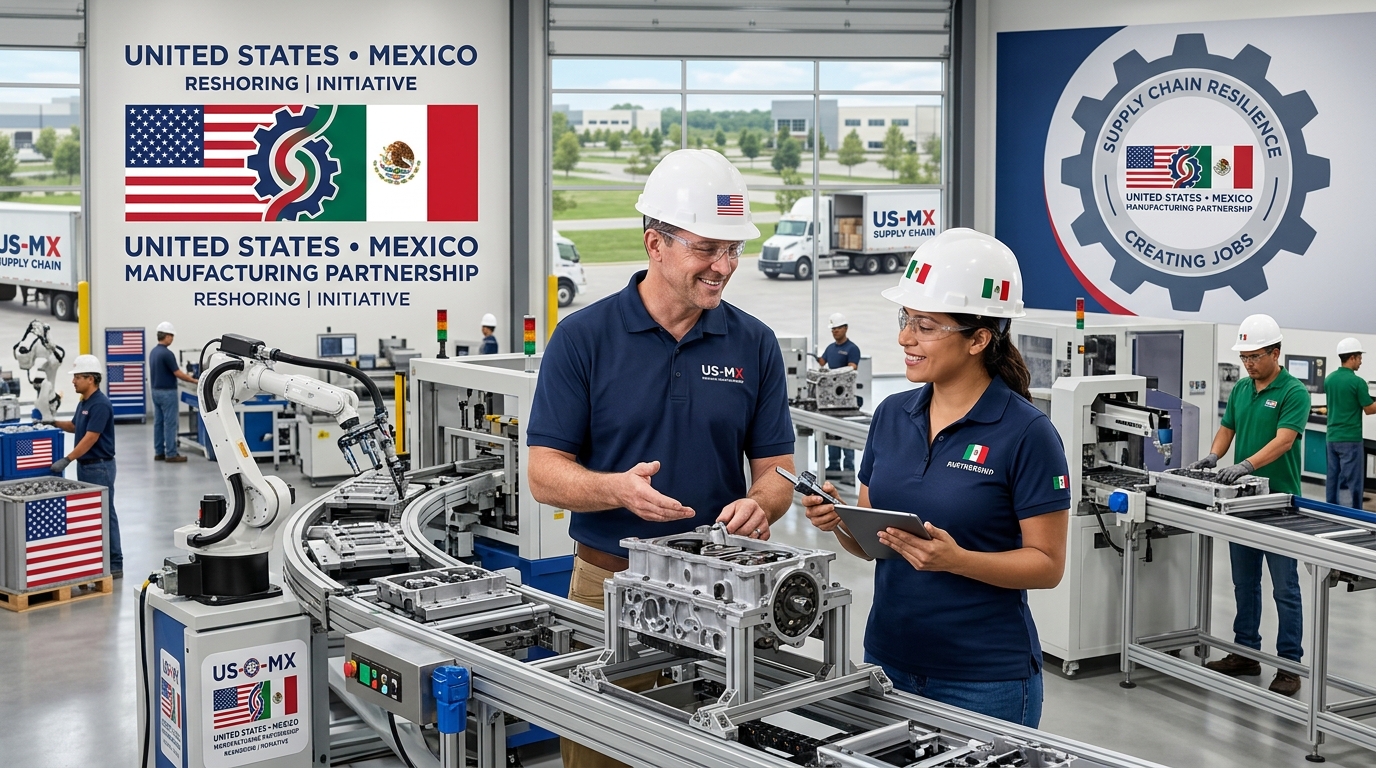
Why Reshoring Is Accelerating in 2026
The business case for reshoring has fundamentally changed. According to the Reshoring Initiative's 2024 Data Report, reshoring and FDI job announcements have stayed above 250,000 annually since 2022 — a historic high. Three forces are driving the shift:
- Tariff exposure: Section 301 tariffs on Chinese goods, combined with new 2025 trade actions, have erased the labor arbitrage for many product categories.
- Nearshoring economics: Mexico's manufacturing wages, paired with USMCA duty-free access, often beat landed cost from China when total cost of ownership is modeled honestly.
- Resilience demands: Post-pandemic buyers and retailers now score suppliers on lead time reliability, not just unit price.
For plastics programs specifically — injection molding, blow molding, thermoforming — the math has tipped decisively. Tooling is portable. Labor-to-material ratios are favorable. And Mexico's plastics cluster in Querétaro, Monterrey, and Tijuana has matured into a world-class ecosystem.
Phase 1: Strategic Assessment (Weeks 1–4)
Before you move a single mold, you need a clear-eyed view of what you're moving and why.
Build Your Product Portfolio Map
Not every SKU should come home. Classify your products along two axes:
| Category | Reshoring Priority | Rationale |
|---|---|---|
| High-volume, low-complexity plastics | Medium | Labor cost matters more; Mexico strong fit |
| Tooling-intensive injection molded parts | High | Tariff exposure + tooling portability |
| Low-volume, IP-sensitive components | High | Risk reduction outweighs cost delta |
| Commodity components with deep China supply | Low | Keep offshore or pursue China+1 |
Run a Total Cost of Ownership (TCO) Analysis
Landed cost is not total cost. A proper TCO model includes freight volatility, tariffs and duties, inventory carrying costs, quality failure rates, travel and oversight, IP risk, and lead-time penalties. We've seen clients discover that a product appearing 22% cheaper from China was actually 8% more expensive on a true TCO basis once all variables were modeled.
Choose Your Strategy: China+1 or Full Reshoring
Two dominant strategies have emerged:
- China+1: Maintain Chinese production while standing up a parallel line in Mexico or the US. Lower risk, slower savings.
- Full reshoring: Complete exit from China suppliers. Higher execution risk, maximum tariff and IP relief.
The right answer depends on your revenue concentration, tooling portfolio, and risk tolerance. For plastics programs with fewer than 15 active tools, full reshoring is typically achievable in 6–9 months.
Phase 2: Supplier Sourcing and Qualification (Weeks 4–10)
This is where most reshoring projects stall. Finding the right factory in Mexico or the US is not a Google search — it's a structured qualification process.
Define Your Manufacturing Requirements
Document specifications before you engage suppliers:
- Part geometry, tolerances, and material grades
- Annual volume and demand variability
- Secondary operations (assembly, printing, packaging)
- Certifications required (ISO 9001, IATF 16949, ISO 13485, FDA)
- Target PPAP or equivalent validation path
Deploy the Right Sourcing Document
Many buyers confuse RFI, RFQ, and RFP. Use each for its intended purpose:
| Document | Purpose | When to Use |
|---|---|---|
| RFI | Information gathering | Early market mapping |
| RFP | Solution proposal | Complex programs with design input |
| RFQ | Price and delivery quote | Mature specs, apples-to-apples pricing |
Vet Potential Suppliers Rigorously
Our best practices for vetting Mexican and US suppliers include on-site audits (not virtual), financial health checks, verification of machine capacity and uptime data, reference calls with three current customers, and review of quality systems documentation. Never award tooling transfer to a supplier you haven't physically visited.
Reshore's AI-powered supplier matching engine shortlists pre-vetted, verified manufacturers in the Americas based on your part geometry, volume, and certifications — which typically compresses this phase from 10 weeks to under 3.
Phase 3: Tooling Transfer (Weeks 8–16)
For plastics reshoring, the mold transfer is the critical path. Done wrong, you lose weeks and destroy tool life. Done right, it's uneventful.
Legal and Ownership Foundations
Before a mold leaves China, confirm clear ownership via your MSA, tooling agreements, and paid invoices. We've seen suppliers claim liens on tools they don't legally own — these disputes can freeze transfers for months. Engage Chinese legal counsel early if ownership is ambiguous.
The Physical Transfer
A typical mold transfer sequence:
- Tool inspection in China — dimensional validation, wear assessment, spare parts inventory
- Documentation package — 2D drawings, 3D models, process parameters, material specs
- Export logistics — customs classification, export licensing, ocean or air freight decision
- Import to Mexico or US — IMMEX program enrollment (Mexico) or duty drawback planning (US)
- Receipt inspection — damage assessment at destination
- Tool recommissioning — sampling, first article inspection, PPAP resubmission
Recommissioning and Validation
The new press is not the old press. Expect to re-tune process parameters: cycle times, cooling profiles, gate pressures. Budget 2–4 sampling rounds before production release. This is normal — and why experienced plastics engineers on the receiving side matter more than any line item in the quote.
Phase 4: Production Ramp and Stabilization (Weeks 14–26)
Dual-Source During Transition
Do not cut off China supply the day Mexican production starts. Maintain 8–12 weeks of parallel production to buffer against quality escapes during ramp. This inventory cushion is non-negotiable for customer-facing consumer goods and regulated medical devices.
Build a Quality Control Cadence
Establish weekly quality reviews for the first 90 days covering first-pass yield, customer complaints, and dimensional drift. Many issues surface only at volume — be ready to act fast.
Document the New Supply Chain
Update BOMs, approved supplier lists, country-of-origin declarations, and customs documentation. For USMCA duty-free treatment, you'll need regional value content calculations and certificates of origin.
Common Reshoring Mistakes to Avoid
From hundreds of client engagements, the most frequent pitfalls we see:
- Underestimating tooling condition — old molds often need refurbishment before transfer
- Skipping the on-site audit — virtual tours hide real problems
- Ignoring logistics timing — Chinese New Year and Golden Week still matter during transition
- Over-indexing on unit price — the cheapest quote is rarely the best TCO
- Neglecting IP protection in the new jurisdiction — file trademarks and patents in Mexico before production begins
- Launching without a dual-source buffer — creates customer-facing stockouts
- Poor internal change management — your engineering team needs to own the transition, not just procurement
For a deeper breakdown of each pitfall and how to sidestep it, see 10 Common Reshoring Mistakes and How to Avoid Them.
Industry-Specific Considerations
Consumer Goods
Consumer plastics programs — housewares, personal care packaging, toys — typically have the cleanest reshoring path. Mexico's Bajío region hosts dozens of consumer-goods molders with experience serving US retailers.
Medical Devices
Medical device manufacturers face additional regulatory complexity: FDA establishment registration, design history file transfers, supplier quality agreements, and — for Class II/III devices — potential 510(k) updates. Plan 12–18 months for medical device migrations rather than the typical 6–9.
Automotive and Industrial
USMCA regional content rules make Mexico particularly attractive for automotive plastics. IATF 16949 certification is non-negotiable; confirm it before engagement.
What a Typical Reshoring Engagement Looks Like
For a mid-sized plastics program (8–12 tools, $2–8M annual spend), expect the following rough timeline:
| Month | Milestone |
|---|---|
| 1 | Strategic assessment, TCO model, portfolio decisions |
| 2 | Supplier shortlisting and RFQs issued |
| 3 | Audits, supplier selection, contracts signed |
| 4–5 | Tooling transfer logistics and legal clearance |
| 5–6 | Recommissioning and PPAP |
| 6–8 | Dual-source production and ramp |
| 9 | China wind-down, full production in Mexico/US |
For a detailed week-by-week breakdown of what to expect at each stage, see the Reshoring Project Timeline guide.
Companies using Reshore's AI-coordinated process have compressed this to 4–6 months in the majority of engagements by parallelizing supplier vetting with TCO modeling and tool documentation.
Next Steps for Your Reshoring Initiative
If reshoring is on your 2026 roadmap, the single most valuable early action is a rigorous readiness assessment. Understand your tooling inventory, TCO baseline, and supplier risk profile before committing to timelines with your executive team.
We at Reshore offer a structured reshoring assessment that covers all three — typically completed in two weeks. Companies emerge with a prioritized product list, a validated TCO model, and a shortlist of qualified Americas-based manufacturers matched to their specifications.
The reshoring window is wide open in 2026, but capacity in the best Mexican plastics plants is filling quickly. The manufacturers who move first will lock in the best partners and the most favorable terms.
Frequently Asked Questions
Q: How long does a typical reshoring project take from decision to full production?
For most plastics programs with 5–15 tools, expect 6–9 months from strategic decision to full production in Mexico or the US, with a dual-source buffer running through month 9. Larger or regulated programs (medical devices, aerospace) typically require 12–18 months due to revalidation requirements.
Q: Is it cheaper to manufacture in Mexico or the United States?
Mexico is generally 15–35% less expensive than US production for labor-intensive plastic parts, due to lower manufacturing wages while still offering USMCA duty-free access. US production wins for highly automated processes, IP-sensitive components, or products where proximity to end customers reduces logistics cost enough to offset labor differences.
Q: What happens to my tooling if I reshore from China?
If you own the tooling outright — confirmed via tooling invoices, your manufacturing agreement, or a separate tooling addendum — your Chinese supplier is legally obligated to release the molds to you. In practice this sometimes requires formal written notice, a final payment structured as a release fee, or third-party logistics coordination to physically recover the tools. For programs where ownership is ambiguous, engage legal counsel before beginning the transfer conversation.
The physical transfer typically takes 8–12 weeks door-to-door: inspection and condition documentation in China, export licensing, ocean freight to a Mexican port (Manzanillo or Lázaro Cárdenas) or a US port of entry, then inland delivery to your new manufacturer. Air freight compresses the timeline to 2–3 weeks at roughly 5–8× the cost — worthwhile if production continuity is at risk.
Once the tool arrives, plan 2–4 sampling rounds before production release. Dimensional verification, process parameter re-tuning, and — for regulated programs — a full PPAP resubmission are standard steps. Reshore coordinates the full sequence: legal documentation, freight logistics, receiving inspection, and recommissioning support, so tooling transfer doesn't become the bottleneck in your overall program timeline.