
Mexican Supplier Certification Glossary: ISO, IATF, USMCA & More
May 18, 2026
Mexican Supplier Certification Glossary: ISO, IATF, USMCA & More
When US buyers begin sourcing from Mexico, one of the first walls they hit is a thicket of acronyms — IATF, IMMEX, OEA, NOM, USMCA Certificate of Origin. Each one represents a different dimension of risk that a supplier has (or hasn't) addressed: quality management, customs compliance, environmental controls, labor standards, or origin documentation that determines whether your goods cross the border duty-free.
This glossary is a practical reference for procurement leaders, quality engineers, and supply chain executives evaluating Mexican manufacturers. We at Reshore use these certifications daily when vetting plants for our clients, and we've structured the list to reflect how they actually matter in a sourcing decision — not just what the standard says on paper.
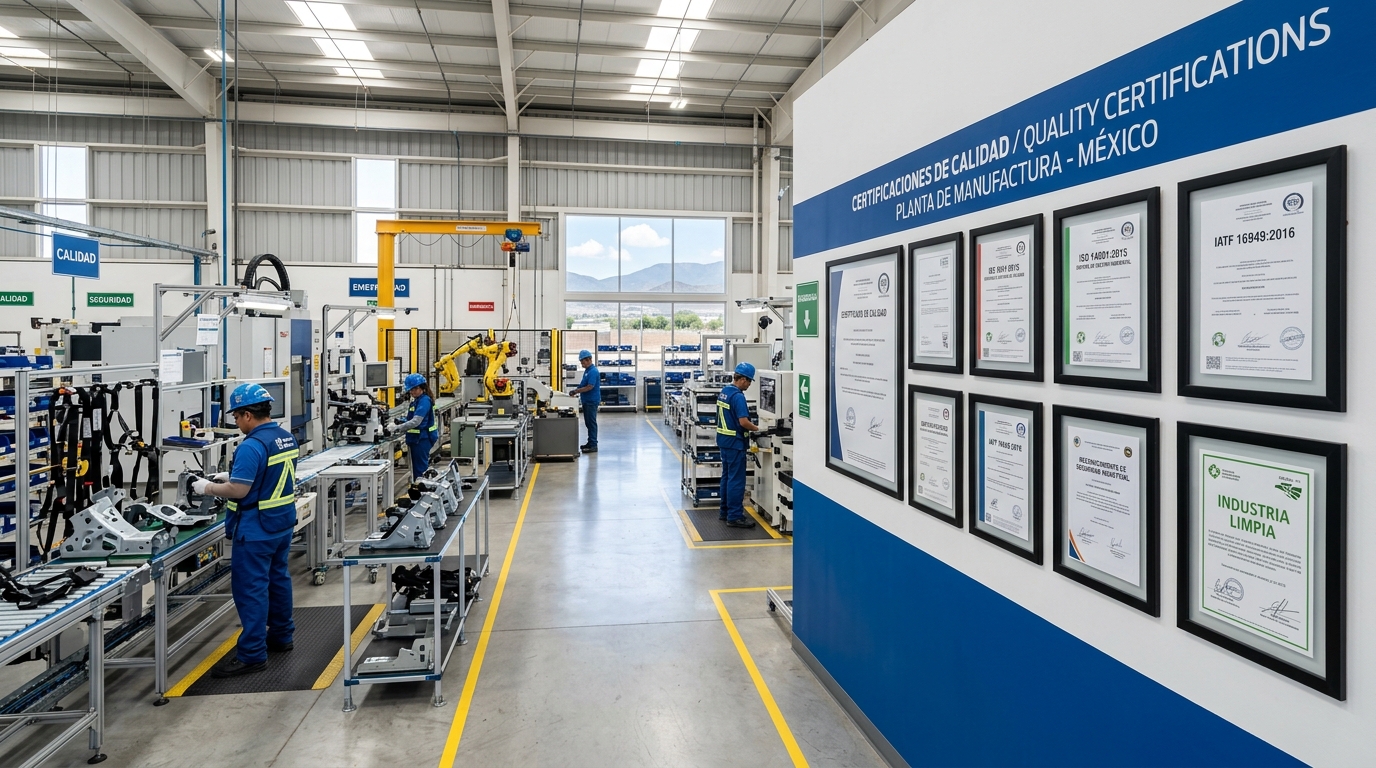
Why Certifications Matter More in Cross-Border Sourcing
In a domestic sourcing scenario, you can drive to a supplier, audit them in person, and resolve issues quickly. In nearshore manufacturing, certifications act as a first-pass filter — they tell you which suppliers have already submitted to independent third-party scrutiny on the dimensions you care about.
But certifications are necessary, not sufficient. A plant with IATF 16949 can still ship bad parts; a plant without ISO 9001 can still run a tight operation. Reshore recommends treating certifications as the entry ticket, then layering on operational due diligence — the kind we cover in our 12-step framework for qualifying Mexican manufacturers.
Quality Management Certifications
ISO 9001:2015 — Quality Management Systems
The baseline. ISO 9001 certifies that a manufacturer has documented processes for managing quality across design, production, and delivery. In Mexico, most contract manufacturers serving export markets carry ISO 9001. If a plant doesn't have it, that's a meaningful signal — not necessarily disqualifying, but it warrants a conversation about why.
What it actually means: The supplier has a written quality manual, performs internal audits, tracks nonconformities, and passes annual surveillance audits from a certification body.
What it doesn't guarantee: Defect-free parts. ISO 9001 audits process discipline, not part quality.
IATF 16949 — Automotive Quality Management
IATF 16949 is the automotive industry's quality standard, built on top of ISO 9001 with additional requirements around APQP, PPAP, FMEA, MSA, and SPC. For any supplier producing parts that go into a vehicle — Tier 1, Tier 2, or even Tier 3 components — IATF 16949 is effectively mandatory.
Mexico has one of the world's densest concentrations of IATF 16949-certified plants, particularly in Bajío (Guanajuato, Querétaro, Aguascalientes) and the northern border states (Coahuila, Nuevo León, Chihuahua). If you're sourcing automotive plastic parts, this is the floor.
Tip for buyers: Verify the certificate scope. A plant may be IATF certified for injection molding but not for assembly, or vice versa.
ISO 13485 — Medical Devices
Required for any supplier producing medical device components. Mexico's medical device manufacturing cluster, concentrated in Baja California (Tijuana, Mexicali) and Jalisco, is heavily ISO 13485-certified and serves a large portion of the FDA-regulated devices sold in the US.
AS9100 — Aerospace
The aerospace equivalent of IATF 16949. Querétaro is Mexico's aerospace hub, with a growing population of AS9100D-certified suppliers serving Bombardier, Safran, and tier-1 primes.
Environmental, Safety & Social Certifications
| Certification | What It Covers | When to Require It |
|---|---|---|
| ISO 14001 | Environmental management systems | OEM customers with sustainability mandates |
| ISO 45001 | Occupational health & safety | High-risk processes, large OEM buyers |
| ISO 50001 | Energy management | Energy-intensive operations (molding, metals) |
| SA 8000 | Social accountability / labor | Brands with ESG or labor-audit exposure |
| Clean Industry (PROFEPA) | Mexican federal environmental compliance | Any export-grade plant — increasingly expected |
The Clean Industry Certificate ("Industria Limpia") issued by Mexico's PROFEPA is a Mexico-specific environmental compliance attestation. It's voluntary but signals that the plant has been audited by federal environmental authorities and is in good standing — useful protection against the kind of regulatory shutdown that can blindside a US buyer. For plastics-specific compliance considerations, see our ISO certification guide for Mexico plastic manufacturers.
Customs, Trade & USMCA Certifications
This is where Mexican manufacturing certifications get genuinely unique — and where most US buyers underestimate complexity.
IMMEX (Maquiladora Program)
IMMEX is a Mexican federal program that allows manufacturers to temporarily import raw materials, components, and equipment duty- and VAT-free, provided the finished goods are exported. Roughly every serious export-oriented Mexican factory operates under IMMEX.
Why it matters to you: If your supplier doesn't have IMMEX, the duties and 16% VAT on inputs are baked into your unit price. If they do have IMMEX, you get a cleaner cost structure — but you also inherit some documentation obligations around proving export.
OEA (Operador Económico Autorizado)
Mexico's equivalent of the US C-TPAT program — an authorized economic operator certification issued by SAT (Mexican customs). OEA-certified suppliers get expedited customs clearance, fewer inspections, and lower risk of border delays.
For high-volume cross-border programs, sourcing from an OEA supplier can shave days off transit variance. We've seen border crossing times drop from 36 hours to under 8 for OEA shippers paired with C-TPAT importers.
USMCA Certificate of Origin
Not a certification of the plant — a certification of each shipment. Under the USMCA, goods that meet rules-of-origin thresholds qualify for duty-free entry into the US. Your supplier must be able to:
- Determine origin under the correct tariff classification
- Document regional value content (RVC) calculations
- Maintain supporting records for five years
- Issue a USMCA Certificate of Origin on demand
A supplier who fumbles USMCA documentation will cost you duty assessments and back-charges. Test this during qualification — ask for a sample certificate on a recent shipment.
NOM (Normas Oficiales Mexicanas)
Mandatory Mexican technical standards — the rough equivalent of US federal regulations. Most NOMs apply to goods sold in Mexico, but several relate to occupational safety inside the plant (NOM-STPS series) and matter when you're qualifying a supplier's working conditions.
Industry-Specific Certifications
UL, CSA, ETL (Electrical Safety)
Not Mexican certifications, but commonly held by Mexican producers of electrical components, appliances, and lighting destined for the US and Canadian markets.
FDA Registration
Required for medical device contract manufacturers shipping to the US. Mexican plants serving the device industry typically maintain FDA establishment registration alongside ISO 13485.
FSC, PEFC
Forestry stewardship certifications, relevant for packaging suppliers and any wood-content products.
NSF
Food-contact and water-system certifications, common in Mexican plastics suppliers producing housewares, food packaging, and appliance components.
Financial & Operational Attestations
Certifications don't cover everything you should care about. Financial health, IP protection, and operational resilience aren't certified by any standard body — they're discovered through due diligence. This is why Reshore pairs certification review with supplier risk scoring across financial, quality, and operational dimensions. Many of these blind spots overlap with the common red flags in Mexican sourcing that even certified plants can exhibit.
A plant can hold every ISO certificate on the wall and still be one bad month away from a payroll crisis that delays your tooling shipment. The certification stack is the start of the conversation, not the end.
How to Verify a Certification Is Real
Certificate fraud is rare but not unheard of. Three quick verifications:
- Check the certification body. A real certificate names the issuing registrar (e.g., DNV, SGS, TÜV, BSI). Look the registrar up on the IAF database to confirm accreditation.
- Verify the certificate number. Most major registrars have a public online lookup. Enter the certificate number and confirm scope, issue date, and status.
- Ask for the most recent surveillance audit report. Certificates are renewed annually; a supplier who can't produce the latest audit summary may be operating on an expired certificate.
Putting the Glossary to Work
Certifications are a sourcing filter, not a sourcing strategy. The work of matching your specific program — geography, volume, tooling, lead time, financial risk tolerance — to the right Mexican supplier is what determines whether nearshoring actually delivers margin and reliability.
Reshore's platform indexes Mexican manufacturers by industry, process, and certification, then layers AI-driven matching against your specific tooling, volume, and timeline. If you're evaluating a move from China to Mexico, the certifications above are the vocabulary. Translating them into a working supply base is the next step.
Frequently Asked Questions
Q: What is the difference between ISO 9001 and IATF 16949 for Mexican suppliers?
ISO 9001 is the general-purpose quality management standard that applies to any industry, while IATF 16949 is the automotive-specific extension that builds on ISO 9001 with additional requirements around production part approval (PPAP), advanced product quality planning (APQP), and statistical process control. Any Mexican supplier producing automotive components for OEMs or Tier 1s should hold IATF 16949 — ISO 9001 alone is insufficient for the automotive supply chain.
Q: Is USMCA certification required for every shipment from Mexico to the US?
No — USMCA certification is only required when you want to claim duty-free preferential treatment under the agreement. Goods can still cross the border without it, but they'll be assessed standard MFN tariffs. For most plastic and manufactured goods originating in Mexico with sufficient regional value content, the duty savings make USMCA documentation essential.
Q: How do I verify that a Mexican manufacturer's ISO certification is current?
Check the certification body listed on the certificate (DNV, SGS, BSI, TÜV, etc.) and use their public certificate lookup tool, or search the IAF CertSearch database for accredited certifications. Always confirm the certification scope — a plant may be certified for one process but not another — and request the latest surveillance audit report, which is conducted annually.
Q: What is IMMEX and why does it matter for US buyers sourcing from Mexico?
IMMEX is a Mexican federal program that lets manufacturers import raw materials and components duty- and VAT-free as long as the finished products are exported. For US buyers, sourcing from an IMMEX-certified plant typically means cleaner unit pricing because the supplier isn't passing through Mexican import duties and the 16% VAT on inputs.
Q: Does Reshore verify supplier certifications as part of its sourcing process?
Yes — Reshore's platform validates certifications during supplier onboarding and matches buyers to manufacturers based on industry-specific requirements like IATF 16949 for automotive, ISO 13485 for medical, and AS9100 for aerospace. We also layer on financial and operational due diligence that certifications alone don't address, including IP protection assessments for buyers transitioning from Chinese suppliers.
Q: What certifications should a Mexican plastic injection molder hold at minimum?
At minimum, ISO 9001:2015 for general quality management and IMMEX registration for cross-border efficiency. Depending on the end market: IATF 16949 for automotive parts, ISO 13485 for medical components, ISO 14001 for buyers with sustainability mandates, and AS9100 for aerospace. OEA certification is a strong plus for any plant doing high-volume cross-border shipments.
Q: How long does it take a Mexican manufacturer to obtain IATF 16949 certification?
For a plant that already holds ISO 9001 and has automotive-grade processes in place, IATF 16949 typically takes 9 to 14 months from project kickoff to certification, including the Stage 1 and Stage 2 audits. Plants starting from scratch on quality systems can take 18 to 24 months. This is why buyers shouldn't expect non-automotive Mexican plants to pivot quickly into automotive supply.
Q: Can a Mexican supplier without ISO 9001 still be a good fit for nearshore manufacturing?
Yes, particularly for smaller programs, prototyping, or low-risk commercial goods where the cost of certification overhead would inflate unit pricing. But the absence of ISO 9001 raises the burden of operational due diligence — you'll need to inspect quality processes directly, set up tighter incoming inspection on your side, and consider whether the supplier can scale with your program. For regulated industries or large volumes, certifications are non-negotiable.