
The State of Embedded Finance in B2B Manufacturing: 2026 Report
May 18, 2026
The State of Embedded Finance in B2B Manufacturing: 2026 Report
Embedded finance has quietly become the connective tissue of cross-border manufacturing. What started as a fintech experiment — credit, payments, and insurance offered inside non-financial software — is now the operating layer beneath some of the largest nearshoring programs running between the US and Mexico. This report compiles the most recent data, transaction trends, and adoption signals from the past 12 months to give procurement leaders, CFOs, and supplier-side finance teams a grounded view of where embedded B2B finance stands in 2026.
We at Reshore see this shift up close. Every reshoring program we coordinate — from [tooling transfer](tooling transfer) to first-shipment financing — touches a stack of embedded credit, factoring, and payment rails that simply didn't exist five years ago. This dataset is meant to inform how you build your own [working capital strategy](working capital strategy) around that new reality.
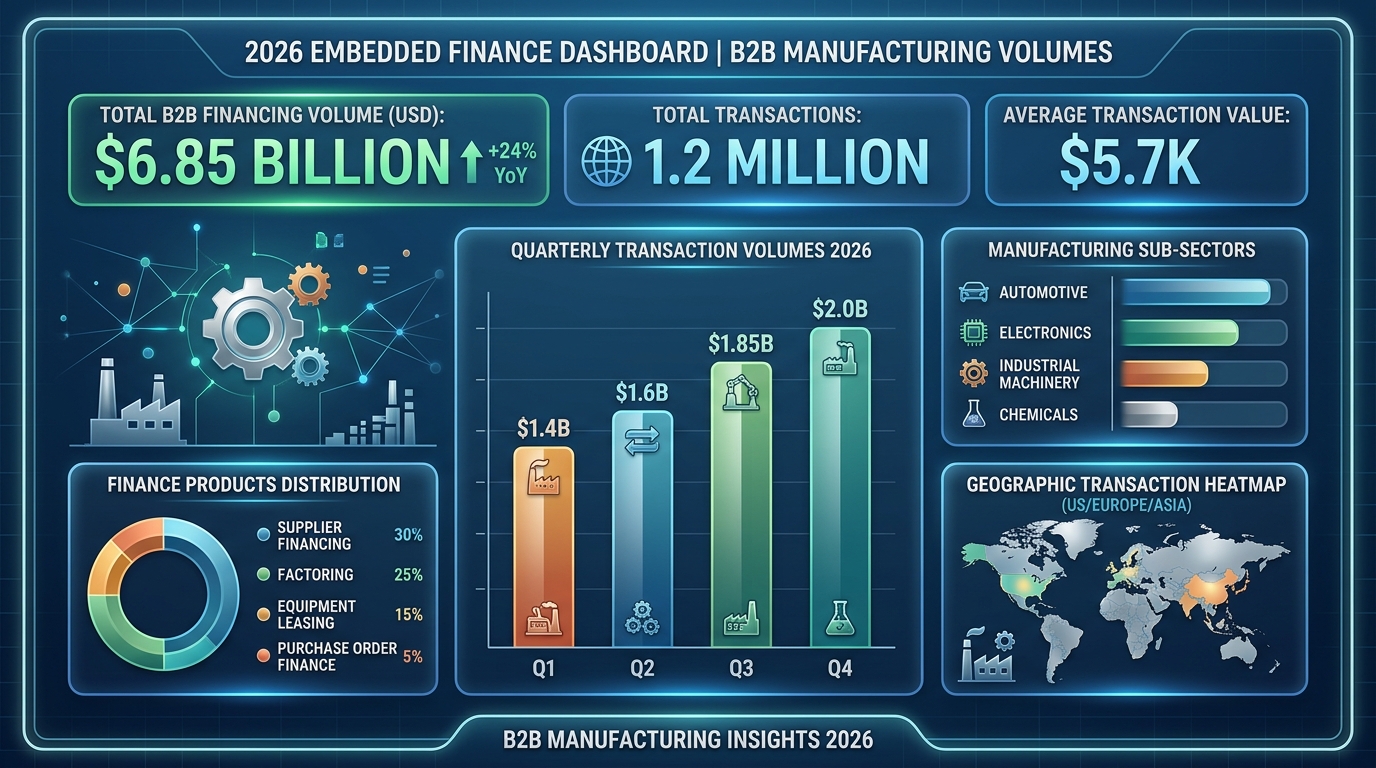
Headline Numbers: Embedded Finance in B2B Manufacturing, 2026
The headline figures below synthesize data from Bain & Company's embedded finance tracking, McKinsey's Global Payments Report, and platform-level disclosures from the largest B2B finance providers.
| Metric | 2024 | 2025 | 2026 (YTD) | YoY Change |
|---|---|---|---|---|
| Global embedded B2B finance revenue | $21B | $32B | $46B | +44% |
| Share of B2B payments routed through embedded platforms | 11% | 17% | 24% | +7 pts |
| Manufacturers using embedded PO financing | 14% | 22% | 31% | +9 pts |
| Average time-to-funding (PO to cash) | 11 days | 6 days | 3.2 days | -47% |
| [Mexican suppliers](Mexican suppliers) enrolled in US-buyer SCF programs | ~38,000 | ~71,000 | ~118,000 | +66% |
| Reverse factoring volume on US-MX trade lanes | $14B | $24B | $39B | +63% |
Sources: Bain & Company, McKinsey Global Payments Report, Banxico cross-border data, and platform disclosures from Taulia, C2FO, and Marco.
The single most important data point: 24% of B2B manufacturing payments now flow through embedded rails, more than double 2024's share. Embedded finance is no longer a fringe tool — it's mainstream working capital infrastructure.
Adoption by Use Case
Not all embedded finance products are growing at the same rate. The data shows clear winners — and a few categories that have plateaued.
| Use Case | Adoption Rate (Mfg.) | 12-Mo Growth | Primary Buyer |
|---|---|---|---|
| Reverse factoring / SCF | 38% | +41% | Tier-1 US buyers |
| Embedded PO financing | 31% | +52% | Mid-market importers |
| Invoice factoring (embedded) | 44% | +18% | Mexican suppliers |
| Dynamic discounting | 19% | +29% | CFO-led programs |
| Embedded FX hedging | 12% | +88% | Cross-border treasurers |
| Embedded trade credit insurance | 9% | +34% | New supplier onboarding |
Embedded FX hedging is the fastest-growing category — unsurprising given peso/dollar volatility in 2025–2026 and the operational drag that unhedged exposure puts on Mexican supplier margins. Reverse factoring remains the volume leader because it solves the most expensive problem on the table: extending Net 60 or Net 90 terms to a Mexican supplier without crushing their cash position.
For a deeper conceptual overview, see our companion piece What Is Embedded Finance for Manufacturing? A 2026 Primer and the side-by-side breakdown in Embedded Finance vs. Traditional Trade Finance: Side-by-Side.
The US-Mexico Corridor: Where the Money Is Moving
USMCA-aligned trade flows are the single largest growth driver in embedded B2B finance this year. According to Banxico and US Census Bureau trade data, US imports from Mexico crossed $560B in 2025 and are pacing to exceed $610B in 2026. Roughly one in four of those dollars is now financed through some form of embedded credit instrument before it reaches the supplier's bank account.
Where Mexican Suppliers Are Getting Financed
- Bajío corridor (Guanajuato, Querétaro, Aguascalientes): Highest concentration of embedded SCF program enrollment, driven by automotive Tier-1s.
- Monterrey / Nuevo León: Largest invoice factoring volumes, with deep penetration into industrial equipment and plastic injection suppliers.
- Tijuana / Mexicali: Fastest growth in PO financing for electronics and medical device contract manufacturers.
- Jalisco: Emerging hub for embedded finance in consumer plastics and appliances.
For procurement leaders mapping suppliers against financing readiness, our Mexico Plastic Manufacturing Hub Directory and Mexico Manufacturing Hubs Directory: Cities, Specialties & Costs break this down by region and capability.
Time-to-Funding by Lane
| Trade Lane | Avg. Days (PO to Funded) | Typical Discount Rate |
|---|---|---|
| US buyer → US supplier | 2.8 days | SOFR + 2.1% |
| US buyer → Mexican supplier (USMCA-compliant) | 3.4 days | SOFR + 3.0% |
| US buyer → Mexican supplier (non-USMCA) | 7.1 days | SOFR + 4.6% |
| US buyer → China supplier | 12.5 days | SOFR + 5.8% |
USMCA documentation is no longer just a duty-free benefit — it's a financing accelerant. Suppliers with clean USMCA paper get funded roughly four days faster and at 160 bps lower spreads than non-compliant peers. This is one of the under-discussed reasons that reshoring programs have economics that compound over time: the longer you operate in the corridor, the cheaper your working capital becomes.
Platform Market Map: Who's Winning in 2026
The competitive landscape has consolidated meaningfully over the past 18 months. We track three tiers of providers:
Tier 1 — Enterprise SCF Platforms
Taulia (SAP), Kyriba, PrimeRevenue, C2FO. These handle the largest reverse factoring and dynamic discounting programs for buyers with $1B+ in annual COGS.
Tier 2 — Mid-Market & Embedded-Native
Marco, Stenn, Tradeshift, Resolve, Slope. Focused on mid-market importers ($50M–$1B revenue) with API-first integration and faster onboarding for Mexican suppliers.
Tier 3 — Vertical & Cross-Border Specialists
Konfío, Mundi, Drip Capital, Nuvocargo Finance. Mexico-headquartered or LatAm-focused; deepest penetration in peso-denominated factoring and FX-embedded invoice products.
A fuller breakdown is available in our platform-by-platform market map.
What's Changed Since 2024
Three structural shifts define the 2026 landscape:
API-first onboarding has collapsed supplier enrollment time from weeks to hours. Mexican suppliers can now be qualified, KYB'd, and enrolled in a US buyer's SCF program in under 48 hours — versus 3–6 weeks in 2023.
Buyer-funded vs. third-party-funded models are merging. The cleanest 2026 programs let the buyer choose dynamically: self-fund early payment when cash is available, route to a third-party funder when it isn't, on an invoice-by-invoice basis.
Embedded FX is now table stakes for cross-border programs. In 2024, fewer than 5% of SCF programs offered peso-denominated payouts with embedded hedging. In 2026, more than 30% do — and Mexican suppliers increasingly require it as a condition of accepting extended terms.
What This Means for Reshoring Programs
If you're moving production out of China and into Mexico, the financing layer is no longer something you bolt on after the factory is selected. It's part of the supplier qualification process itself. A factory that can integrate with embedded SCF rails is a factory that can absorb your payment terms without raising prices to cover their cost of capital. A factory that can't, isn't.
This is why we treat finance-readiness as a qualifying dimension alongside tooling capability, certifications, and capacity. Our Supplier Qualification Checklist: 40 Questions Before You Sign includes a full finance and treasury module, and our [reshoring program](reshoring program) assessments evaluate candidate factories on whether they're enrolled in — or eligible for — the major embedded SCF networks.
The cost-of-capital arbitrage is real: a Mexican supplier financed at SOFR + 3% can quote you tighter than the same supplier financed informally at peso-rate factoring of 18–24%. Across a multi-million-dollar program, that's a margin difference of several hundred basis points — money that either stays with you, stays with the supplier, or disappears into the cost of cash.
Frequently Asked Questions
Q: What is the embedded finance report most useful for?
This report is most useful for CFOs, treasurers, and procurement leaders building or refinancing a cross-border supplier program. It quantifies how fast embedded credit is replacing traditional trade finance, where the cost savings are concentrated, and which trade lanes (especially USMCA) are getting funded fastest.
Q: How does embedded finance differ from traditional supply chain finance?
Traditional supply chain finance lives inside a bank's portal and typically requires weeks of supplier onboarding plus separate documentation for each transaction. Embedded finance sits inside the procurement or ERP system the buyer already uses, with API-driven enrollment and invoice-level funding decisions made in hours rather than weeks.
Q: What are the most important B2B manufacturing finance trends in 2026?
Three trends dominate: API-first supplier onboarding collapsing enrollment from weeks to hours, embedded FX hedging becoming standard on US-Mexico programs, and USMCA-compliant suppliers receiving meaningfully better financing terms than non-compliant ones. Together they're making nearshore production cheaper to capitalize than offshore.
Q: Why is the US-Mexico corridor growing faster than other trade lanes?
USMCA documentation reduces both duty exposure and credit risk, which translates directly into lower financing spreads and faster funding cycles. Combined with the structural reshoring trend pulling supply chains out of China, this has made Mexico the fastest-growing destination for embedded B2B finance volume in the world.
Q: How does Reshore evaluate a Mexican factory's financing readiness?
Reshore evaluates factories on whether they're enrolled in major embedded SCF networks, their existing factoring relationships, their USMCA documentation discipline, and their ability to accept Net 30/60/90 terms without raising unit prices to cover cost of capital. We treat this as a core qualifying dimension, not a post-selection concern.
Q: Do embedded finance platforms work for small Mexican suppliers?
Increasingly, yes. Tier 2 and Tier 3 platforms like Marco, Mundi, Konfío, and Stenn have specifically built onboarding flows for SMB Mexican manufacturers, with thresholds as low as $25K–$50K in monthly invoice volume. The constraint is usually documentation quality, not size.
Q: How much can embedded finance save versus traditional bank factoring?
For US-Mexico trade lanes, the typical savings are 150–300 basis points on financing spreads, plus 4–7 days of working capital cycle time. On a $10M annual program, that can translate to $200K–$400K of direct cost savings, before counting the operational gains from faster supplier onboarding.
Q: Is embedded finance worth implementing for a company just starting to reshore?
For companies in the early stages of reshoring, building an embedded finance layer into the supplier program from day one is significantly easier than retrofitting it later. The supplier qualification, contract terms, and ERP integration choices you make in the first six months will determine which financing options stay available to you in years two and three.