
Embedded Finance for B2B Manufacturing
May 18, 2026
Embedded Finance for B2B Manufacturing
Manufacturing has always been a capital-intensive business, but the cash flow choreography behind it — purchase orders, deposits, work-in-progress, freight, customs, invoices, net terms — has historically been managed through a patchwork of banks, factors, and spreadsheets. Embedded finance is changing that. In 2026, the financing layer is increasingly built directly into the procurement, ERP, and supplier management platforms that manufacturers already use to run their operations.
For US companies reshoring production from China to Mexico, this shift matters more than most realize. The working capital gap between issuing a PO to a Mexican factory and shipping finished goods across the border is where many nearshoring programs stall — not because the unit economics don't work, but because no one funded the middle. This guide explains what embedded finance is, how it applies to B2B manufacturing, and where it fits into a cross-border production strategy.
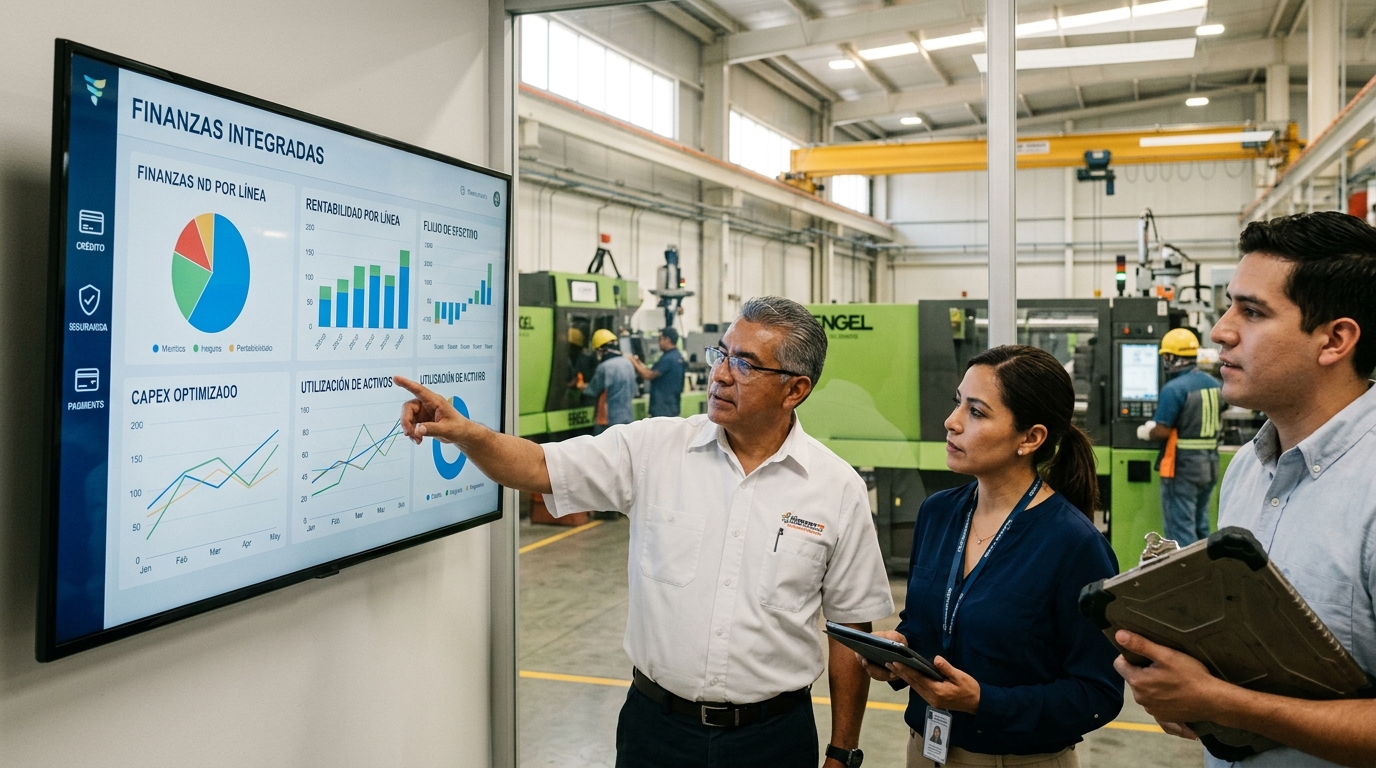
What Is Embedded Finance for Manufacturing?
Embedded finance refers to financial services — credit, payments, insurance, FX hedging — delivered inside a non-financial software product at the moment of need. In a B2B manufacturing context, that means:
- A procurement platform offering instant PO financing when a buyer issues a purchase order
- An ERP system extending net-90 terms to a supplier with the click of a button, while the supplier gets paid net-10
- A sourcing marketplace bundling freight, customs, and trade credit into a single line item on the quote
- A supplier portal letting a Mexican factory advance-discount specific invoices without setting up a separate factoring relationship
The defining feature is that the financing decision happens inside the operational workflow, not in a separate bank application. Underwriting is informed by the transactional data the platform already holds — order history, on-time delivery rates, invoice dispute frequency, certifications — which is often a richer signal than the financial statements a traditional lender would request. For readers who want a deeper conceptual grounding, our introductory primer on embedded manufacturing finance walks through the underlying mechanics.
This is a structural departure from traditional trade finance, where a CFO opens a relationship with a bank, negotiates a facility, and pulls on it through a separate set of documents and approvals.
Embedded Finance vs. Traditional Trade Finance: Side-by-Side
| Dimension | Traditional Trade Finance | Embedded Finance |
|---|---|---|
| Onboarding | Weeks to months; bank KYC, audited financials | Hours to days; data already in platform |
| Underwriting basis | Balance sheet, collateral, guarantees | Transactional data, behavioral signals, platform reputation |
| Cost transparency | Quoted per facility, often opaque | Per-transaction, displayed at point of decision |
| Integration | Manual reconciliation, separate systems | Native to ERP/procurement/marketplace |
| Best suited for | Large, recurring, high-ticket exposures | Mid-market volume, episodic needs, supplier-level flexibility |
| Cross-border friction | High — separate FX, documentation, correspondent banks | Often abstracted by the platform |
Neither model replaces the other. Large enterprises still rely on syndicated trade facilities and structured letters of credit for top-of-house exposures. But for the mid-market manufacturer running 20 to 200 active supplier relationships, embedded finance is closing the gap where banks were never going to show up. We've built out a more detailed head-to-head comparison of these two financing models if you want to see the trade-offs at a granular level, and a broader overview of trade finance instruments available to manufacturers for context on the traditional side.
Where Embedded Finance Fits in a Nearshoring Program
The cash conversion cycle for a US company sourcing from a Mexican factory typically runs 90 to 150 days from PO to receivables collection on the end product. That window contains several distinct financing needs:
1. PO Financing at Issuance
When a US buyer issues a PO to a Mexican manufacturer, the factory needs to procure resin, tooling adjustments, labor, and overhead well before the first invoice is issued. Embedded PO financing — offered through the sourcing platform that hosted the RFQ — lets the supplier draw against the confirmed PO at competitive rates, secured by the buyer's creditworthiness rather than the supplier's.
2. Work-in-Progress Funding
Long production runs, especially in injection molding where tooling commissioning can take 8 to 12 weeks, create exposure that neither party wants to carry. Milestone-based draws against work completed — verified by inspection data flowing through the platform — keep both parties liquid.
3. Invoice Factoring and Dynamic Discounting
Once goods ship and an invoice is raised, the supplier can either factor the invoice for immediate cash or accept a dynamic discount in exchange for early payment from the buyer. Embedded into the AP workflow, this becomes a two-click decision instead of a separate vendor relationship.
4. Cross-Border FX and Settlement
Peso/dollar volatility can erase margin between PO and payment. Embedded FX hedging — locked at the moment a PO is confirmed — removes a variable that has historically required a separate treasury workflow.
Why This Matters for Reshoring Decisions
We at Reshore see embedded finance as a load-bearing piece of the reshoring thesis, not a nice-to-have. Here's why: when a US importer is comparing a known Chinese supplier against a new Mexican one, the variable that often kills the deal isn't unit cost or quality — it's the supplier's ability to hold the working capital. Chinese exporters have spent two decades building relationships with state banks and export credit agencies that subsidize their float. A newer Mexican supplier in Guanajuato or Querétaro may have equivalent technical capability and a structurally lower delivered cost, but no comparable financing infrastructure.
Embedded finance neutralizes this gap. When the financing rides on the buyer's PO and the platform's data, rather than the supplier's standalone balance sheet, a mid-sized Mexican injection molder can compete on terms that previously only Chinese incumbents could offer. To put numbers behind this, you can model the working capital impact in our embedded finance savings calculator built for manufacturers.
This is also why financial qualification has to sit alongside operational qualification when evaluating suppliers. Our 12-step framework for qualifying Mexican manufacturing suppliers treats access to working capital — whether through embedded platforms, regional banks, or factor relationships — as a first-class screening criterion.
Embedded B2B Finance Market Map: Categories to Know
The embedded finance landscape for manufacturing breaks into a few distinct categories:
- Procurement-native lenders: Embedded into sourcing platforms and marketplaces, offering PO financing at the point of order.
- AP/AR automation platforms with credit: Tools that started in invoice automation and added supplier early payment programs.
- ERP-embedded working capital: Modules inside NetSuite, SAP, and similar systems that surface financing options against live transactional data.
- Cross-border specialists: Platforms purpose-built for US-Mexico, US-Vietnam, or other corridor flows, bundling FX, customs, and trade credit.
- Reverse factoring platforms: Buyer-led programs where the buyer's investment-grade credit is used to finance an entire supplier base at favorable rates.
For a US buyer running a nearshoring program, the right architecture is usually a combination — a reverse factoring backbone for high-volume suppliers, PO financing for new or smaller Mexican factories, and dynamic discounting layered on top to capture early payment savings. For a full vendor breakdown by category, see our market map of key embedded B2B finance players and use cases.
Practical Considerations Before Adopting
Embedded finance is not free, and the convenience can obscure the all-in cost. Before integrating these tools into a reshoring program, work through:
- Effective APR vs. nominal fee. A 1.5% fee on a 30-day advance is roughly 18% annualized. That's competitive with some unsecured lines and expensive vs. a drawn revolver.
- Recourse vs. non-recourse structure. Who carries the loss if the buyer doesn't pay? This affects how the financing shows up on the supplier's balance sheet.
- Off-balance-sheet treatment. Reverse factoring has come under accounting scrutiny (IFRS and FASB updated disclosure rules in recent years). Confirm treatment with your auditor before scaling.
- Concentration risk. If a single embedded platform funds 60% of your supplier base, you've created a new dependency. Diversify.
- Data portability. Underwriting that depends on platform-resident data can lock suppliers in. Make sure your suppliers can export their performance history.
How Reshore Approaches the Financing Layer
When we coordinate a reshoring program — tooling transfer from a Chinese facility to a partner factory in Mexico, supplier matching, qualification, ramp — financing is treated as part of the operational design, not a separate workstream. That means structuring POs, milestones, and invoice cadence in ways that are friendly to embedded financing products, and qualifying suppliers on whether they can plug into those products at all. For broader industry context on adoption rates and trends, our 2026 state-of-the-industry report on embedded finance in B2B manufacturing is a useful companion read.
For plastic manufacturing and injection molding specifically, where tooling timelines and resin price volatility create predictable working capital pressure, this integration is what separates a reshoring program that ships on time from one that gets stuck waiting for the next deposit.
If you're evaluating whether your existing China-based production can move to Mexico — and want a clear-eyed view of the operational, qualification, and financing pieces together — we can walk you through it.
Frequently Asked Questions
Q: How is embedded finance different from a traditional line of credit?
A traditional line of credit is a standalone facility negotiated with a bank, drawn against the borrower's balance sheet, and managed in a separate system. Embedded finance delivers credit inside the operational platform — procurement, ERP, marketplace — and underwrites against transactional data rather than balance-sheet collateral. The result is faster onboarding, transaction-level pricing, and access for suppliers who would not qualify for bank credit on their own.
Q: Can a small Mexican manufacturer actually access embedded finance, or is it only for large suppliers?
Embedded finance is often more accessible to small and mid-sized Mexican manufacturers than traditional bank credit, because the underwriting leans on the US buyer's creditworthiness and the supplier's platform performance data. A factory in Querétaro with 80 employees and no audited financials can frequently access PO financing through a sourcing platform that would be impossible to obtain from a regional bank.
Q: What's the typical cost of embedded PO financing for US-Mexico trade?
Costs vary widely by structure, volume, and risk profile, but transaction fees in the range of 1% to 3% per 30-day period are common for PO financing and invoice factoring in this corridor. Reverse factoring backed by an investment-grade US buyer can be significantly cheaper, sometimes pricing close to the buyer's own cost of capital plus a small platform spread.
Q: Does Reshore offer financing directly?
Reshore is not a lender. We focus on the operational side of relocating manufacturing from China to Mexico — tooling transfer, factory sourcing, supplier qualification, and production setup — and we structure programs so they integrate cleanly with the embedded finance and trade credit providers our clients choose to work with.
Q: How does embedded finance handle peso/dollar FX risk?
Many embedded finance platforms targeting US-Mexico trade now bundle FX hedging into the financing product itself, locking the exchange rate at the moment a PO is confirmed and settling in the supplier's preferred currency. This removes one of the biggest variables in cross-border margin calculations, though hedging costs should be evaluated as part of the all-in financing cost.
Q: Is embedded finance considered debt on the buyer's balance sheet?
It depends on the structure. Standard PO financing extended to suppliers typically does not appear on the buyer's balance sheet. Reverse factoring programs, however, have been subject to increased disclosure requirements from both FASB and IFRS, and in some structures may need to be reclassified from trade payables to debt. Always confirm treatment with your auditor before scaling.
Q: When should I use embedded finance vs. asking my bank for a trade facility?
Use a bank trade facility for large, recurring, predictable exposures where the cost of capital matters more than speed — typically your top 10 to 20 supplier relationships by volume. Use embedded finance for episodic needs, new supplier onboarding, the long tail of mid-sized suppliers, and any situation where speed of decision is more valuable than a few basis points of cost.
Q: How does embedded finance affect supplier qualification in a reshoring program?
It changes the calculus significantly. Suppliers who would previously have been disqualified for thin balance sheets or limited banking relationships become viable if they can access PO financing through a platform. This expands the addressable supplier base in Mexico, particularly in newer industrial clusters where traditional trade finance infrastructure is still developing.