
The 2026 Manufacturer's Guide to Trade Finance Instruments
May 18, 2026
The 2026 Manufacturer's Guide to Trade Finance Instruments
For US manufacturers [reshoring production from China to Mexico](reshoring production from China to Mexico), the financial mechanics of a deal often matter more than the sourcing decision itself. A factory you can't pay on time is a factory you can't use. A purchase order you can't fund is a purchase order that never ships. As [nearshoring accelerates under USMCA](nearshoring accelerates under USMCA) and capital costs remain elevated, trade finance has shifted from a back-office line item to a strategic lever — one that determines which suppliers you can engage, how fast you can scale a program, and how much of your unit margin actually survives the trip across the border.
This guide walks through the core trade finance instruments available to manufacturers in 2026: letters of credit, purchase order financing, invoice factoring, supply chain finance, and the new generation of embedded working capital products. We'll cover what each one does, when to use it, and what it costs — with a specific lens on cross-border US–Mexico production. For a broader orientation to the discipline, our introduction to trade finance for manufacturers provides the foundational framework this guide builds on.
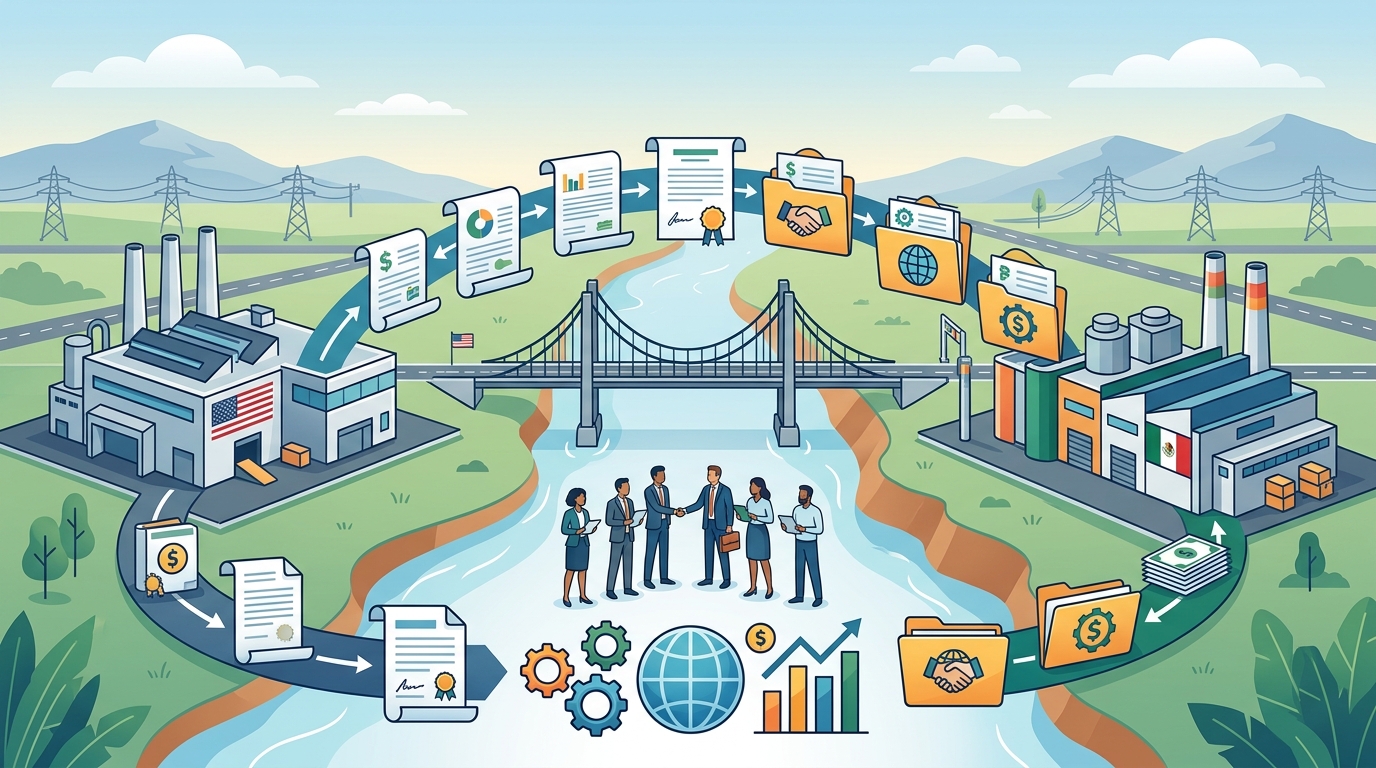
Why Trade Finance Matters More in a Reshoring Era
The classic challenge in cross-border manufacturing is the cash flow gap. A Mexican supplier may need 30 to 60 days to procure raw materials and produce goods. Freight, customs clearance, and final delivery add another 7 to 21 days. The US buyer then typically pays on Net 30 to Net 90 terms after receipt. End to end, suppliers can wait 90 to 180 days from PO issuance to cash in the bank.
That gap has to be financed by someone. The question of who finances it — the supplier, the buyer, a bank, a factor, or an embedded platform — is the question trade finance answers. Get it right, and you unlock supplier capacity, extend your own [days payable outstanding](days payable outstanding) (DPO), and accelerate program ramp. Get it wrong, and you'll watch promising suppliers walk away from your RFQ because they can't carry your working capital on their balance sheet.
According to the International Chamber of Commerce's 2024 Trade Register, trade finance instruments fund roughly 80% of global merchandise trade — but adoption among small and mid-sized manufacturers lags significantly, especially in cross-border production scenarios.
The Core Trade Finance Instruments in 2026
1. Letters of Credit (LCs)
A letter of credit is a bank's irrevocable promise to pay a supplier once specified shipping and documentary conditions are met. The buyer's bank issues the LC; the supplier's bank confirms and pays against compliant documents.
Best for: First-time supplier relationships, high-ticket orders ($250K+), and jurisdictions where direct credit risk is hard to underwrite.
Drawbacks: Document-heavy, slow (5–10 business days to issue), and expensive (typically 0.75%–3% of LC value per annum, plus issuance and amendment fees). LCs also tie up a portion of the buyer's bank credit line.
For US–Mexico flows under USMCA, LCs are increasingly seen as overkill for established suppliers — but they remain a useful tool when you're qualifying a new factory and want a bank's documentary discipline enforcing the transaction.
2. Purchase Order (PO) Financing
PO financing advances funds to a supplier — or directly to the supplier's raw materials vendors — based on a verified PO from a creditworthy buyer. The lender is repaid when the buyer pays the resulting invoice.
Best for: Suppliers without strong balance sheets who have a large order from a creditworthy buyer. Common scenario: a Monterrey injection molder lands a $1.2M PO from a US consumer goods brand but doesn't have the resin or tooling capital to fulfill it.
Cost: Typically 2.5%–6% per month on the financed amount — expensive, but often the only way to unlock production from a capacity-constrained supplier.
3. Invoice Factoring
After a supplier ships and invoices, they sell the receivable to a factor at a discount (typically 1%–4% of face value) for immediate cash. The factor collects from the buyer at maturity.
Best for: Mexican manufacturers needing to convert receivables to cash quickly to fund the next production cycle. Recourse vs. non-recourse factoring affects who absorbs default risk.
4. Supply Chain Finance (Reverse Factoring)
In supply chain finance (SCF), the buyer initiates a program with a bank or fintech platform. Approved suppliers can choose to receive early payment on approved invoices at a discount keyed to the buyer's credit rating — usually far cheaper than the supplier could borrow on its own.
Best for: Large US importers wanting to extend their DPO from Net 30 to Net 60 or Net 90 while giving suppliers a low-cost early payment option. This is the workhorse instrument of strategic working capital management.
Why it's powerful in nearshoring: A US buyer with an investment-grade rating can effectively transfer its cheap cost of capital to a Mexican supplier whose local borrowing rate may be 14%–18% in pesos. Everyone wins.
5. Dynamic Discounting
A self-funded cousin of SCF: the buyer uses its own cash to pay suppliers early in exchange for a discount on the invoice. No bank required. Returns on excess cash often exceed treasury yields.
Best for: Cash-rich buyers looking to deploy idle balance sheet capacity into supplier relationships.
6. Embedded Finance
The newest category: working capital products built directly into B2B platforms, ERPs, and procurement tools. Approval is algorithmic, funding is instant, and the UX feels like Stripe — not a bank loan application.
For a deeper dive, see our companion piece on embedded finance for manufacturing in 2026.
Instrument Comparison at a Glance
| Instrument | Who Pays the Cost | Typical Cost | Speed to Fund | Best Use Case |
|---|---|---|---|---|
| Letter of Credit | Buyer (mostly) | 0.75%–3% p.a. + fees | 5–10 days | New supplier, high-value order |
| PO Financing | Supplier | 2.5%–6% / month | 3–7 days | Supplier capacity gap |
| Invoice Factoring | Supplier | 1%–4% of face | 1–3 days | Post-shipment liquidity |
| Supply Chain Finance | Supplier (at buyer's rate) | 0.5%–2% of face | 1–2 days | Extending buyer DPO |
| Dynamic Discounting | Buyer (negative cost — earns return) | Buyer keeps the discount | Same day | Cash-rich buyer |
| Embedded Finance | Either, configurable | Varies | Minutes to hours | Modern B2B platforms |
If terminology in the table is unfamiliar, our 75-term trade finance glossary defines every concept referenced here in plain language.
How to Choose: A Decision Framework
We at Reshore see manufacturers default to the wrong instrument all the time — usually because their bank only sells one. The right choice depends on three variables:
Whose balance sheet is strongest? If the buyer is investment-grade and the supplier isn't, SCF or reverse factoring transfers the buyer's credit advantage to the supplier at minimal cost. If both are mid-sized, factoring or embedded finance is usually more practical.
Where in the order lifecycle is the cash gap? Pre-production gaps need PO financing or LCs. Post-shipment gaps are factoring or SCF territory.
How mature is the supplier relationship? New, unvetted suppliers benefit from the documentary discipline of an LC. Established suppliers with three or more clean cycles can usually move to open account terms supported by SCF.
To pressure-test the numbers behind these choices, run your scenario through our tool for comparing LC, factoring, and SCF rates before committing to a structure.
For a side-by-side scenario analysis, see our breakdown of when an LC beats supply chain finance on a reshoring deal.
The Cross-Border Wrinkle: USMCA and Peso/Dollar Dynamics
Cross-border trade finance has unique considerations:
- Currency: Most US–Mexico contracts price in USD, but Mexican suppliers pay labor and some materials in pesos. Trade finance instruments that fund in USD shift FX risk to the supplier; peso-denominated financing keeps it with the buyer or lender.
- Documentation: USMCA certification, customs broker invoices, and pedimentos all need to align for LCs and factoring to release funds. Document mismatches are the #1 cause of delayed payments.
- Tax treatment: IVA (Mexican VAT) refund timing affects supplier cash flow regardless of which financing instrument you use. Smart programs account for this in the structuring.
Where Financing Meets Sourcing
The reason we cover trade finance on a sourcing platform: in nearshoring, you can't separate the two. A supplier's financial capacity is as much a qualification criterion as their press tonnage or ISO certifications. A factory that can't carry 60 days of working capital on a $2M program isn't really a fit for that program — no matter how good their plastic injection molding capability looks on paper.
That's why Reshore's AI-powered supplier matching evaluates Mexican and US manufacturers on financial dimensions alongside operational ones, and why we structure reshoring programs with working capital realities built in from day one.
If you're evaluating a move from China to Mexico or the US, the trade finance question shouldn't be an afterthought. It should sit alongside tooling transfer, supplier matching, and logistics planning — because it's what makes everything else actually work.
Frequently Asked Questions
Q: What is the difference between trade finance and supply chain finance?
Trade finance is the broad category of instruments — letters of credit, PO financing, factoring, guarantees — that facilitate cross-border commerce. Supply chain finance is a specific subset where a buyer extends its credit rating to its suppliers via a bank or fintech program, typically to enable early payment on approved invoices. All SCF is trade finance, but not all trade finance is SCF.
Q: How much does a letter of credit cost in 2026?
LC pricing typically ranges from 0.75% to 3% per annum of the face value, plus fixed issuance fees of $250–$1,500 and amendment fees of $75–$300 per change. Confirmed LCs cost more because a second bank adds its guarantee. For cross-border US–Mexico deals, expect to be on the higher end of that range if your supplier's local bank requires confirmation.
Q: Can a small US manufacturer qualify for purchase order financing?
Yes — PO financing is generally easier to qualify for than traditional bank loans because lenders underwrite the creditworthiness of your buyer, not your own balance sheet. You'll typically need a verified PO from a creditworthy customer ($100K+ is common minimum), a supplier with delivery capacity, and gross margins above 15%–20% to absorb the financing cost.
Q: Is invoice factoring better than a bank line of credit?
It depends on your stage and cash flow profile. Factoring is faster, doesn't require strong personal credit, and scales automatically with sales — but it costs more (1%–4% per invoice vs. 6%–10% annualized for a bank LOC). Growing manufacturers with concentrated customer bases often prefer factoring; established companies with diversified revenue usually prefer a line of credit.
Q: How does Reshore help with trade finance for reshoring projects?
Reshore evaluates suppliers on financial as well as operational criteria, structures reshoring programs with working capital realities built in, and connects clients with vetted trade finance partners — including SCF platforms, factors, and PO financing specialists familiar with US–Mexico cross-border production. We don't lend directly, but financing fit is part of how we match buyers to factories.
Q: What documents are required to use a letter of credit for US-Mexico trade?
Standard LC documentation for USMCA shipments includes the commercial invoice, packing list, bill of lading or air waybill, USMCA certificate of origin, certificate of insurance (if CIF terms), and the Mexican pedimento for customs clearance. Document accuracy is critical — the issuing bank will reject any discrepancies, delaying payment even when goods have already shipped.
Q: Does embedded finance replace traditional banks in trade finance?
Not entirely, but it's reshaping the lower and middle end of the market. Embedded finance platforms typically handle transactions under $500K with speed and UX that legacy banks can't match. Larger, more complex cross-border transactions — particularly those requiring confirmed LCs or syndicated facilities — still flow through traditional trade finance banks. The two models increasingly coexist within the same buyer's program.
Q: Should I use the same financing instrument for every supplier in my Mexican manufacturing program?
Generally no. A portfolio approach works better: LCs for new or high-risk suppliers, SCF for your strategic Tier 1 partners, factoring or PO financing as a backup for capacity-constrained suppliers, and dynamic discounting for situations where you have excess cash. Matching the instrument to the supplier's profile and the order's risk characteristics minimizes total financing cost across the program.