
Trade Finance Fundamentals for Manufacturers
May 18, 2026
Trade Finance Fundamentals for Manufacturers
Trade finance is the invisible plumbing of every cross-border manufacturing deal. It determines whether your Mexican supplier can buy resin to start your tooling run, whether your CFO sleeps at night during the 90-day cash gap between PO and customer payment, and ultimately whether the margin math of your reshoring strategy actually works once the freight, customs, and currency dust settles.
Yet most US manufacturers approaching nearshoring treat financing as an afterthought — something the AP team will figure out after the supplier is chosen. We at Reshore see this play out repeatedly: a strong operational reshoring plan stalls because no one mapped the working capital mechanics first. This guide walks through the core trade finance instruments every manufacturer should understand before signing a cross-border supply agreement.
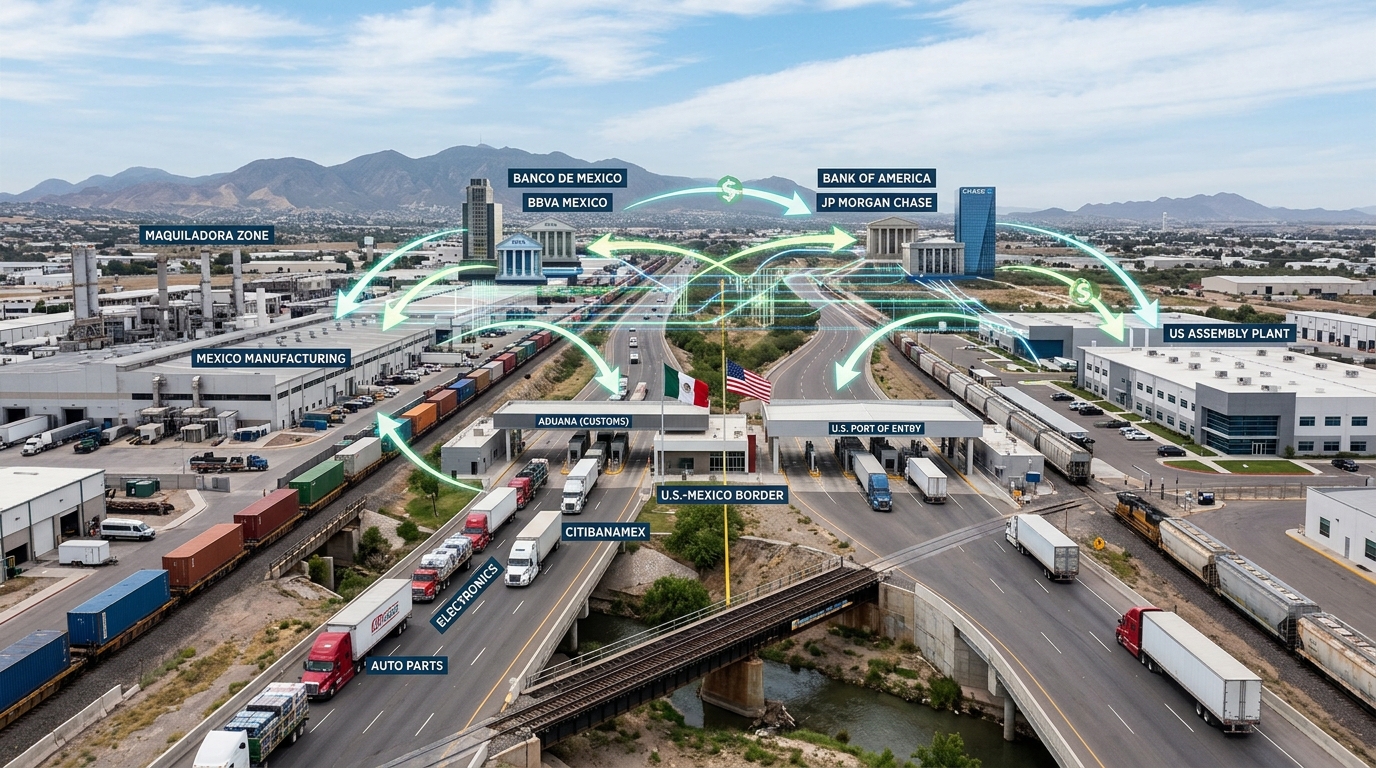
What Trade Finance Actually Solves
At its core, trade finance exists to bridge a timing mismatch. A manufacturer needs cash to buy raw materials, pay labor, and produce goods before it gets paid. A buyer, meanwhile, wants to delay payment until goods are received, inspected, and ideally sold to its own customers. Without financing instruments to bridge that gap, every cross-border transaction would require one party to absorb 60–120 days of unfunded working capital — and most simply can't.
The gap widens in nearshoring scenarios for three specific reasons:
- Transit and customs timing. Even with a US-Mexico land border, goods spend 5–15 days in transit, inspection, and USMCA documentation review.
- Currency exposure. Peso/dollar volatility means a 60-day payment term can swing margins 2–4% in either direction.
- Supplier capitalization. Many emerging Mexican industrial suppliers — particularly outside Monterrey, Querétaro, and Tijuana — are thinly capitalized and cannot self-fund a large PO.
Trade finance instruments are how sophisticated buyers and suppliers neutralize those frictions.
The Core Instruments
There are five financing structures every manufacturer should know. Each solves a slightly different problem, and the right answer is almost always a combination. If unfamiliar terminology is slowing you down, our glossary of 75 essential trade finance terms is a useful companion to this section.
1. Letters of Credit (LCs)
A letter of credit is a bank's promise to pay the seller once specific documentary conditions are met — bill of lading, certificate of origin, inspection report, etc. The buyer's bank guarantees payment; the seller's bank confirms it.
LCs are the oldest tool in the toolbox and remain dominant in transactions involving unfamiliar counterparties or higher-risk jurisdictions. They're also slow, paperwork-heavy, and expensive — typically 0.75%–2.5% of the transaction value, plus amendment fees every time something changes.
Best for: First-time supplier relationships, high-value capital equipment, transactions where political or counterparty risk is meaningful.
2. Purchase Order (PO) Financing
PO financing advances funds to a supplier against a confirmed purchase order from a creditworthy buyer, before any invoice has been issued. The lender pays the supplier's raw material costs and is repaid from the eventual customer payment.
This is critical in nearshoring because it lets smaller Mexican manufacturers accept POs that would otherwise exceed their working capital — which is exactly the constraint that knocks promising suppliers out of contention.
Best for: Suppliers without the balance sheet to fund production of a large order from a strong-credit US buyer.
3. Invoice Factoring
After goods ship and an invoice is issued, the supplier sells that invoice to a factor at a discount (typically 1–3% per 30 days) in exchange for immediate cash. The factor then collects from the buyer at maturity.
Factoring is faster and more flexible than LCs and doesn't require buyer cooperation — the supplier alone makes the decision. The trade-off is cost: it's usually the most expensive instrument on a per-dollar basis.
4. Reverse Factoring (Supply Chain Finance)
This is the instrument that has reshaped cross-border manufacturing finance over the past decade. In reverse factoring — also called supplier pay or supply chain finance (SCF) — the buyer initiates the program. The buyer's bank or platform pays suppliers early (often within days of invoice approval) at a financing rate based on the buyer's credit, not the supplier's.
The result: the supplier gets cash fast and cheap, while the buyer can extend its own payment terms (Net 60 or Net 90) without strangling supplier cash flow. Both sides win.
For US importers sourcing from Mexico, reverse factoring is often the single highest-leverage move available. It's the mechanic behind the case studies where manufacturers free seven figures in working capital without changing a single SKU — a topic we explore further in our work on extended payment terms and supplier pay programs.
5. Dynamic Discounting
A self-funded cousin of reverse factoring. The buyer uses its own cash to pay invoices early in exchange for a discount on a sliding scale — pay on day 10 and get 2% off, pay on day 20 and get 1% off, and so on.
This works when the buyer has excess cash earning low yields and wants a better risk-adjusted return than money markets. It requires no third-party financier.
Side-by-Side Comparison
| Instrument | Who Initiates | Speed to Cash | Typical Cost | Best Fit |
|---|---|---|---|---|
| Letter of Credit | Buyer | 7–30 days post-shipment | 0.75–2.5% + fees | New/high-risk relationships |
| PO Financing | Supplier | At PO confirmation | 2–4% per 30 days | Undercapitalized supplier, strong buyer |
| Invoice Factoring | Supplier | 1–3 days post-invoice | 1–3% per 30 days | Supplier needs cash, no buyer cooperation |
| Reverse Factoring | Buyer | 2–5 days post-approval | 0.5–1.5% per 30 days | Established buyer-supplier programs |
| Dynamic Discounting | Buyer | Variable | Negotiated discount | Cash-rich buyer, willing suppliers |
To run the numbers on your own program, our side-by-side rate calculator for LCs, factoring, and SCF lets you model each instrument against your actual transaction volume and payment terms.
How Payment Terms Multiply the Cost
The instrument matters, but so does the underlying payment term. Moving a supplier from Net 30 to Net 60 doubles the working capital they need to carry; moving to Net 90 triples it. For a $5M annual program, that's the difference between a supplier carrying ~$420K in receivables and ~$1.25M.
If you extend terms without offering a financing program to bridge the gap, you are effectively asking the supplier to absorb the cost — which they will eventually price back into their unit cost, often at a markup of 1.5–2x the actual financing rate. The math almost always favors a structured supplier pay program over an informal term extension.
This is why working capital strategy and supplier strategy are inseparable. You cannot meaningfully evaluate a Mexican factory on price alone without also asking: can they fund the production cycle, and if not, what does it cost me to help them?
USMCA, Currency, and the Documentation Layer
One often-overlooked piece of cross-border trade finance is the documentary infrastructure. To qualify for USMCA preferential tariff treatment, certificates of origin, bills of materials, and producer affidavits all need to align. Lenders financing the transaction will require the same paperwork — and any discrepancy can delay funding by weeks.
A practical checklist before initiating any trade finance facility on a US-Mexico transaction:
- USMCA certificate of origin completed and signed
- Bill of lading and packing list reconciled to PO
- Commercial invoice in correct currency with Incoterms specified
- HTS classification consistent across all documents
- For factored invoices: notice of assignment delivered to the buyer's AP team
Currency choice is its own decision. Most US-Mexico trade is invoiced in USD, which pushes the FX risk onto the Mexican supplier. Sophisticated suppliers price that risk in. If you want a true unit cost, ask for a peso-denominated quote alongside the USD one — the delta tells you exactly how much hedging cushion is baked into your price.
Embedded Finance Is Changing the Default
Historically, accessing these instruments meant a bank, a relationship manager, a credit committee, and a 6–12 week underwriting timeline. That's still how most large facilities work.
What's changed in the last few years is the rise of embedded finance for B2B manufacturing — financing offered directly inside the procurement, ERP, or sourcing platforms where transactions already happen. Approvals run in hours instead of weeks; pricing is transparent; and the supplier onboarding flow looks more like signing up for a SaaS product than opening a bank account.
For mid-market US manufacturers reshoring from China to Mexico, this matters because it removes one of the historical barriers to using nearshore suppliers: the assumption that only the largest buyers could deploy supplier pay programs. They no longer have a monopoly. If you're weighing whether to stay with a bank relationship or move to a platform model, our head-to-head breakdown of embedded vs. traditional trade finance walks through the practical trade-offs.
Where Trade Finance Sits in a Reshoring Project
When we work with clients moving production out of China, the financing conversation typically belongs in three places:
- Supplier qualification. Alongside ISO certifications, capacity, and tooling capability, we evaluate financial dimensions: working capital, leverage, banking relationships, and whether the supplier can accept (or needs help with) a financing program.
- Commercial terms negotiation. Payment term and financing structure are negotiated together, not sequentially. Net 60 with reverse factoring is a different deal than Net 60 without it.
- Scaling phase. As volume ramps, the financing structure that worked for the first $500K rarely works for the first $5M. We build the upgrade path into the original program design.
Treated this way, trade finance stops being a back-office line item and becomes one of the levers that determines which suppliers you can credibly use and how fast you can scale.
Frequently Asked Questions
For a broader set of answers tailored to growing manufacturers, see our FAQ hub for SMB trade finance questions.
Q: What's the difference between trade finance and supply chain finance?
Trade finance is the broad umbrella covering any instrument that funds international transactions — LCs, PO financing, factoring, and more. Supply chain finance is a specific subset, typically referring to buyer-initiated programs (like reverse factoring) that finance approved invoices across an entire supplier base rather than transaction by transaction.
Q: Do I need a bank to access trade finance, or are there alternatives?
You no longer need a traditional bank for most instruments. Specialty factors, fintech platforms, and embedded finance providers now offer PO financing, factoring, and reverse factoring with faster onboarding and more transparent pricing than legacy banks — though banks still tend to win on cost for the largest, most established programs.
Q: How does peso-dollar volatility affect trade finance decisions?
When the peso weakens, Mexican suppliers invoicing in USD see their margins expand, which can reduce pressure to finance early — but it also raises the cost of imported inputs they need to buy. Most sophisticated US-Mexico programs invoice in USD and use shorter payment cycles or reverse factoring to keep both parties insulated from sharp FX swings.
Q: Is invoice factoring a sign that a supplier is in financial trouble?
Not anymore. A decade ago, factoring carried a stigma; today it's a standard working capital tool used by healthy growth-stage manufacturers who simply want to convert receivables to cash faster than their customers pay. The relevant question is whether the supplier is factoring selectively or has factored 100% of receivables — the latter is the warning sign.
Q: What does Reshore do on the trade finance side of a reshoring project?
Reshore coordinates the operational side of moving production — tooling transfer, supplier matching, factory sourcing, and logistics — and we factor financial qualification into how we vet Mexican manufacturers, since a supplier's ability to fund a production cycle is as important as their technical capability. We help clients structure payment terms and identify suppliers who can plug into supplier pay programs, while leaving the actual financing facility to specialist providers our clients choose.
Q: How early in a reshoring project should I think about trade finance?
Before signing your first supplier agreement. The payment terms and financing structure shape unit pricing, supplier selection, and how fast you can ramp — getting it wrong at the outset is expensive to renegotiate later. We recommend mapping the working capital flow during the supplier qualification phase, not after production starts.
Q: Can a small Mexican supplier qualify for PO financing on a large US order?
Yes — that's exactly what PO financing is designed for. The lender underwrites primarily on the strength of the buyer's credit and the validity of the PO, not the supplier's balance sheet. A well-structured PO from a creditworthy US buyer can unlock production capacity at a Mexican supplier who could never self-fund the order.
Q: What's the typical all-in cost of using trade finance on a US-Mexico transaction?
For most mid-market programs, expect financing costs in the range of 0.5%–3% of transaction value per 30-day cycle, depending on the instrument and credit profile. Reverse factoring tied to a strong US buyer's credit tends to anchor the low end; factoring against weaker counterparties or in stressed markets anchors the high end.