
Frequently Asked Questions About Trade Finance for SMB Manufacturers
May 18, 2026
Frequently Asked Questions About Trade Finance for SMB Manufacturers
Trade finance can feel like a black box if you're a small or mid-sized manufacturer running on tight working capital. You know your factory in Monterrey or Guadalajara can produce the order. You know your US buyer is good for the money. The problem is the 90-to-180-day cash flow gap between buying raw materials and getting paid — and the alphabet soup of instruments (LCs, factoring, PO financing, SCF, reverse factoring) that supposedly close it.
This FAQ answers the questions we hear most often from SMB manufacturers and US importers navigating cross-border production under USMCA. If you're sourcing from Mexico, reshoring tooling out of China, or trying to extend supplier terms without breaking your balance sheet, start here.
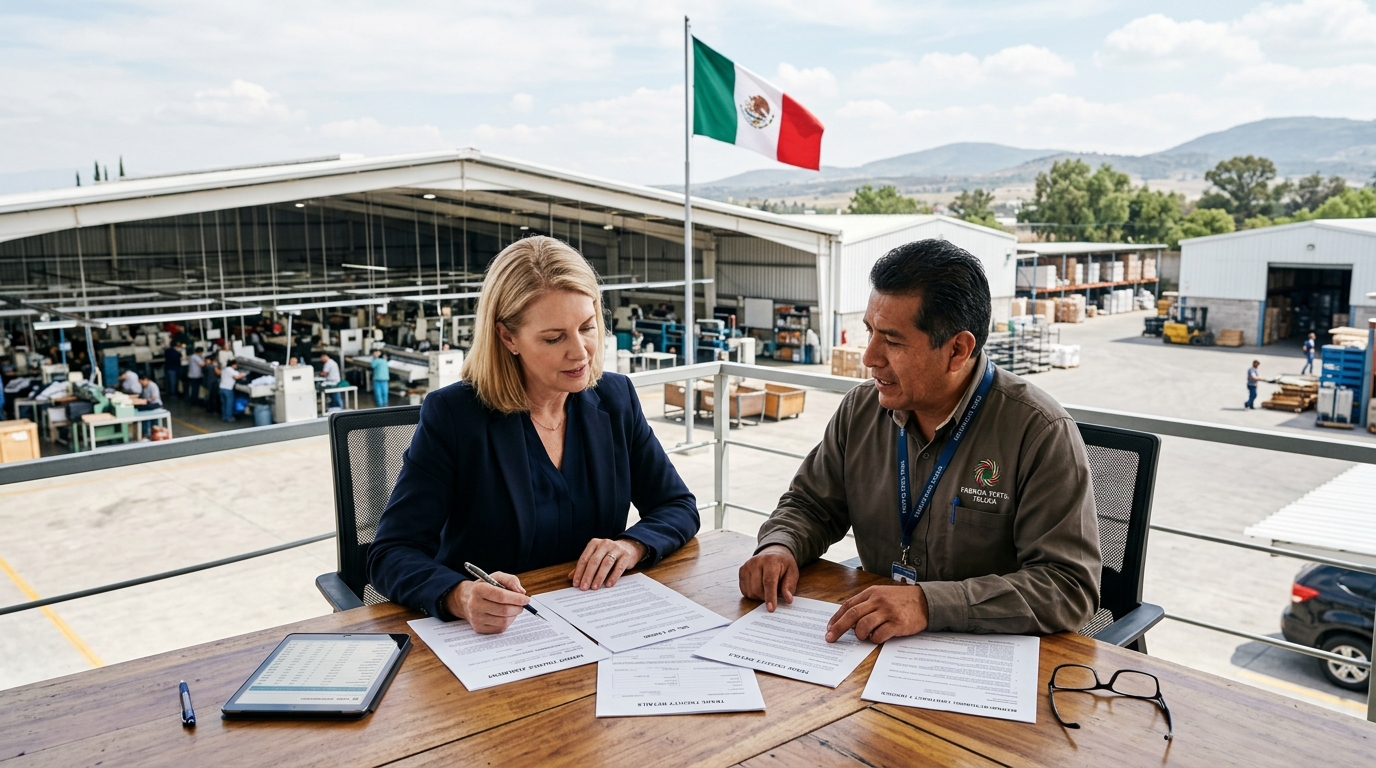
The Basics: What Trade Finance Actually Means
What is trade finance, in plain terms?
Trade finance is the set of financial products that bridge the time and trust gap between a buyer placing an order and a supplier getting paid. For a manufacturer, that gap can be brutal: you might pay for resin, labor, and freight in week one and not see a dollar from your US customer until week sixteen.
The instruments most SMB manufacturers encounter are:
- Letters of Credit (LCs) — a bank guarantees payment to the supplier once shipping documents are presented.
- Purchase Order (PO) financing — a lender advances funds against a confirmed PO so the supplier can produce.
- Invoice factoring — a factor buys your receivable at a discount and pays you now instead of in 60 or 90 days.
- Supply chain finance (SCF) / reverse factoring — the buyer's bank pays the supplier early at the buyer's credit rating, and the buyer settles with the bank later.
- Dynamic discounting — the buyer pays early in exchange for a discount, funded from its own cash.
For a side-by-side, see our LC versus SCF comparison for reshoring deals breakdown.
How is trade finance different from a regular business loan?
A traditional loan is underwritten against your balance sheet, your collateral, and your credit history. Trade finance is underwritten against a specific transaction — usually a PO or an invoice — and the creditworthiness of the buyer at the other end. That's why a Mexican contract manufacturer with thin equity can still finance a $2M order to a Fortune 500 buyer: the lender is essentially betting on the buyer, not the supplier.
Is trade finance only for big importers and exporters?
No. This is the most common misconception we hear. Embedded B2B finance platforms have dramatically lowered the floor over the last five years. Deals as small as $50K — and in some cases under $25K — are now bankable through fintech-native factors and PO financiers. The U.S. International Trade Administration maintains a free SMB-focused trade finance guide that's a good starting point.
Questions Small Manufacturers Ask Most
I'm a small manufacturer in Mexico. Can I get financed without a long credit history?
Usually yes, if you have a strong PO from a creditworthy US buyer. The lender's primary risk is buyer default, not your historical financials. That said, you'll need to demonstrate:
- Capacity to actually produce the order (audited BOM, capacity utilization, prior shipment records)
- Clean USMCA documentation and HTS classifications
- A real bank account and corporate structure (not just an RFC)
- No active liens on the receivables you're trying to assign
We see this play out constantly when matching US buyers to Mexican factories on the Reshore platform — the strongest operational supplier sometimes loses the deal because their paperwork can't support financing. Get your house in order before you chase the PO.
What's the difference between PO financing and invoice factoring?
| Dimension | PO Financing | Invoice Factoring |
|---|---|---|
| When it funds | Before production (against the PO) | After shipment (against the invoice) |
| What it pays for | Raw materials, labor, tooling deposits | Working capital while waiting on Net 30/60/90 |
| Typical cost | 2.5%–6% per month | 1%–3% per month |
| Underwriting basis | Buyer creditworthiness + production feasibility | Buyer creditworthiness + invoice validity |
| Best for | Manufacturers with thin cash to start production | Manufacturers waiting on receivables to clear |
In practice, many SMB manufacturers stack them: PO financing to fund production, then factoring on the resulting invoice to keep cash moving for the next order.
How much does trade finance actually cost?
It depends on the instrument, the buyer's credit rating, the tenor, and the country risk. Rough benchmarks as of 2026:
- Letters of Credit: 0.75%–2% of face value per quarter
- Invoice factoring (US buyer, Mexican supplier): 1.2%–2.5% per month effective rate
- PO financing: 2.5%–6% per month
- Reverse factoring / SCF: often inside 1% per month because it prices off the buyer's credit
The all-in cost matters less than the alternative. If a 2% factoring fee unlocks a 12% gross margin order you'd otherwise have to decline, the math is obvious. You can model your own numbers with our side-by-side cost calculator for LC, factoring, and SCF rates.
What credit score or financials do lenders want to see?
For PO financing and factoring, lenders care more about your buyer's credit than yours. They'll typically run a D&B or Experian Business report on the buyer, check for prior payment disputes, and verify the PO directly. For the supplier side, expect to provide:
- Two years of financials (or whatever you have)
- Bank statements (typically 6–12 months)
- A/R aging report
- Corporate documents and beneficial ownership disclosure (FinCEN and AML requirements)
US Buyer Questions
As a US importer sourcing from Mexico, why should I care about my supplier's financing?
Because it directly determines whether your supplier ships on time, ships at full quality, or ships at all. A factory that can't fund raw materials will substitute cheaper resin, stretch lead times, or in worst cases stop work mid-run. Strong buyers solve for this proactively — usually by sponsoring a supply chain finance program that lets suppliers get paid early off the buyer's credit.
If you're new to evaluating Mexican suppliers, our Supplier Qualification Checklist: 40 Questions Before You Sign includes the financial diligence questions most procurement teams forget to ask.
What's reverse factoring and why is everyone talking about it?
Reverse factoring (also called payables finance or buyer-led SCF) flips the model: the buyer initiates the program, a bank or fintech pays suppliers early at the buyer's credit rating, and the buyer pays the bank on the original due date. Suppliers get cheap, fast cash. Buyers get to extend payment terms without strangling their supply base. It's the dominant working capital structure in Fortune 500 supply chains and is rapidly moving into the mid-market.
Can I extend supplier terms to Net 60 or Net 90 without hurting my suppliers?
Yes — but only if you pair the extension with a supplier early-payment option. Unilaterally pushing Mexican suppliers from Net 30 to Net 90 without a financing offset is a common mistake that quietly destroys supplier relationships and eventually quality. The proper structure: extend terms to 60 or 90 days on paper, then enroll the suppliers in an SCF program where they can opt to be paid in 10 days at a discount priced off your credit.
Cross-Border and USMCA Questions
Does USMCA change how trade finance works between the US and Mexico?
USMCA itself doesn't directly regulate trade finance, but it changes the documentation and origin requirements that financing depends on. Lenders financing cross-border deals will want to see:
- Certificates of Origin establishing USMCA preference
- Correct HTS classification (see our Glossary of Trade Policy Terms: HTS, FTZ, Section 301 and More)
- Proof that Regional Value Content thresholds are met
- Customs broker documentation (CBP entry summaries)
Sloppy USMCA paperwork is one of the most common reasons cross-border financing gets delayed or denied.
How does peso/dollar volatility affect my financing decisions?
It matters more than most SMB manufacturers realize. If your costs are in pesos and your revenue is in dollars (the typical Mexican contract manufacturer setup), a 10% peso appreciation can wipe out your margin between PO and payment. Common hedges:
- Price contracts in USD with FX adjustment clauses above a threshold (e.g., ±5%)
- Use forward contracts through your bank for known receivables
- Match the currency of your financing to the currency of your receivable
What happens if the goods get stuck at the border?
This is exactly why financing structures include shipping document triggers (for LCs) or proof-of-delivery requirements (for factoring). Customs delays don't void financing, but they can extend tenor and trigger additional fees. The fix is upstream: get your customs broker, HTS codes, and USMCA documentation right before the truck leaves the plant.
Choosing a Financing Partner
Should I use my bank or a fintech platform?
Both have a place. Banks offer LCs and traditional SCF at the lowest cost but the slowest speed and highest documentation burden. Fintech platforms (embedded B2B finance providers) offer faster onboarding, smaller deal sizes, and API-driven workflows — at a higher per-deal cost. Our Embedded Finance vs. Traditional Trade Finance: Side-by-Side walks through when each makes sense.
What red flags should I watch for in a trade finance provider?
- Vague or hidden fee structures (advance rates, reserves, discount rates should all be disclosed in writing)
- Recourse vs. non-recourse not clearly defined
- Long-term exclusivity clauses on receivables
- Lack of regulatory registration (in the US, check FinCEN MSB and state lending licenses)
- No clear process for disputed invoices
If any of the terminology above is unfamiliar, our glossary of 75 essential trade finance terms breaks down the jargon you'll see in provider contracts.
How This Fits the Bigger Reshoring Picture
For US companies relocating production out of China, trade finance is often the missing piece of the business case. The TCO math works, the Mexican supplier base is qualified, the tooling can be moved — but no one funded the 120-day working capital gap to get the first production runs out the door. That's the gap we close.
We at Reshore coordinate the full reshoring stack — supplier matching, tooling transfer, factory qualification, and the financing relationships that keep it all moving. If you're sizing up a move from China to Mexico, the core principles of trade finance for manufacturers should be on your assessment checklist alongside the operational ones.
For deeper reading, see our complete 2026 walkthrough of trade finance instruments and the TCO FAQ: 25 Questions Finance Teams Ask About Reshoring.
Quick-Reference FAQ
Can I finance a deal if I'm a brand-new manufacturer with no track record?
If the buyer is creditworthy and the PO is real, yes — through PO financing or buyer-led SCF. Pure factoring on your own credit will be harder until you build a payment history.
How long does it take to get trade finance approved?
Traditional bank LCs: 2–6 weeks. Fintech factoring or PO financing: often 3–10 business days for first approval, then near-instant on subsequent invoices.
Is invoice factoring considered debt on my balance sheet?
Non-recourse factoring is typically a true sale of receivables and stays off-balance-sheet. Recourse factoring usually appears as debt. Confirm with your auditor — this is one of the most common accounting mistakes in mid-market manufacturing finance.
Can I use trade finance to fund tooling transfer from China to Mexico?
Yes, in some structures. Tooling is generally not financed by traditional factors, but specialized reshoring finance, equipment finance, and certain PO financing structures can cover it. This is one of the most common questions we get on reshoring assessments.
What's the minimum deal size for trade finance?
Embedded fintech platforms will go as low as $25K–$50K. Bank-led trade finance typically starts at $250K+. Reverse factoring programs at the buyer level often have no per-invoice minimum.
Where can I find vetted Mexican manufacturers that are already financeable?
Start with the Directory of Top Contract Manufacturers in Mexico by Industry and the Mexico Plastic Manufacturing Hub Directory. Suppliers listed have been pre-qualified on operational and basic financial criteria.
Does Reshore help with the financing side of reshoring, or just operations?
Both. The platform coordinates supplier matching, tooling transfer, and factory qualification, and connects buyers and manufacturers to the financing partners that fit each deal. If you want to discuss your specific situation, book a reshoring assessment.