
Letter of Credit vs. Supply Chain Finance: Which Fits Your Reshoring Deal?
May 18, 2026
Letter of Credit vs. Supply Chain Finance: Which Fits Your Reshoring Deal?
When you move production out of China and into Mexico or the United States, the financing playbook changes. The instruments that worked for a 45-day ocean shipment from Shenzhen — most often a documentary letter of credit — were built for a world of long lead times, unfamiliar counterparties, and bank-intermediated risk transfer. Nearshore production runs on different rails: shorter transit, more frequent shipments, [USMCA documentation requirements](USMCA documentation), and supplier relationships that often look more like domestic vendor agreements than offshore trade.
That shift is why CFOs running reshoring programs are increasingly weighing letter of credit vs SCF (supply chain finance) when they redesign their working capital stack. Both are legitimate trade finance options for manufacturers. They solve overlapping problems in very different ways, and choosing the wrong one can quietly add weeks to your cash conversion cycle or burn margin you assumed was locked in.
This guide walks through how each instrument actually works, where each one fits in a reshoring deal, and how to think about the trade-offs before you commit.
The Short Version
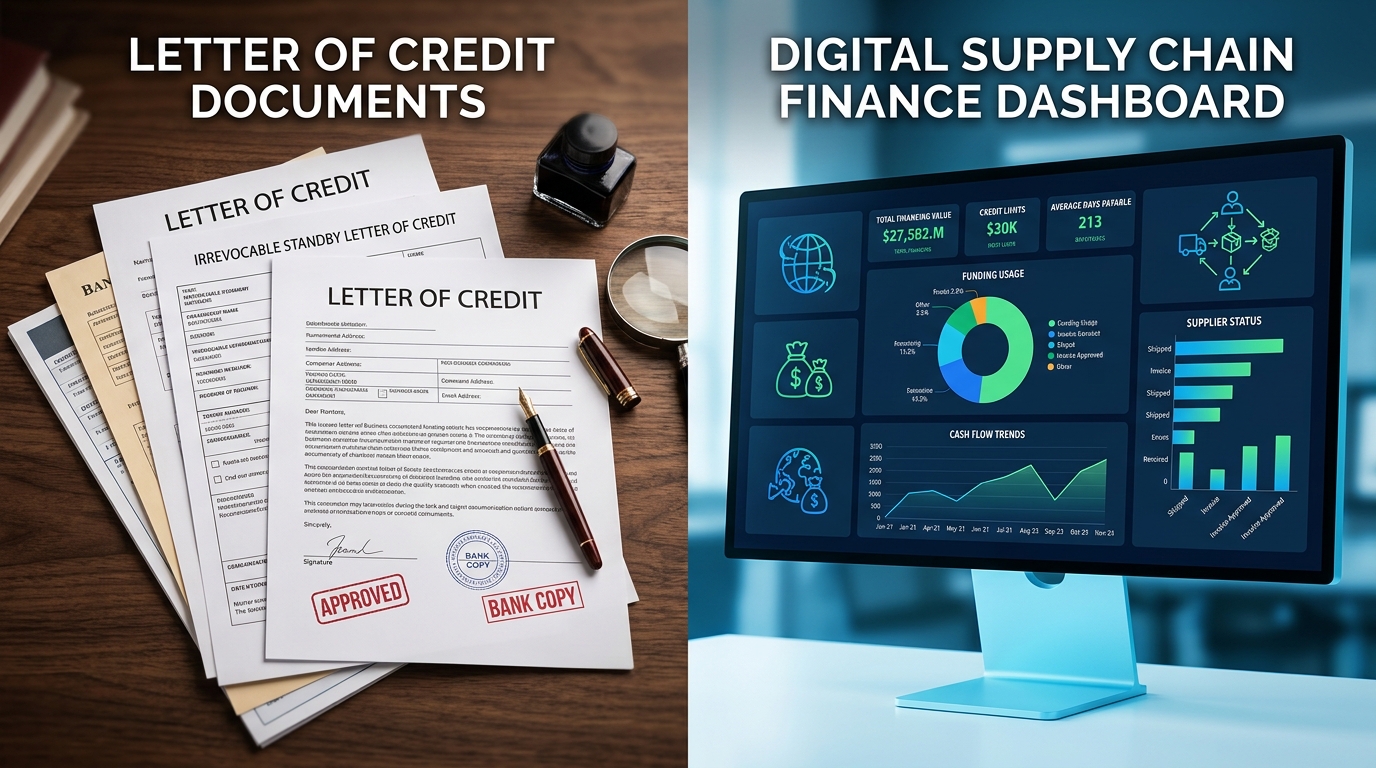
A letter of credit (LC) is a bank-issued payment guarantee. Your bank promises the supplier's bank that payment will be made once the supplier presents conforming shipping and trade documents. It's a risk transfer instrument: the buyer's creditworthiness is replaced, for the duration of the transaction, by the issuing bank's.
Supply chain finance (SCF) — sometimes called reverse factoring or approved-payables financing — is a buyer-led program where a financier (a bank or fintech) pays the supplier early against an approved invoice, then collects from the buyer on the original due date. It's a liquidity instrument: it lets the buyer extend payment terms while the supplier gets paid faster.
Different problems. Different mechanics. Different costs.
How a Letter of Credit Works in a Reshoring Context
In a classic LC transaction:
- Buyer and supplier agree on terms and reference an LC in the purchase order.
- The buyer applies for the LC with its bank (the issuing bank).
- The issuing bank sends the LC to the supplier's bank (the advising or confirming bank).
- The supplier ships and presents documents — commercial invoice, bill of lading, certificate of origin, packing list, and any USMCA-specific documentation.
- If documents conform, the supplier is paid. The buyer reimburses the issuing bank under whatever credit terms they negotiated.
LCs were dominant in US-China trade for good reasons: long ocean transit, limited recourse against an offshore counterparty, currency complications, and the need for a neutral third party to enforce performance. For a first-time engagement with an unknown Mexican factory in an emerging industrial cluster — say, a tier-2 injection molder in Querétaro you've never worked with — that same logic can still apply.
LCs are most useful when:
- You're qualifying a brand-new supplier with no payment history.
- The order is large enough to justify bank fees (typically 0.5%–3% of value, depending on confirmation and tenor).
- The supplier explicitly requires payment security to take the order.
- Cross-border documentary risk is material — for example, when customs or USMCA certification timing creates a window where neither party wants to be exposed.
LCs are less useful when:
- You're running repeat, high-frequency orders with an established supplier.
- Margins are tight enough that 1%–2% in bank fees per transaction matters.
- You need flexibility on shipment quantities, partial shipments, or last-minute spec changes — LCs are notoriously rigid about document conformity.
How Supply Chain Finance Works in a Reshoring Context
SCF flips the perspective. Instead of guaranteeing payment to the supplier upfront, the buyer approves the supplier's invoice for payment on standard terms — Net 60 or Net 90, say — and a financier offers to pay the supplier early at a discount.
The mechanics:
- Supplier ships and invoices.
- Buyer approves the invoice (confirms receipt, quality, quantity).
- Approved invoice is uploaded to the SCF platform.
- Supplier chooses whether to take early payment (minus a small financing fee) or wait for the original due date.
- On the due date, the buyer pays the financier the full invoice amount.
The pricing is anchored to the buyer's credit rating, not the supplier's — which is the whole point. A mid-market Mexican manufacturer might borrow domestically at 14%–18% in pesos. Inside an SCF program backed by a US investment-grade buyer, that same supplier can access early payment at single-digit annualized rates in dollars. Everyone wins: the supplier improves liquidity, the buyer extends DPO without breaking the relationship, and the financier earns a spread on low-risk approved receivables.
SCF fits naturally when:
- You have an ongoing, high-volume relationship with established suppliers.
- You want to extend payment terms (Net 30 → Net 60 → Net 90) without forcing suppliers into a cash crunch — this is the foundation of structured supplier pay programs.
- You're consolidating a nearshore supplier base and want a scalable, repeatable funding mechanism.
- You're optimizing working capital at the portfolio level rather than transaction by transaction.
SCF doesn't fit when:
- The supplier is unproven and you need third-party performance assurance.
- Volumes are too small to justify onboarding into a program.
- The supplier's bank can't or won't participate (less common with modern embedded platforms, but still a factor with smaller Mexican factories).
Side-by-Side: Letter of Credit vs. Supply Chain Finance
| Dimension | Letter of Credit | Supply Chain Finance |
|---|---|---|
| Primary purpose | Payment guarantee / risk transfer | Liquidity and DPO extension |
| Who initiates | Buyer (at supplier's request) | Buyer (program-wide) |
| Who benefits most | Supplier (payment certainty) | Both (supplier liquidity, buyer working capital) |
| Pricing basis | Buyer's credit, plus document risk premium | Buyer's credit rating |
| Typical cost | 0.5%–3% of LC value, per transaction | 50–300 bps annualized on financed amount |
| Best for | New suppliers, large one-off shipments | Recurring orders, established suppliers |
| Cross-border friction | High — document conformity is strict | Low — digital approval workflow |
| Speed to deploy | Days to weeks per transaction | Weeks to set up program, then near-instant per invoice |
| Balance sheet treatment | On-balance-sheet payable | Often off-balance-sheet (with proper structuring — see IFRS disclosure guidance) |
| USMCA documentation | Embedded in LC document set | Handled separately in trade docs |
If you want to model the actual dollar impact across instruments before committing, our side-by-side rate comparison tool lets you plug in deal size, tenor, and supplier mix to see effective annualized costs.
A Practical Decision Framework
For most reshoring programs, the answer isn't LC or SCF — it's both, deployed at different stages of the supplier lifecycle.
Stage 1: Initial qualification (months 0–6). New Mexican supplier, first one or two production runs. Use an LC if the supplier requests it or if order value is high. This buys you time to verify quality, on-time delivery, and financial stability without taking on counterparty risk.
Stage 2: Steady-state production (months 6+). Performance history is established. Move to open account terms (Net 30 or Net 60) and layer in SCF so the supplier can pull early payment when they need it. This is where the working capital math actually starts working in your favor.
Stage 3: Portfolio optimization (year 2+). Pull supplier-level data, identify your top 20 nearshore vendors by spend, and standardize them onto a single SCF platform. This is the move that unlocks the kind of cash captured in the Case Study: Manufacturer Frees $4.2M in Cash by Restructuring Supplier Terms.
The mistake we see most often at Reshore is companies defaulting to LCs because that's what they used in China, then never revisiting the assumption. The cost — both in direct fees and in the operational drag of document conformity — compounds quickly when you're running 40 or 50 shipments a quarter instead of 4. For a deeper look at how the full instrument set fits together, see our comprehensive guide to trade finance instruments.
How Currency and USMCA Reshape the Calculus
Two cross-border factors push the analysis toward SCF over time:
Peso/dollar volatility. When your supplier is invoicing in pesos and you're paying in dollars, every day of float carries FX risk. LCs lock in payment terms but don't shorten the cycle. SCF compresses the supplier's cash conversion cycle, which reduces their need to price in FX cushions — and that often shows up as more competitive quotes over time.
USMCA documentation. Origin certification under USMCA is a recurring, document-intensive requirement. SCF platforms increasingly integrate trade documentation workflows, which means certifications, commercial invoices, and customs paperwork flow through the same system that triggers payment. LCs, by contrast, treat each shipment as a discrete documentary event — efficient for one-offs, painful at scale. The USTR's USMCA resources outline the documentation requirements in detail.
Where Embedded Finance Changes the Picture
The newer wrinkle is that "supply chain finance" no longer means just a bank-run program with a six-month onboarding process. Embedded finance platforms — fintechs that sit inside procurement or AP software — can stand up SCF for a mid-market buyer in weeks, not quarters. Suppliers self-onboard. Approval and funding happen in the same workflow as invoice processing. We've broken down the structural differences in our comparison of embedded and traditional trade finance models.
This matters for reshoring because the suppliers you're working with are often smaller than the multinationals that anchored legacy SCF programs. A $30M-revenue Mexican injection molder isn't going to navigate a traditional bank-led KYC process for a single buyer. They will, however, click through a digital onboarding flow if it gets them paid in three days instead of sixty.
If you're early in the reshoring journey and the financing question feels like a downstream problem, it isn't. The decision of which suppliers you can use is constrained by how you can pay them — and that's a decision worth making before you've already committed tooling and timelines. If terminology like "confirming bank," "tenor," or "approved payables" is slowing your team down, our glossary of 75 essential trade finance terms is a useful reference to keep open.
Frequently Asked Questions
Q: Can a letter of credit and supply chain finance be used on the same supplier relationship?
Yes, and it's actually a common pattern. Buyers often use LCs for the first one or two production runs with a new Mexican supplier to manage counterparty risk, then transition to open account terms with SCF once performance is proven. The two instruments serve different stages of the relationship rather than competing head-to-head.
Q: How does supply chain finance affect a supplier's willingness to extend payment terms?
When a supplier has access to early payment through an SCF program at the buyer's credit rate, the cost of carrying Net 60 or Net 90 receivables drops dramatically. That usually unlocks term extensions the supplier would otherwise refuse, because their effective DSO doesn't change — only the legal due date does. This is the core mechanic behind extending DPO without damaging supplier relationships.
Q: Are letters of credit becoming obsolete in nearshore trade?
Not obsolete, but their share is shrinking. The combination of shorter transit times, more frequent shipments, and digital trade finance platforms means LCs are increasingly reserved for first-time engagements, very large orders, or transactions where the supplier explicitly requires bank-backed payment certainty. For steady-state nearshore production, SCF and open account terms dominate.
Q: What does supply chain finance typically cost compared to a traditional bank loan?
Because SCF pricing is anchored to the buyer's credit rating rather than the supplier's, suppliers often access funding at rates significantly below what they could get on their own — often 200 to 800 basis points cheaper than a local working capital line, especially for mid-market Mexican manufacturers. The buyer typically pays no direct fee, though some programs charge a small platform or arrangement fee. For more nuanced scenarios, our SMB manufacturer trade finance FAQ addresses common pricing and structuring questions.
Q: Does Reshore help companies set up trade finance when relocating production to Mexico?
Reshore focuses on the operational side of reshoring — tooling transfer, factory sourcing, supplier matching, and production setup — and works alongside the financing partners our clients choose. We can help you structure supplier relationships in a way that's compatible with either LC or SCF arrangements, and we surface financial qualification data on potential factories as part of our AI-powered sourcing process.
Q: What documents are required for a USMCA-compliant letter of credit?
Beyond standard LC documents (commercial invoice, bill of lading, packing list, insurance certificate), USMCA shipments require a certificate of origin or equivalent producer/exporter/importer certification demonstrating qualifying content. The LC text should explicitly reference the USMCA documentation requirements to avoid discrepancies at document presentation, which can trigger payment delays or rejections.
Q: When should a CFO escalate the LC vs. SCF decision to the board?
Any time the working capital impact crosses materiality thresholds — typically when a nearshoring program is expected to involve $20M+ in annual supplier spend, or when an SCF program would shift more than a few percentage points of DPO. Off-balance-sheet treatment, supplier concentration, and program governance are all board-level considerations under current IFRS and US GAAP disclosure rules.