
Nearshoring to Mexico: CFO & Procurement Playbook
May 18, 2026
Nearshoring to Mexico: CFO & Procurement Playbook
Nearshoring is no longer a contingency plan — it's the operating model. For US companies that once viewed Mexico as a backup option to China, the math has flipped. Tariff exposure, ocean freight volatility, USMCA tailwinds, and a 13-hour drive between Monterrey and Laredo have made Mexican production the default conversation in boardrooms from Detroit to Austin.
But the conversation between the CFO and the CPO is where nearshoring lives or dies. One of them is modeling landed cost, FX exposure, and capital deployment. The other is qualifying factories, negotiating payment terms, and managing the cash flow gap between purchase order and finished goods crossing the border. When those two functions are aligned, nearshoring delivers margin. When they aren't, the program stalls — usually at a working capital bottleneck no one priced into the original business case.
This playbook is built for both seats at the table.
Why Nearshoring to Mexico Is a 2026 Imperative
The structural drivers haven't softened — they've compounded. US-China tariff layers continue to expand, with Section 301 duties on many product categories now exceeding the cost arbitrage that once justified Asian production. Meanwhile, Mexico has overtaken China as the largest source of US goods imports, a position it has held since 2023 and continues to widen.
For executives, the headline metrics are now:
- Lead-time compression: 4–6 weeks ocean freight from China collapses to 2–5 days truck from Mexico.
- Inventory reduction: Most clients we work with cut safety stock 30–50% within the first year. See how one OEM cut lead times 62% for a real-world benchmark.
- Tariff arbitrage: USMCA-qualified goods enter the US duty-free when rules of origin are met.
- FX optionality: Peso-denominated production costs paired with dollar-denominated revenue create natural hedging opportunities — and risks.
The question is no longer whether to nearshore. It's how to fund it, sequence it, and not blow up your working capital cycle doing it.
The CFO's Lens: Five Financial Decisions That Shape the Program
1. Total Landed Cost, Not Unit Price
Procurement teams love unit price. CFOs need landed cost. The two are rarely the same — and the gap is where nearshoring deals are won or lost.
A complete landed cost model for Mexico production includes:
| Cost Component | China Baseline | Mexico Comparison |
|---|---|---|
| Unit FOB price | Low | 5–20% higher typical |
| Ocean/truck freight | $4,000–$8,000/40ft | $1,500–$3,500/truck |
| Tariffs/duties | 7.5–25%+ (Section 301) | 0% under USMCA |
| Inventory carrying cost | 60–90 days transit | 3–7 days transit |
| Quality/rework | Higher (distance) | Lower (proximity) |
| FX hedging cost | CNY managed | MXN floating |
We've published a deeper version of this analysis in our side-by-side landed cost comparison tool, which most clients use as the opening artifact in their board memo.
2. Capital Structure for Tooling Transfer
Moving production isn't free. Tooling transfer, qualification runs, dual-sourcing periods, and supplier onboarding all consume cash before a single saleable unit ships from Mexico. The CFO question: where does that capital come from, and does it sit on or off the balance sheet?
Common structures we see:
- Operating cash + capex line: Cleanest, but burns liquidity at the worst moment.
- Supplier-financed tooling: Mexican factory absorbs tooling capex and amortizes across PO volume.
- Off-balance-sheet trade finance: PO financing or import factoring covers the working capital wedge between supplier payment and customer remittance.
- Reverse factoring: US buyer extends supplier terms while the supplier draws early payment from a financing partner against the buyer's credit.
For mid-market OEMs, the off-balance-sheet routes typically preserve the most strategic flexibility. The Mold Transfer from China to Mexico: Complete Playbook covers the operational mechanics; the financial structuring should run in parallel.
3. FX Exposure and Peso/Dollar Strategy
The peso has moved 15–25% in single-year windows over the past decade. A nearshoring program with three-year payback assumptions cannot ignore that. CFOs should be asking:
- Are supplier contracts denominated in USD or MXN?
- If MXN, what's the natural hedge inside our own P&L?
- Do we layer forward contracts at the PO level, the annual budget level, or both?
- What does a 20% peso appreciation do to our unit economics?
The honest answer for most companies: contract in USD where possible, hedge selectively, and price FX volatility into your supplier negotiations rather than your treasury operations.
4. Tax, Incentives, and IMMEX
Mexico's IMMEX (Maquiladora) program allows temporary importation of inputs duty- and VAT-free when goods are exported. For US companies sending components south for assembly, this is foundational. Pair it with state-level incentives in Nuevo León, Querétaro, Coahuila, or Jalisco and effective tax positioning can swing the IRR meaningfully.
5. Working Capital Cycle Redesign
The biggest unforced error we see: companies model Mexico landed cost correctly but forget that their cash conversion cycle just changed shape. Shorter lead times mean less inventory, but also faster supplier payment cycles. Net 30 from a Mexican supplier hits your cash differently than Net 90 from a Chinese one — especially when your customer terms didn't change.
This is where supply chain finance instruments — dynamic discounting, reverse factoring, embedded B2B payment platforms — become strategic rather than tactical. Our deeper CFO-focused financing playbook walks through specific instrument selection by program scale.
The Procurement Lens: Executing the Playbook
Step 1: Qualify the Right Manufacturing Hub
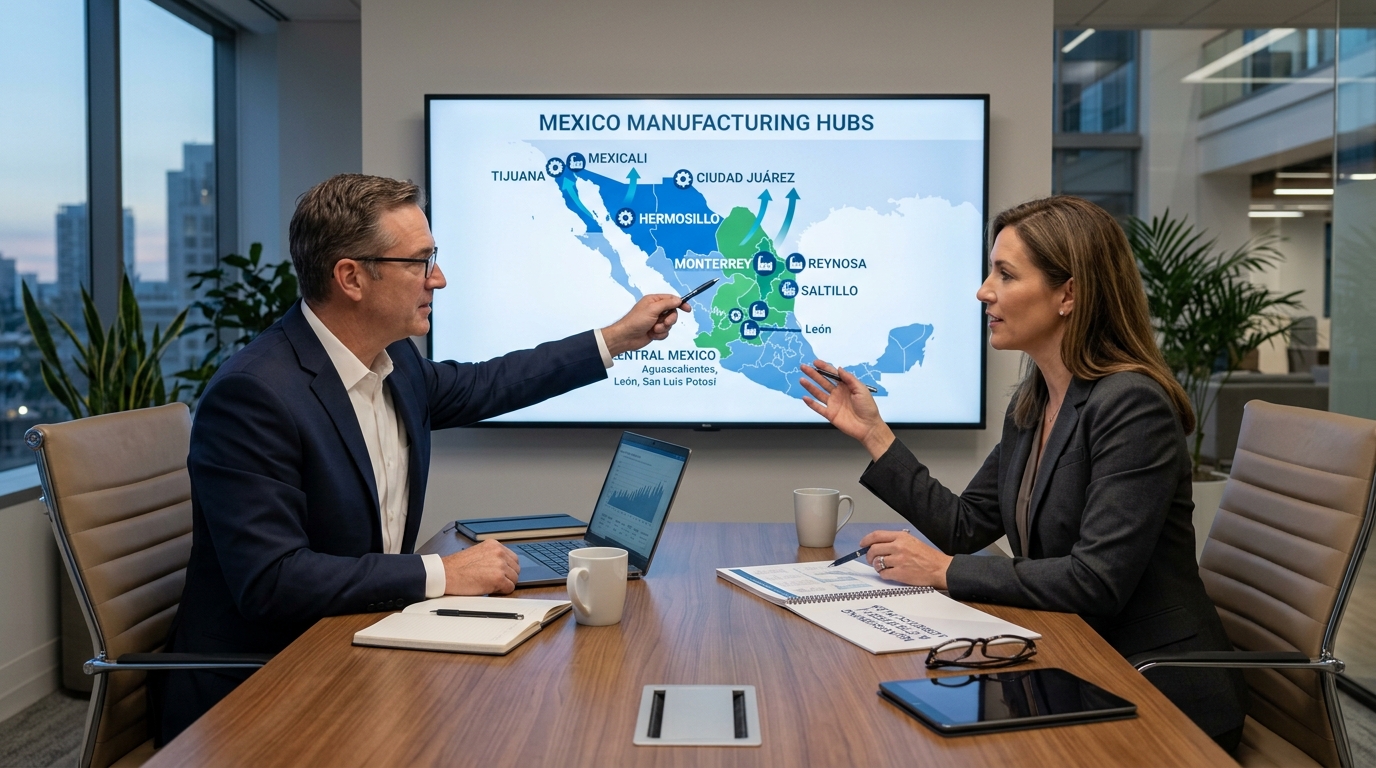
Mexico is not monolithic. Monterrey dominates heavy industrial, automotive, and metalworking. Guadalajara owns electronics and medical devices. Querétaro is aerospace and precision. Tijuana and Mexicali handle high-mix electronics and consumer goods for the West Coast. Bajío cities like León and San Luis Potosí have become automotive and appliance corridors.
Our directory of Mexican manufacturing hubs by city and specialty maps wages, logistics costs, and industry specialization by region — a useful starting filter before any RFQ goes out.
Step 2: Build the RFQ Around What Matters
Procurement teams accustomed to Chinese sourcing often over-index on unit price and under-index on engineering capability, financial stability, and tooling capacity. For Mexico, the RFQ should explicitly probe:
- USMCA rules-of-origin compliance and documentation discipline
- IMMEX certification status
- ISO/IATF/FDA certifications appropriate to your category
- Engineering bandwidth for design transfer
- Financial health (auditable statements, banking relationships)
- Existing US customer references
If you're new to structured sourcing, RFQ vs. RFP vs. RFI in Manufacturing: Which to Use When breaks down which document to deploy at which stage.
Step 3: Negotiate Terms That Reflect Cross-Border Reality
Net 30 dock-to-dock is the most common starting point, but the real conversation is around:
- Tooling payment schedules: 50/50, 40/30/30, or full amortization across PO volume
- Quality holdbacks: 5–10% retention until PPAP/qualification
- FX adjustment clauses: Bands within which prices reset
- Volume commitments vs. flexibility: Forecast accuracy is your leverage
Step 4: Manage the Cash Flow Gap
This is where many nearshoring programs hit the wall. The supplier wants payment on shipment from the factory. Your customer pays on delivery to their warehouse, plus terms. The wedge — sometimes 60–120 days — has to be funded.
Options:
- PO financing for the supplier (advance against your purchase order)
- Invoice factoring for the supplier (advance against shipped invoice)
- Reverse factoring / supply chain finance sponsored by your credit
- Dynamic discounting if you have cash to deploy at attractive yields
The right instrument depends on your credit profile, supplier sophistication, and program scale. The wrong choice — or no choice — strangles the program before it scales.
Where Programs Go Wrong (and How to Avoid It)
Three patterns we see consistently:
- CFO and CPO model in different spreadsheets. The landed cost model doesn't reconcile with the working capital plan. Margin assumptions evaporate when treasury sees the actual cash impact.
- Supplier financial qualification is skipped. A factory that quotes 15% under the next-best option may be undercapitalized. They'll win the PO, struggle with tooling, miss the first three deliveries, and cost you a year.
- USMCA documentation is treated as an afterthought. Rules of origin require active management. Get this wrong and your duty-free goods aren't duty-free.
Building Your 2026 Plan
For most mid-market companies, the sequence looks like:
- Run a readiness assessment (start with this 10-question nearshoring readiness quiz)
- Model total landed cost against your current baseline
- Identify 1–3 SKUs or product families for an initial transfer
- Qualify 3–5 Mexican manufacturers per category
- Structure tooling transfer and working capital financing in parallel
- Pilot, measure, scale
We at Reshore coordinate this end-to-end for plastic manufacturing and injection molding programs — AI-powered supplier matching, tooling transfer logistics, factory qualification, and production setup — so the operational complexity doesn't outrun the financial plan.
For a fuller strategic view, our 2026 nearshoring guide for Mexico manufacturing and The Complete Reshoring Playbook for US Manufacturers in 2026 cover the broader frameworks. And if you're still weighing options, comparing reshoring, nearshoring, and friendshoring side by side and China+1 vs. Full Reshoring: Which Strategy Fits Your Business? lay out the comparative cases. Companies pursuing a parallel domestic track may also want to review our broader work on US supply chain realignment.
The companies winning at nearshoring in 2026 aren't the ones with the cheapest unit cost. They're the ones whose CFO and CPO are reading from the same playbook.
Frequently Asked Questions
Q: How long does a typical nearshoring project from China to Mexico take?
For a single product line with existing tooling, most projects run 4–9 months from kickoff to first production shipment. Programs involving new tooling, complex assemblies, or regulated industries (medical, aerospace, automotive) typically extend to 9–18 months. The biggest variables are tooling transfer logistics, supplier qualification cycles, and PPAP or first-article approval timelines.
Q: What's the minimum revenue or volume threshold to justify nearshoring to Mexico?
There's no universal floor, but the economics generally work best above $1–2 million in annual COGS for the product line being transferred. Below that, fixed costs of tooling transfer, qualification, and supplier onboarding compress the ROI. That said, companies with strategic motivations — IP protection, tariff exposure, customer-driven mandates — sometimes nearshore smaller volumes for non-financial reasons.
Q: How does Reshore approach supplier matching for nearshoring projects?
Reshore uses an AI-powered sourcing engine that matches buyers to verified Americas-based manufacturers based on product specifications, certifications, capacity, and financial qualification. Rather than running open RFQs, the platform narrows the candidate pool to factories that have already been vetted on operational and financial dimensions — which compresses qualification timelines significantly. You can read more in our overview of Reshore's reshoring solutions.
Q: What is IMMEX and why does it matter for US buyers?
IMMEX (formerly Maquiladora) is a Mexican government program that allows manufacturers to temporarily import raw materials, components, and equipment duty- and VAT-free, provided the finished goods are exported. For US buyers sending components into Mexico for assembly, working with an IMMEX-certified supplier eliminates significant tax friction and is often the difference between a workable cost model and an uncompetitive one.
Q: How do tariffs and USMCA affect the cost case for Mexico production?
Goods that meet USMCA rules of origin enter the US duty-free, which for many product categories represents a 7.5–25%+ cost advantage versus Chinese imports subject to Section 301 tariffs. The catch is documentation: rules of origin require regional value content thresholds and proper certificate management. Goods that don't qualify can be subject to MFN duty rates, which erodes the case substantially.
Q: Can small or mid-market companies access supply chain finance for nearshoring?
Yes, though the instruments differ from those used by Fortune 500 buyers. PO financing and invoice factoring are widely available to mid-market companies and their suppliers, typically priced as a percentage of invoice value. Reverse factoring and supply chain finance platforms historically required investment-grade buyer credit, but embedded fintech platforms have pushed access down-market significantly over the past three years.
Q: What's the difference between nearshoring and reshoring?
Nearshoring means relocating production to a geographically and culturally closer country — for US companies, that typically means Mexico or Central America. Reshoring means bringing production back to the home country (the US). Many companies pursue both in parallel: reshoring strategic or IP-sensitive production to the US while nearshoring labor-intensive assembly to Mexico. Reshoring vs. Nearshoring vs. Friendshoring: Which Strategy Wins? covers the trade-offs in detail.
Q: How should we handle FX risk when buying from Mexican suppliers?
The simplest approach is to contract in USD, which pushes FX risk onto the supplier — most established Mexican exporters are comfortable with this. If you contract in MXN, common hedging tools include forward contracts, options, and natural hedges through Mexico-based revenue. CFOs should also pressure-test the business case against a 15–20% peso appreciation scenario, since that's within historical norms and can materially compress the cost advantage.