
The Complete 2026 Reshoring Strategy Guide for US Manufacturers
May 18, 2026
The Complete 2026 Reshoring Strategy Guide for US Manufacturers
The conversation about reshoring has shifted decisively. What started as a pandemic-era contingency plan has become a structural realignment of how US companies source, manufacture, and finance their supply chains. Tariff escalations, freight volatility, geopolitical risk, and the maturing industrial corridors of Mexico have made one thing clear: the question is no longer whether to reshore, but how to do it without burning capital or stalling production.
This guide lays out a complete reshoring strategy for US manufacturers in 2026 — covering the decision frameworks, financial modeling, supplier qualification, and execution sequencing that separate successful programs from expensive false starts.
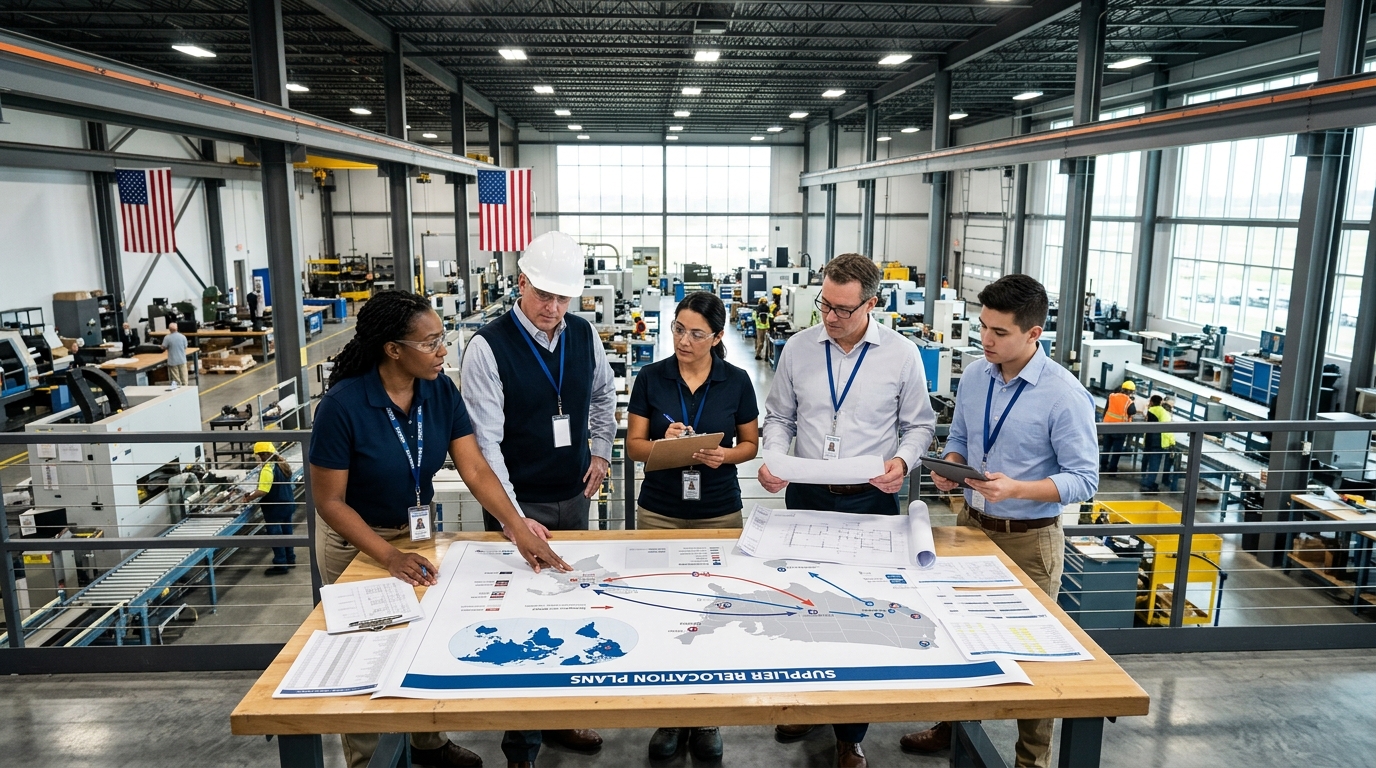
Why Reshoring Strategy Matters in 2026
The reshoring wave is no longer speculative. According to the Reshoring Initiative, reshoring and FDI job announcements have continued at record pace, with manufacturing investment in Mexico and the US Sun Belt accelerating year over year. For a deeper look at the underlying numbers, our latest reshoring trends dashboard tracks job creation, capex flows, and industry-level momentum. Three forces are driving this:
- Tariff and trade policy uncertainty on Chinese imports has made landed cost modeling unpredictable for multi-year procurement contracts.
- USMCA preferential treatment offers duty-free pathways for qualifying goods produced in Mexico and the US, dramatically improving margin math.
- Lead time compression — moving from 60-day ocean transit to 3-day truck transit fundamentally changes inventory carrying costs and working capital requirements.
But reshoring without a strategy is just relocation. The companies winning at this are the ones treating supply chain realignment as a portfolio decision — segmenting SKUs, modeling [Total Cost of Ownership](Total Cost of Ownership) (TCO), and sequencing transitions so cash flow holds steady through the move.
Step 1: Build the Strategic Case (Not Just the Cost Case)
Most reshoring projects fail at the business-case stage because finance teams compare unit price in China against unit price in Mexico or the US — and stop there. That's the wrong comparison.
What to actually model
A defensible reshoring business case includes:
| Cost Category | Offshore (China) | Nearshore (Mexico) | Reshore (US) |
|---|---|---|---|
| Unit production cost | Baseline | +5–15% typical | +15–30% typical |
| Tariffs & duties | High, volatile | USMCA-qualifying: 0% | 0% |
| Freight & logistics | $4,000–8,000/FEU | $2,000–3,500/truck | Domestic |
| Inventory carrying (lead time) | 60–90 days | 7–14 days | 3–7 days |
| Quality/rework risk | Moderate–high | Moderate | Low |
| IP and tooling risk | High | Low | Very low |
| Working capital tied up | High | Moderate | Low |
When you sum these into a true TCO model, the cost gap between China and Mexico routinely closes to zero — and in many plastics and injection-molded product categories, Mexico is already cheaper on a landed basis. If you want to pressure-test your own numbers quickly, our interactive ROI calculator models the full financial impact in minutes.
Step 2: Segment Your SKU Portfolio
You don't reshore everything at once. A disciplined US supply chain realignment starts with SKU segmentation:
- Tier 1 — Reshore now: High-volume, high-margin SKUs with stable demand, complex tooling, or IP sensitivity. These deliver the fastest ROI.
- Tier 2 — China+1 candidates: SKUs where you want supply diversification but full migration isn't yet justified. Dual-source between China and Mexico.
- Tier 3 — Stay offshore: Commodity items with thin margins, no IP concerns, and demand patterns that tolerate long lead times.
This portfolio view is the foundation of every successful reshoring program we've seen. For a real-world example, see how one US distributor reshored 40% of its SKUs in 18 months using exactly this kind of tiered approach. It also makes the financing conversation easier — you're not asking your CFO to fund a moonshot; you're presenting a phased, ROI-ranked roadmap.
Step 3: Choose the Right Geography
Where you reshore depends on what you make.
Mexico (Nearshoring)
The default choice for most plastic manufacturing, injection molding, electronics assembly, automotive components, and medical device housings. Mexico offers:
- USMCA duty-free access
- Mature industrial clusters in Monterrey, Querétaro, Guadalajara, Tijuana, and the Bajío
- Labor costs competitive with or lower than coastal China
- 2–5 day truck transit to most US destinations
Our in-depth Mexico nearshoring guide breaks down cluster-by-cluster capabilities, IMMEX program mechanics, and supplier selection criteria in more detail.
United States (Full Reshoring)
The right choice for highly automated production, regulated industries (defense, certain medical), products where "Made in USA" carries marketing premium, or low-labor-content processes.
Friendshoring (Vietnam, India, Eastern Europe)
A complement to — not a substitute for — nearshoring when capacity constraints or specific capabilities require it.
Step 4: Plan the Tooling Transfer
This is where most reshoring projects stall. Tooling — particularly injection molds — is expensive, often owned ambiguously, and physically located in your current supplier's facility.
A complete tooling transfer plan covers:
- Ownership verification — who legally owns the mold per the original tooling agreement
- Condition assessment — current state, cycle count, expected remaining life
- Physical logistics — packaging, freight, customs documentation
- Process transfer — cycle times, material specs, tolerances, qualification samples
- PPAP/qualification at new supplier — first article inspection, capability studies
- Dual-running period — overlap where old and new suppliers both produce while quality is validated
Underestimating this step is the single most common reshoring mistake. Plan 4–6 months for complex tooling transfers, and budget for re-qualification costs. Our step-by-step transition guide for moving production out of China walks through tooling logistics, export documentation, and supplier wind-down in granular detail.
Step 5: Qualify Suppliers on Financial AND Operational Dimensions
A Mexican factory that hits your quality and capacity specs but can't fund a 60-day payment cycle will become a delivery problem within a quarter. Supplier qualification needs to cover:
Operational fit: ISO certifications, equipment capability, capacity, quality systems, engineering support.
Financial fit: Working capital position, access to factoring or supply chain finance, ability to extend Net 30/60/90 terms, exposure to peso/dollar volatility.
Compliance fit: USMCA documentation capability, customs broker relationships, IMMEX program participation if applicable.
This dual lens — operational and financial — is what determines whether your nearshoring program ships profitably or stalls at the border.
Step 6: Sequence the Transition
A typical reshoring engagement runs 6–18 months end-to-end. The sequencing matters:
- Months 1–2: TCO modeling, SKU segmentation, supplier longlist
- Months 2–4: Supplier visits, RFQ, sample production
- Months 4–6: PPAP, tooling transfer planning, working capital structuring
- Months 6–9: Tooling moves, qualification production, dual-running
- Months 9–12: Production ramp, China supplier wind-down
- Months 12–18: Optimization, expansion to next SKU tier
Cash flow planning across this timeline is critical. You'll be paying old and new suppliers simultaneously during the dual-running period — exactly when most companies discover they need PO financing or invoice factoring to bridge the gap. The full reshoring playbook for US manufacturers covers the working capital structuring for this overlap window in depth.
Step 7: Manage the Financial Mechanics
Reshoring isn't just a sourcing project — it's a working capital event. Three financing realities reshape every transition:
- Tooling investment is front-loaded. New molds, fixtures, and qualification runs hit the books before any new revenue.
- Mexican suppliers often need shorter terms than Chinese suppliers offered. Negotiating extended payment terms or implementing a reverse factoring program preserves your cash conversion cycle.
- Inventory profiles change. Shorter lead times mean lower safety stock — a one-time working capital release that can partially fund the transition itself.
Smart programs use this inventory release plus structured supplier finance to make reshoring close to cash-flow neutral over a 12-month horizon.
Common Reshoring Mistakes to Avoid
From the engagements we've led at Reshore, the recurring pitfalls are:
- Comparing unit price instead of TCO
- Underestimating tooling transfer complexity
- Skipping financial qualification of new suppliers
- Cutting over too fast without a dual-running period
- Treating reshoring as a one-time project rather than an ongoing capability
- Ignoring USMCA documentation requirements until the first shipment is at customs
- Not modeling peso/dollar exposure in long-term contracts
How Reshore Approaches This
We at Reshore built our platform specifically to compress this entire workflow. Our AI-powered system handles SKU segmentation, supplier matching across Mexico and US industrial clusters, tooling transfer coordination, and factory qualification — particularly for plastic manufacturing and injection molding programs. Instead of rebuilding your supply chain from scratch, we map your existing tooling and specs to verified Americas-based manufacturers and run the transition as a managed program.
The result for most clients is a reshoring timeline measured in months rather than years, with the financial and operational dimensions handled in parallel rather than sequentially.
If you're evaluating a reshoring strategy, the right next step is a structured assessment of your current tooling, SKU portfolio, and supplier landscape. That assessment will tell you which SKUs reshore profitably today, which belong in a China+1 posture, and which should stay offshore.
Frequently Asked Questions
Q: How long does a typical reshoring project take from decision to full production?
For a focused product line with existing tooling, plan on 6–9 months from kickoff to qualified production at the new supplier. Full portfolio transitions covering multiple SKU tiers typically run 12–18 months, with the timeline driven primarily by tooling transfer complexity and PPAP qualification cycles.
Q: Is reshoring to Mexico actually cheaper than producing in China in 2026?
For a growing share of product categories — particularly plastic injection molding, automotive components, medical device housings, and electronics assembly — yes, on a Total Cost of Ownership basis. When you include tariffs, freight, inventory carrying costs, and quality risk, Mexico is often cost-competitive or better than China, with the added benefit of USMCA duty-free treatment for qualifying goods.
Q: What's the difference between reshoring, nearshoring, and friendshoring?
Reshoring means relocating production back to the US. Nearshoring typically refers to moving production to Mexico or other geographically proximate countries. Friendshoring refers to relocating to politically aligned partner countries like Vietnam, India, or Eastern Europe. Most US manufacturers in 2026 are pursuing a hybrid: nearshoring the bulk of production to Mexico, friendshoring select categories, and fully reshoring high-automation or regulated products to the US.
Q: How does Reshore help with tooling transfer specifically?
Reshore coordinates the full tooling transfer workflow — ownership verification, condition assessment, freight and customs, qualification at the receiving supplier, and PPAP support. Our focus on plastic manufacturing and injection molding means we've built standardized playbooks for mold relocation, including the engineering documentation and sampling protocols that most companies underestimate.
Q: Do I need to reshore everything, or can I keep some production in China?
You should almost never reshore everything at once. A disciplined strategy segments SKUs into tiers — high-priority reshore candidates, China+1 dual-sourcing candidates, and commodity items that stay offshore. This portfolio approach manages risk, preserves working capital, and delivers ROI in phases rather than betting the supply chain on a single cutover.
Q: What financing options exist to fund a reshoring transition?
The most common tools are PO financing to fund production at new suppliers, invoice factoring to accelerate cash from existing receivables, reverse factoring programs to extend supplier terms while preserving supplier liquidity, and one-time inventory releases from shorter lead times. A well-structured program often makes the transition close to cash-flow neutral over 12 months.
Q: How do I know if my Mexican supplier qualifies for USMCA preferential treatment?
USMCA qualification depends on Regional Value Content rules and product-specific rules of origin. Your supplier needs to maintain documentation supporting the origin of inputs and processes performed. Most established Mexican manufacturers in industrial clusters like Monterrey and Querétaro are familiar with USMCA documentation, but verifying this during supplier qualification — not after the first shipment — is essential.
Q: What industries see the strongest ROI from reshoring to Mexico in 2026?
Plastic manufacturing and injection molding, automotive Tier 1 and Tier 2 components, medical device assembly and housings, consumer electronics, appliances, and industrial equipment are seeing the clearest TCO advantages. The common thread is meaningful tariff exposure, moderate-to-high labor content, and benefit from shorter lead times — all of which compound in Mexico's favor under current trade conditions.